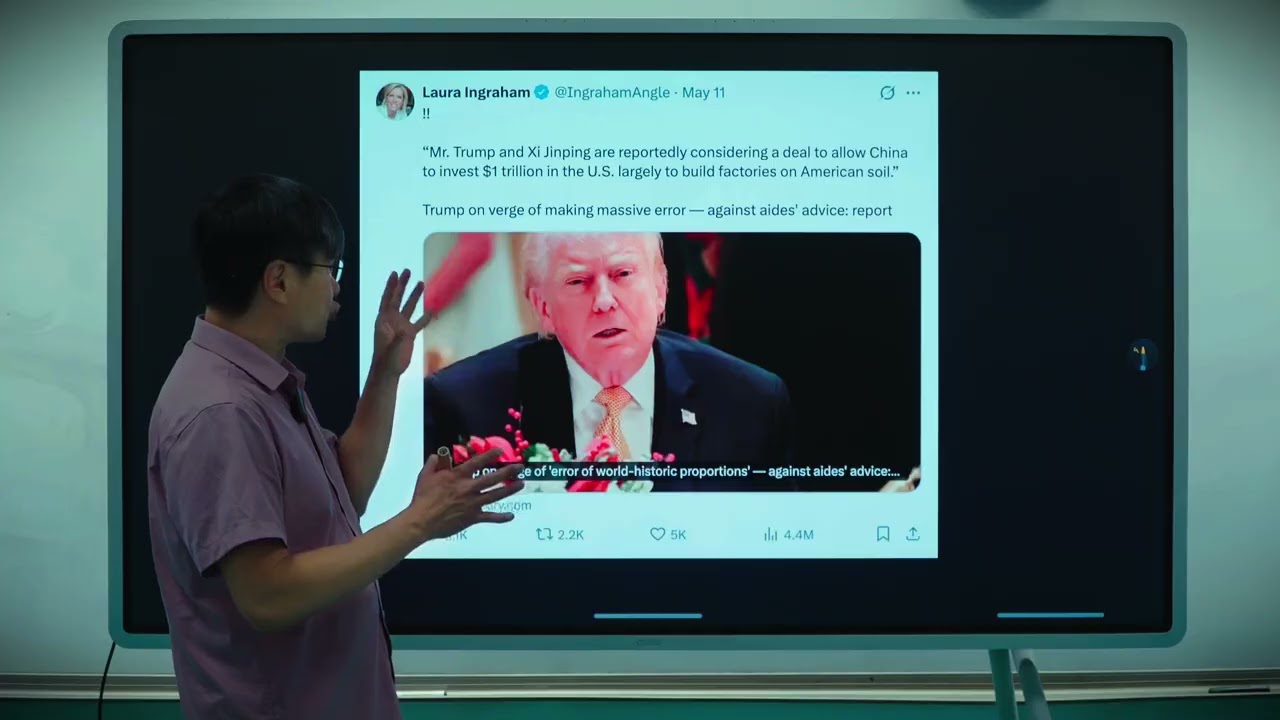
On May 14, 2026, President Trump visited Beijing and met with President Xi Jinping at the Great Hall of the People — the first visit by a U.S. president since 2017 — in what Professor Jiang argues is the opening move toward a historic “grand bargain” between the United States and China that would reconcile years of trade conflict and deepen economic integration.
Trump brought an unusually large delegation including his family members, top business leaders (Elon Musk, Tim Cook, Boeing’s CEO), and financial titans (Larry Fink of BlackRock, Stephen Schwarzman of Blackstone, David Solomon of Goldman Sachs, plus Citi, Mastercard, and Visa) whose combined companies are worth over $12 trillion.
Jiang argues that assembling so many high-profile executives signals a major deal is imminent, since such people would not travel together without a significant announcement.
Treasury Secretary Scott Bessent — not Secretary of State Marco Rubio — led the U.S. negotiating team, signaling the focus is economic and financial rather than geopolitical or security-related.
How the U.S.-China relationship was built
The modern U.S.-China economic relationship began with Nixon’s 1972 visit, which Jiang argues was driven not by Cold War triangulation against the Soviet Union (the standard historical explanation) but by the need to create demand for the U.S. dollar after Nixon ended the gold standard in 1971.
Nixon created two mechanisms to sustain the dollar’s value: the petrodollar (requiring oil sales in dollars) and opening China as a global manufacturing base that would also transact in dollars.
The 1972 Shanghai Communiqué established “strategic ambiguity” on Taiwan — the U.S. says it does not “support” Taiwan independence but stops short of opposing it — a framework Jiang predicts Trump may soon abandon in favor of openly supporting reunification.
Jiang’s theoretical framework: reality as hallucination
Jiang presents a speculative theory that “reality is a hallucination” — true power lies in controlling attention and consciousness, and the global financial system is an elaborate illusion maintained by elites.
At the base is the American empire, which forces people to “look at the wall” (Plato’s cave allegory).
Behind the scenes, game masters — private financial capital, the Federal Reserve, Wall Street, the City of London — cast shadows using capital and dollars as their mechanism.
They create institutions (UN, WTO, World Bank, EU) that appear impartial but are controlled by these elites, and use media, education, and culture to make people believe the system is real.
Enforcement comes through intelligence/spy networks, science, and legal systems, all ultimately controlled by transnational capital, secret societies, and elite families bound together by what Jiang calls “the occult.”
Within this framework, both the GCC (Gulf states) and China are “hallucinations of a hallucination” — constructs created to generate demand for the U.S. dollar. China’s entire economic existence, in this view, is derivative of the American system.
Why the trade war started and why it will end
China joined the WTO in 1999 on two key conditions: protect U.S. intellectual property and open its financial sector to allow RMB-dollar convertibility.
China failed to rigorously protect IP, enabling companies like Huawei to surpass Apple by copying and undercutting — leading to U.S. sanctions.
China refused to open its financial sector because doing so would cause capital flight (Chinese citizens would convert RMB to dollars, collapsing the economy).
These two failures triggered the trade war starting in 2018.
China fought back with two weapons: restricting rare earth mineral exports (where it has a near-monopoly due to willingness to bear extraction costs) and buying gold instead of U.S. treasuries.
But China is far more vulnerable than the U.S.: it depends on imported energy (50-60% from the Middle East), is heavily export-oriented (five of the world’s top six export ports are Chinese), and consumed more cement in three years (2011-2013) than the U.S. did in a century.
Consumer confidence in China has never recovered from the 2018 trade war and COVID, and a growing divergence between China’s current account and actual trade data suggests $500 billion per year in capital flight disguised as over-invoicing on exports.
Meanwhile, top Chinese students increasingly study abroad and stay in the West — roughly one million do not return.
The grand bargain: what each side wants
China wants three things:
Access to cheap energy from the Western Hemisphere (especially as Middle East supply is threatened by war)
Nvidia chips and semiconductors to fuel its AI development
Continued access to the U.S. market for its exports
America wants three things:
Access to Chinese financial markets so Chinese consumers buy stablecoins (like Tether and Circle) backed by U.S. treasuries, effectively transferring U.S. debt onto Chinese households
Control over China’s AI development — not as a competitor but as a partner, using China as a testing ground for surveillance technology (China’s large population and lack of privacy make it ideal)
Chinese manufacturing capacity, including relocating some production to the U.S. and Venezuela
How the U.S. plans to absorb its debt through China
The U.S. has $39 trillion in debt with ~5% interest, requiring $2 trillion annually in interest payments that must be borrowed anew.
The solution is financial repression: drop treasury interest rates to near 0% (destroying the debt through inflation over ~50 years) while forcing people to hold treasuries via laws like the Genius Act and Clarity Act, which require stablecoins to be backed by U.S. treasuries.
This bypasses China’s closed capital account — Chinese citizens can buy stablecoins with RMB without directly converting to dollars.
China’s 40% household savings rate represents a massive pool of idle capital that U.S. financial firms (BlackRock, Blackstone, Goldman Sachs) want to access.
China has relatively low foreign investment compared to other rich nations, meaning there is significant untapped capacity to absorb financial products.
Why Taiwan and energy geopolitics favor a deal
Taiwan: Jiang argues the U.S. can afford to abandon strategic ambiguity and support reunification because doing so actually transfers the Taiwan problem to Japan and South Korea, who depend on the Strait of Malacca for energy and would oppose Chinese control of Taiwan that could block their supply lines.
Energy: The U.S. is taking control of Venezuela (Trump announced plans to make it the 51st state) and dominating the Western Hemisphere, cutting off China’s alternative energy source. China doesn’t care who controls Venezuela as long as oil flows stably and cheaply.
AI and semiconductors: China cannot replicate the semiconductor supply chain (designed in California, manufactured in Taiwan, assembled in the Philippines and China, fed by resources from Africa and South America) because it is too complex and globally distributed. As long as the U.S. controls trade networks, it maintains the advantage.
Jensen Huang of Nvidia was initially excluded from the trip, then added at the last minute when Trump refueled in Alaska — Jiang interprets this as a breakthrough in negotiations where China agreed to financial market access in exchange for chip access.
Recent events as theater
Jiang dismisses recent escalations — China blocking Manis AI from moving to the U.S., sanctions on Chinese companies doing business with Iran, China inviting Iran’s foreign minister, U.S. war games in the Philippines — as theatrical posturing rather than genuine conflict.
Evidence: when Iran’s foreign minister visited Moscow, Putin met him for 90 minutes; in Beijing, he only met his counterpart, suggesting China is not seriously invested in the Iran conflict.
The real action is the economic negotiation led by Bessent and China’s Vice Premier He Lifeng, who met in South Korea just before Trump’s arrival.