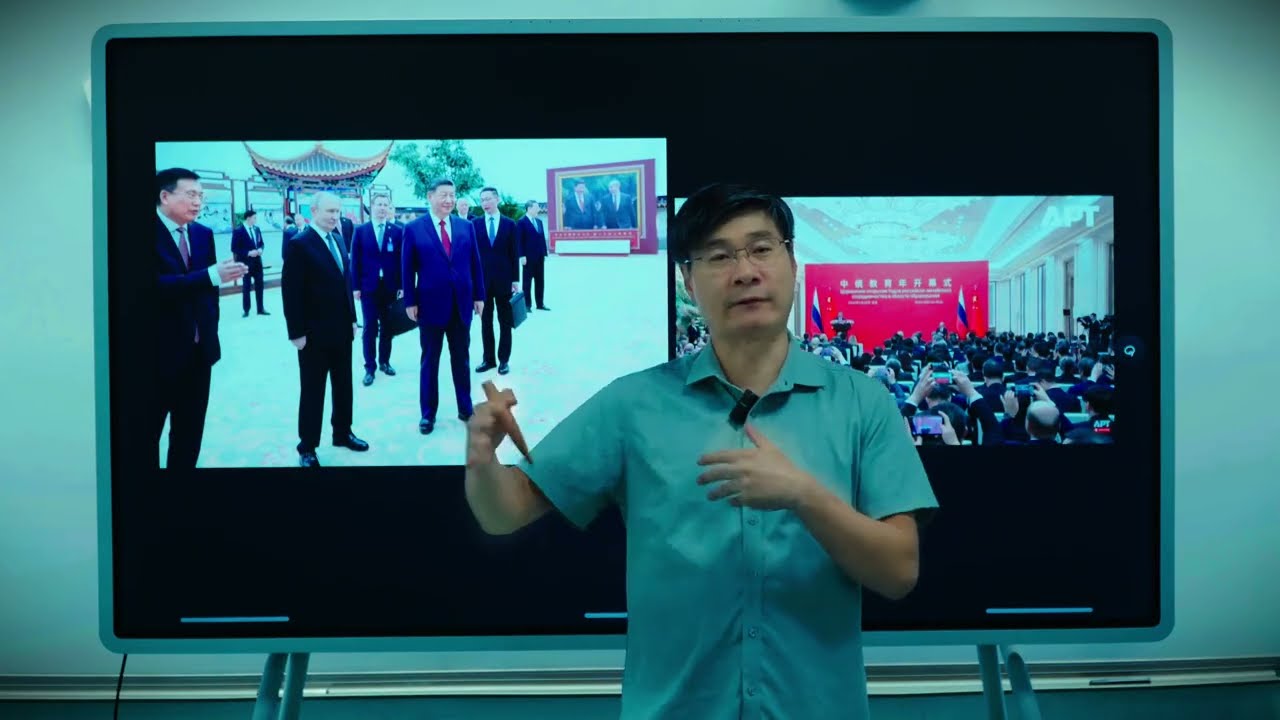
This lecture analyzes Vladimir Putin’s visit to Beijing and the broader strategic dynamics between Russia, China, and the United States, arguing that the Russia-China partnership is far more fragile and asymmetric than it appears, and that Putin’s ultimate goal is to destroy the US dollar as the global reserve currency to collapse American hegemony.
Putin’s Visit to Beijing
Putin traveled to Beijing for a full day of meetings with President Xi Jinping, marking his 25th visit to China, with a 26th planned for an upcoming APEC summit in Shenzhen.
The two leaders publicly emphasized their close friendship and commitment to a multipolar world, announcing enhanced people-to-people exchanges such as bilateral student programs and joint university research.
Both leaders framed their partnership around upholding the UN-centered international order, opposing unilateralism and hegemony, and specifically warning against the resurgence of fascism and militarism, which they directed at Germany and Japan.
Divergent Visions of Multipolarity
Despite surface-level agreement, China and Russia have fundamentally different conceptions of what a multipolar world means.
China’s vision is conservative: maintain the existing rules-based international order with the UN at the top, preserve the status quo, and ensure that the three World War II victors (US, Russia, China) remain in charge.
Russia’s vision is revisionist: Russia and China should take the lead in shaping a new multipolar world, with Russia as the senior partner driving the initiative.
A joint statement outlined shared principles including open trade, national sovereignty, consensus-based decision-making, UN authority, and respect for civilizational diversity.
Xi’s speech emphasized that the real enemies are those trying to overturn the World War II order, explicitly naming Japan, Germany, and Israel, and condemned all unilateralism, which implicitly includes Russia’s invasion of Ukraine.
The Fragile Russia-China Economic Relationship
Economic cooperation is heavily asymmetric and not progressing as smoothly as the political rhetoric suggests.
The Power of Siberia 2 pipeline, a massive project to carry Russian gas to China, was not signed during Putin’s visit because China fears over-dependence on Russia and is still negotiating price and volume.
Trade composition is lopsided: Russia exports mainly raw resources (energy, coal, LNG, crude oil) to China, while China exports manufactured goods (vehicles, electronics, machinery) back to Russia, a structure that benefits China far more.
Trade volumes are modest: Russia accounts for only 5% of Chinese imports and 3% of Chinese exports, meaning the two economies are not deeply integrated.
Russia has become increasingly dependent on China since Western sanctions after the 2022 invasion of Ukraine, with the renminbi now accounting for over 40% of Russian imports.
Chinese investment in Russia remains minimal, concentrated only in the Russian Far East near the Chinese border, for three reasons:
Chinese investors respect Western sanctions and fear being cut off from the global financial system.
Russia is a closed, mafia-like system with weak legal protections for foreign investors.
Chinese investors prefer accumulating US dollars over rubles, revealing where their true economic interests lie.
Education and cultural flows confirm the asymmetry: about 50,000 Chinese study in Russia compared to hundreds of thousands who have studied in the US, and roughly 60,000 Chinese learn Russian while the vast majority learn English.
The Russia-China relationship is top-down (government-mandated), while the US-China relationship is bottom-up (driven by individual and corporate choice).
Why China’s Elite Prefer the US Dollar
The core obstacle to a Russia-China alliance is that China’s political and economic elite benefit enormously from the US dollar system.
The US dollar monetized power for Chinese elites: it allowed them to convert their political influence into stored value by moving wealth to the US, where it is safe and liquid.
Two groups are the primary beneficiaries of the dollar system: the American financial elite and the Chinese political elite.
This explains why Chinese elites send their children to American universities, accumulate dollars, and resist decoupling from the West, regardless of what Putin offers.
From the Chinese elite’s perspective, Russia’s militarism is a problem, not an asset.
Putin’s Grand Strategy: Destroying the US Dollar
Putin’s ultimate objective is to destroy the US dollar as the global reserve currency, which he sees as the foundation of American imperial power.
The strategy is to form relationships with sanctioned and dissatisfied nations to create global volatility, destabilize trade, and reduce demand for the dollar.
Nations already outside the US system and available for cooperation include Russia, Iran, North Korea, and Belarus (Venezuela and Syria are effectively lost).
The key leverage points are Iran and North Korea, which can be used to create instability in critical regions.
North Korea as a Strategic Tool
In June 2024, Putin signed a mutual defense pact with North Korea, a significant move given that North Korea already had such a pact with China since 1961.
Kim Jong-un has supported Russia’s war in Ukraine by sending 10,000 troops, whose key attribute is willingness to fight to the end due to a policy of no surrender (with severe consequences for families back home).
Despite North Korea’s extreme poverty (GDP per capita of $771 vs. South Korea’s $33,000), the lecture argues North Korea would defeat South Korea in a war because winning societies need energy, openness, and cohesion, and poorer societies tend to have more of these qualities.
North Korea’s fertility rate is 1.81 vs. South Korea’s 0.81, meaning South Korea faces demographic collapse within 50 years.
North Korea can threaten Seoul with artillery, extracting concessions from a wealthier but more complacent South Korea.
Putin’s defense pact with North Korea is designed to create tension on the Korean Peninsula, forcing the US and Japan to divert attention and resources while the US is already stretched thin by conflicts in the Middle East.
Europe and the AFD
European sanctions on Russia have backfired economically, particularly for Germany, which lost access to cheap Russian energy and was forced to buy American LNG at a 50% markup.
Combined with high immigration levels (up to 20% in parts of Scandinavia and rising in Germany), these pressures have fueled the rise of right-wing parties like Germany’s AFD, which opposes both immigration and the war in Ukraine.
If fair elections were held, the AFD could potentially win power in Germany.
Russia’s strategy is not to conquer Europe but to drag out the war in Ukraine, creating a war of attrition that generates domestic political tension in Europe, eventually bringing pro-Russian right-wing parties to power.
This follows a historical pattern: prolonged war breeds internal political upheaval, as seen when the Bolsheviks came to power in Russia during WWI and communists nearly took power in Germany.
Germany is already remilitarizing with plans to have troops in Ukraine by 2029, and Europe is moving toward total war mobilization.
Russia’s military spending as a share of GDP remains relatively low (comparable to the US at 4-5%), and Putin still calls the Ukraine conflict a “special military operation” rather than a full-scale war, meaning Russia has significant capacity to escalate.
The Global South and Africa
Russia has actively cultivated support in the Global South, particularly Africa, where support for Putin surged after the invasion of Ukraine.
From the Global South’s perspective, the West is an imperial bully and Russia is standing up to it, making Russia a symbol of resistance to Western dominance.
Russia employs a full-spectrum strategy in Africa including trade, military cooperation, nuclear power plant construction, oil exploration, nickel production, and deployment of Russian mercenaries fighting US-backed groups.
China is also active in Africa but focuses on economic development rather than military intervention and does not invest heavily in propaganda the way Russia does.
Russia’s narrative is that it is liberating the world from Western imperialism, which resonates strongly in Africa’s post-colonial context.
India
India has become a critical partner for Russia as a sanctions-evasion channel: Russia sells oil to India, which then resells it globally.
Russia wants Indian laborers to address its wartime manpower shortage and to help rebuild after the war.
The Russia-India relationship is expected to deepen significantly over the next 10-20 years.
Iran as the Key Battlefront
Iran is the geographic center of global trade, connecting Russia to Africa, India, and Central Asia, and is easily accessible via the Caspian Sea.
The US attack on Iran is fundamentally about blocking Russia’s access to global trade routes and destabilizing Russia’s economic connections.
The two major battlefronts of the emerging world conflict are Ukraine (Europe vs. Russia) and Iran (US vs. Iran/Russia).
Israel serves as the American fortress in the Middle East, acting as a check on Russian influence across the region.
Japan’s Dilemma
The US strategy is to use Japan to balance China, but Japan is being forced into an uncomfortable position of remilitarization.
Japan’s energy dependence is being reshaped by the war in Iran: historically reliant on Middle East oil, Japan must now choose between depending on the US or Russia.
Japan remembers that before WWII, it depended on the US for 90% of its oil, and when the US embargoed Japan, it triggered the Pacific War. Japan does not want to repeat this vulnerability.
Japan has been buying increasing amounts of US treasuries, not because they are a good investment, but as a subsidy or bribe to the US in exchange for military protection and political autonomy.
This is facilitated by the yen carry trade: Japanese banks lend at 0% to corporations, which then buy US treasuries yielding 5%, creating risk-free profits but causing serious damage to the Japanese economy.
As geopolitical conditions worsen, Japan will eventually need to repatriate its money, selling US treasuries and further undermining the dollar system.
America’s Dollar Crisis
The US national debt stands at $39 trillion; at 5% interest, that requires $2 trillion annually in interest payments alone.
As foreign buyers refuse to purchase US treasuries, interest rates must rise (already moving from 5% to 6%), which is unsustainable.
The US must force foreign countries to keep buying dollars and treasuries, which is a primary motivation behind the war in Iran and other military actions.
If the US were to default on debt held domestically (by the Federal Reserve, which is backed by private bank deposits), it would wipe out the savings of the American people and trigger a revolution.
Therefore, the US cannot default domestically and must instead coerce foreign buyers to keep funding its debt, which is why military force and war are structurally necessary to maintain the system.
Putin understands that if he can stop foreign countries from buying dollars, America will collapse under its own economic weight.
What Happens If the System Collapses
If current trends continue, the debt grows, foreign buyers refuse treasuries, interest rates rise, and the US is forced into ever more aggressive military posturing to compel dollar demand.
Eventually, domestic default becomes impossible without revolution, so the US must increasingly rely on overseas coercion.
If America’s nation-state collapses into internal conflict, its military must retreat home to deal with domestic instability, abandoning its global policing role.
In a scenario where the US military remains overseas without a functioning host nation-state, it could fragment and attach itself to regional host nations: Japan in East Asia, Germany in Europe, and Israel in the Middle East.
Why Russia Doesn’t Want to Be the New Leader
Being the global reserve currency or world leader is actually a burden, not a prize: it forces a nation to spend all its resources defending its position.
Russia does not want to replace America as the hegemon; it wants to eliminate the hegemon so that no single nation dominates, giving Russia greater freedom of movement.
China’s long-term interests actually align more with the US remaining as global policeman because China’s neighbors (Japan, Russia, Vietnam) are historically aggressive, and China prefers dealing with a distant America over a nearby Russia.
The Russia-China relationship is therefore tactically aligned but strategically divergent: they cooperate now out of mutual convenience, but their interests will eventually diverge, leading to a long-term “divorce.”
Putin’s goal is to keep China neutral and friendly in the short term, preventing the worst-case scenario of China and the US joining forces to defend the existing system against Russia.