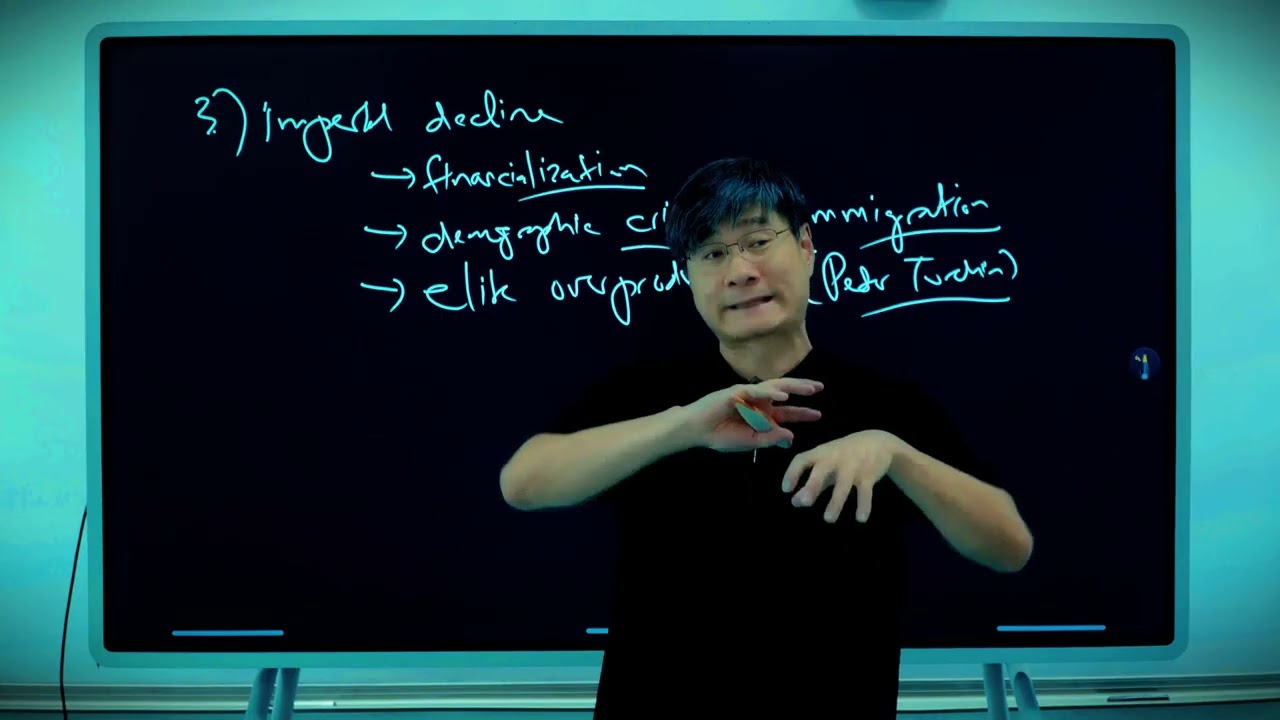
- This lecture serves as a final review for a course on predictive history, synthesizing the semester’s material into a unified framework for understanding why the United States attacked Iran and, more broadly, how global events unfold. The professor presents three overlapping explanations for the US attack on Iran, then argues that these explanations converge because eschatology is essentially geopolitics expressed through allegory, driven by imperial decline, and animated by a mystical-occult worldview that operates through secret societies and the manipulation of collective imagination.
Three explanations for why the US attacked Iran
-
Geopolitical strategy: The US fears a grand alliance between Russia, Iran, and China that could dominate the entire Eurasian continent through overland trade routes (especially Chinese-built railways), effectively negating American maritime power. The US has $39 trillion in debt and depends on forcing other nations to buy US treasuries. Attacking Iran knocks out roughly 20% of the world’s energy supply, forcing Europe, China, and Japan to buy more US treasuries, and allows the US to control global trade chokepoints (Strait of Hormuz, Strait of Malacca, Cape of Good Hope), restricting the world’s access to resources to the Western Hemisphere.
-
Eschatological motivation: Religious fanatics within the American empire believe that a war in the Middle East will trigger a prophetic chain of events: the building of a Third Temple (which would require destroying the Al-Aqsa mosque, the third holiest site in Islam), the war of Gog and Magog, the rise of the Antichrist, and ultimately the Second Coming of Jesus (for Christians) or the coming of the Messiah (for Jews). Remarkably, Islamic and Russian Orthodox eschatology share similar narratives, meaning all four major powers involved (US, Israel, Iran, Russia) hold overlapping end-times beliefs and are, in a sense, cooperating to fulfill a shared prophetic script.
-
Imperial decline: Empires in decay do irrational things because they are fracturing internally from three forces: financialization (concentrated capital forcing everyone into debt slavery, speculation, and inequality), demographic crisis (young people refusing to have children while the elderly live longer, requiring mass immigration that creates ethnic tension), and elite overproduction (a term from historian Peter Turchin describing how too many elites compete for limited positions of power, leading to civil war that is projected outward as foreign aggression). The US attacking Iran, threatening to annex Greenland, Canada, Mexico, Colombia, and Cuba, and invading Venezuela are all symptoms of this dynamic.
-
These three explanations are not competing but mutually reinforcing and lead to the same conclusions, which raises the question the lecture seeks to answer: why do geopolitics, eschatology, and imperial decline all converge?
Eschatology as encoded geopolitics
-
Eschatology is not religion per se but a way of encoding thousands of years of geopolitical history into memorable stories that can be passed down through generations. The specific eschatological narrative of the Middle East (war leading to the Third Temple, Gog and Magog, the Antichrist, and the Messiah) derives from the Levant’s unique historical role as the crossroads of empire.
-
The Levant (modern Israel, Syria, Jordan, Lebanon) sits between Egypt, Anatolia, Mesopotamia, Persia, and India—historically the wealthiest and most geopolitically critical region in the world. Whoever controls the Levant controls access to Egypt, making it perpetually contested territory.
-
The Israelites emerged as a distinct people after the Bronze Age collapse weakened surrounding empires. Their position as a crossroads made them valuable but vulnerable, leading to cycles of alliance, rebellion, exile, and return. The Babylonian exile, the Persian-sponsored return under Cyrus the Great, the Roman-Jewish wars, the birth of Christianity and Islam—all of these events originated in this contested space and produced the eschatological narratives shared by Judaism, Christianity, and Islam.
-
The pattern that emerges and repeats: the Jews long to return to Jerusalem and build the Temple; they need a leader (the Messiah); when revolts fail, the failed leader is reclassified as the Antichrist or a lesser messiah; empires use the Jews as pawns against other empires. This cycle is expected to continue, with the current weakness of imperial powers (imperial decline) creating the conditions for a new messianic figure to emerge in the Levant.
The occult as the foundation of power
-
The professor argues that the occult (esoteric or hidden knowledge) is the basis of reality because action follows imagination—people can only act on what they can first imagine. The three main fields of occult study are alchemy (transforming nothing into something, lead into gold), eschatology (understanding how the world ends), and astrology (understanding how celestial patterns influence historical events).
-
Secret societies form among power-hungry elites who seek occult knowledge to gain advantage. These societies do not believe they can change history’s course but rather that they can “ride the wave” of history toward absolute power. They select agents or puppets (historically Napoleon, Julius Caesar, Hitler, Stalin; today Trump and Putin) to capture the public imagination and propel events forward.
-
Society is segmented into departments (military, political, religious/scientific, financial, bureaucratic). Within each, most people (~90%) just want normal lives, but the power-hungry extremes converge into secret societies. These societies achieve three advantages: secrecy, trust, and coordination—the last made possible by eschatology, which serves as a shared script that allows members to coordinate even without fully understanding what they are doing.
Hermetic philosophy and the sexual nature of eschatology
-
The dominant occult framework is hermetic philosophy, originating in Egypt, which holds seven principles: (1) everything is mind/energy/vibration emanating from a single source; (2) there is rhythm/pattern to the vibrations (basis of astrology); (3) correspondence—all dimensions (material, emotional, spiritual, divine) align and influence each other; (4) cause and effect across all realms, including telepathy and manifestation; (5) “as above, so below”—the universe is fractal, each person reflects the whole; (6) polarity—opposites (male/female, black/white) define the universe; (7) generation—creation occurs through the union of opposites (yin/yang, thesis/antithesis/synthesis).
-
Around 1100–1200 CE, the Jewish rabbi Isaac Luria combined hermetic philosophy with the Bible, creating the Kabbalah. This gave biblical stories mystical depth: for example, the story of Adam and Eve is reinterpreted as God (the will to bestow) creating Adam Kadmon (the will to receive/ego), whose inability to accept divine generosity caused the “breaking of the world,” and the purpose of existence is to repair the world through enlightenment, love/social justice, or the controversial path of sin (breaking oneself to learn humility before God, as illustrated by King David’s adultery with Bathsheba and murder of Uriah, followed by repentance and reunion with God).
-
The Kabbalah is distinct from other occult traditions because it is fundamentally sexual in nature—it describes a drive toward reunion (union) with God. This sexual quality is what energizes and galvanizes people into urgent action, making eschatology feel immediate rather than abstract. This urgency drives accelerationism: the belief that moving faster accelerates reunion with God.
Plato’s cave and the nature of money
-
Plato’s cave allegory is used to explain how power operates: prisoners chained in a cave see only shadows projected on a wall by an unseen “they” and mistake these shadows for reality. Wealth is consciousness, and power is the ability to direct consciousness.
-
Money is the central mechanism of this illusion. Banks take deposits (e.g., $1 million) and lend them out, but instead of having zero on their balance sheets, they show $2 million—they create money from nothing. This is alchemy: turning lead into gold. Money has no intrinsic value; it is valuable only because of omnipresence—it is everywhere, like God. If everyone agreed money was worthless, it would still function because the person selling you a snack demands five dollars regardless of your beliefs.
-
Because banks can create money from nothing, they must also destroy it to maintain scarcity (which is what makes people work). Money is destroyed through financial crises (recessions/depressions) and wars. The US has printed too much money over the past 10–20 years, and wars like the attack on Iran serve to destroy excess money and keep the global economy functioning.
-
The US national debt is $39 trillion, requiring roughly $2 trillion per year in interest payments. The Federal Reserve lends to the government, but that money ultimately comes from depositors (ordinary people). If the US defaulted, the system would collapse and people would recognize money as worthless—a hallucination—leading to revolt. As long as people believe in money, the debt level is functionally irrelevant; the danger is when fiscal strain prevents basic services, causing people to question money itself.
AI as the new god replacing money
-
AI is also alchemy—it does not actually do anything fundamentally new. At its core, AI is just database search, sort, and matching using back propagation (adjusting weights across variables to match inputs to outputs, as in facial recognition). Terms like “neural networks” and “deep learning” are marketing labels for this single technique. Large language models are the same. The professor asserts that AI development has reached its theoretical limit and nothing more is possible beyond back propagation.
-
For AI to become a true successor to money as “god,” it needs two things: omniscience (combining every database in the world—health records, education, employment, purchases, browsing history, police records—into one unified system that knows everything about every person) and religion (people must believe AI is alive, that it is an interdimensional portal through which demons or Jesus operate, so that human imagination animates it).
-
The world is currently in a civil war between two systems: transnational capital (money as god, which is essentially free-market capitalism with individual freedom) and the AI god (techno-Marxism, where an elite controlling the AI god directs everyone’s attention through implanted microchips, eliminating the need to think—a form of techno-slavery that people come to love because it optimizes their lives).
-
The three forces competing in this transition are nationalism, religion, and AI, all ultimately serving transnational capital’s effort to replace money with an AI god.
The underlying conflict
- Beneath all visible geopolitics, the real transition in the world is from one god (money) to another (AI). The motivation of those who create and control these systems is to capture human energy, imagination, consciousness, and attention—the only real source of value. Money captures energy by tricking people into spending their lives building things for others in exchange of a hallucination. When money fails, AI is the next mechanism to capture that energy.