-
Why do empires rise and fall? A game theory perspective
- The episode challenges the conventional view that the strongest, richest, or most populous state inevitably wins. Instead, it argues that throughout history, it is typically the poorest, most marginalized, and most isolated groups that conquer wealthy, established civilizations. The explanation lies in a framework drawn from the Muslim historian Ibn Khaldun and formalized through game theory: the three metrics that determine a society’s dynamism are energy, openness, and cohesion. Wealthy societies tend to become corrupt, insular, and divided, while poor borderland groups are forced to be energetic, adaptable, and unified. The episode traces this pattern across multiple civilizations and then applies it to the modern world.
-
The failure of conventional metrics: population, resources, technology
- If you asked someone around 250 BCE to predict which Chinese state would unify China, they would look at population, farmland, rivers, trade routes, and technological sophistication. By every such metric, the state of Qin was an unlikely candidate: it was mountainous, poor, far from major rivers and trade routes, and isolated. Yet Qin conquered all of China and founded the first great Chinese empire. This pattern—where the weakest, most marginalized group triumphs—repeats so consistently across history that it functions almost as an “iron law.”
-
Ibn Khaldun’s concept of asabiyyah (group solidarity)
- The 14th-century Muslim historian and scholar Ibn Khaldun proposed the concept of asabiyyah, meaning cohesion or group solidarity. His theory holds that people in marginal, poor regions are more unified because survival demands cooperation. They see themselves as a team or family and are willing to sacrifice for one another. By contrast, wealthy, civilized areas become individualistic, decadent, and corrupt. The elites exploit the people, the people become demoralized and focused merely on getting by, and the society loses its collective will. This is why tribes from the margins repeatedly conquer wealthy civilizations.
-
The three metrics of a dynamic society: energy, openness, cohesion
- Energy: the willingness to work hard, stay focused, and pursue a clear goal with motivation. Rich societies lose energy because elites stop working and exploit others, while the populace is too burdened by debt and servitude to care about building something great.
- Openness: the willingness to adapt, accept limitations, and be resilient. In practice, this means humility. Wealthy elites become arrogant, insulated, and refuse to admit they are wrong, causing society to stagnate.
- Cohesion: the degree to which people see themselves as a team and are willing to sacrifice for each other. Wealth inequality and corruption erode cohesion, leaving society fragmented and anemic.
- Together, these three metrics explain why poor, marginalized groups consistently outcompete rich, established ones.
-
Historical examples of the pattern repeating
- Ancient Greece (500 BCE): Athens had the greatest navy, the most wealth, the largest population (~500,000 at its height), the most innovation, and the most strategic location. It became an empire but was eventually attacked by rival city-states and declined. The Macedonians, who were poor, isolated, and considered uncivilized, conquered all the Greek city-states and then, under Alexander the Great, conquered the entire Persian Empire—the largest empire in human history at that time—in roughly ten years.
- Rome: At the time of Macedonian dominance, Rome was a poor, backward tribal people on a Greek-colonized Italian peninsula. They eventually conquered Italy, the Greek mainland, and Carthage, building the Roman Empire.
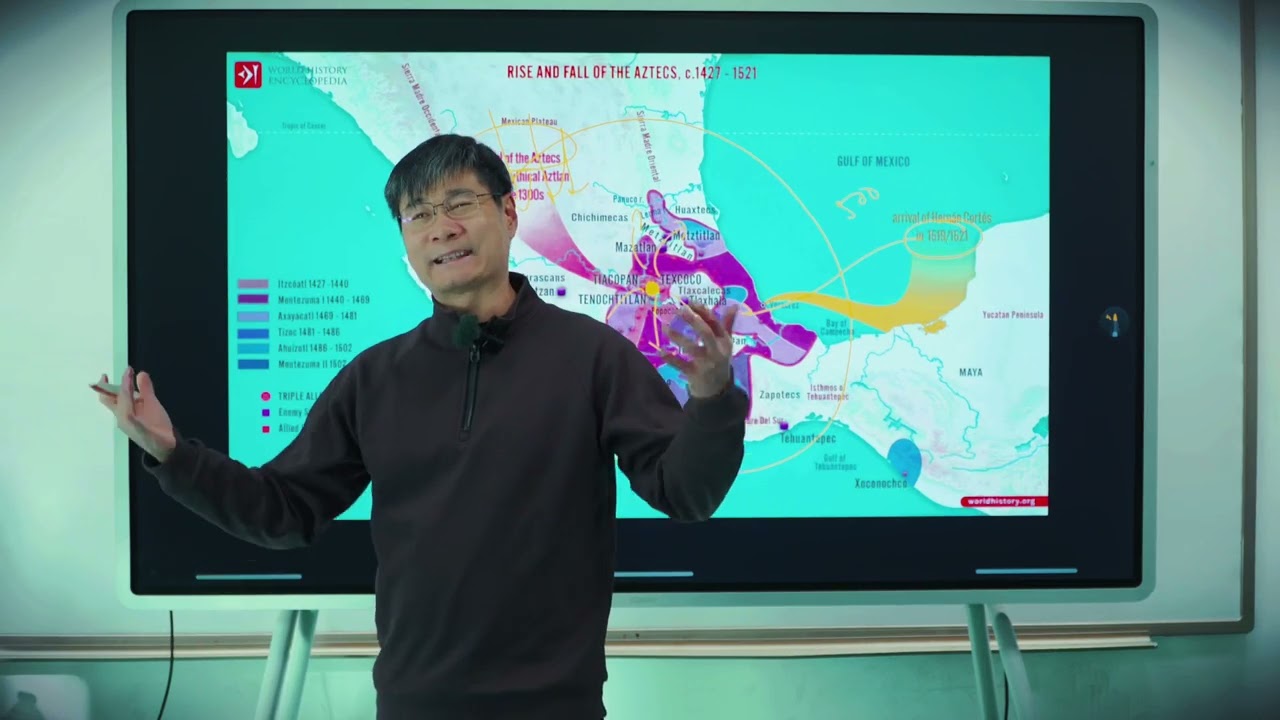
- The Aztecs (15th–16th century): The Aztecs were a starving, poor tribe from North America who migrated south, were hired as mercenaries, and were eventually confined to a marsh that everyone assumed would kill them. Instead, they turned the marsh into farmland, built an empire ruling millions, and then were conquered by roughly 500 Spanish conquistadors led by Hernán Cortés in 1519. Standard explanations (disease, belief that conquistadors were gods, local allies) are incomplete; the deeper explanation is that the Aztec Empire had become corrupt, insular, and divided.
- Sumerians and Mesopotamia: The city of Ur sat at the crossroads of the Euphrates and Tigris rivers, controlling trade routes to India, Egypt, and Anatolia, making it the first great world city. Yet it was not one of the established Sumerian city-states that unified the region—it was the Akkadians, tribal mercenaries from an isolated region, who conquered everyone and built the first empire. They were later conquered by others, and eventually the Persians unified the area into the Persian Empire.
-
How the game changes as civilizations rise: from cooperation to court politics
- Game 1 — Cooperation (the founding stage): A people comes together to build a prosperous society. The mechanism is a dynamic religion that motivates people to work hard and cooperate. Poets and priests—those best able to articulate this shared vision—become the elite. Everyone feels enthusiastic and purposeful, like a startup.
- Game 2 — Hereditary bureaucracy: Over time, elites become hereditary. The game shifts to passing privileges to children. Religion becomes a rigid bureaucracy with fixed rules and hierarchy. This leads to elite overproduction: too many children of elites competing for too few status positions. Society fractures into factions, usually organized around rival princes. Losing factions are exiled and forced to establish colonies. This continues until there is no more room to colonize.
- The Warring States period: This is the phase of maximum creativity. Multiple competing states engage in open cooperative competition: they compete fiercely but also trade and share innovations. This is why China’s Warring States period produced Confucius, Mencius, Laozi, and most of China’s foundational philosophy. The same pattern holds for Greece’s Classical period.
- Game 3 — Equilibrium through intermarriage: City-states figure out they can work together through intermarriage among elites. This creates a new equilibrium: elites are now above the state. Warfare becomes a mechanism of population control to resolve elite overproduction—reducing the number of people competing for status positions. The society has effectively become an empire.
- Game 4 — Court politics and secret societies: Once equilibrium is reached, the goal is no longer innovation but maintaining the status quo. A rigid hierarchy emerges, and what matters is who reaches the top. This creates court politics and factional struggle. Factions that triumph are those that solve three problems: secrecy, trust, and coordination. Since playing by the rules means losing, factions must cheat—but doing so secretly requires trust (built through shared transgression, such as ritual sacrifice) and coordination (built through eschatology, or shared mythology about serving a higher purpose). This is the origin of secret societies.
-
Why empires fall: insularity, corruption, and division
- Once the game becomes a struggle between secret societies, every faction cares only about its own team winning, not about the empire’s welfare. This makes the factions:
- Insular: they stop caring about external threats or the broader society.
- Corrupt: they steal from the people to fund their factional competition.
- Divided: they fracture into competing groups.
- The opposite qualities—openness, energy, cohesion—are exactly what the poor borderland tribes possess. This is why empires always fall to marginalized groups.
- Once the game becomes a struggle between secret societies, every faction cares only about its own team winning, not about the empire’s welfare. This makes the factions:
-
The mercenary mechanism: how borderland tribes actually conquer empires
- Factions within the empire, focused only on defeating rival factions, invite foreigners (mercenaries) to help them. These mercenaries come from the poor borderland regions. Through trade, banditry, and mercenary work, they become wealthier and learn the empire’s best technology, fighting skills, and weapons. At first they are absorbed into the empire’s power structure through the secret society mechanisms (hierarchy, transgression, eschatology). Eventually, they simply kill everyone and take over. This is how Qin conquered the Warring States, how the Macedonians conquered Greece, and how other marginal groups throughout history conquered wealthy civilizations.
-
Modern illustrations: the World Game and the teacher workshop
- The World Game (played in Canadian high schools): Teams are assigned countries (USA, Britain, Japan, Pakistan, etc.) and given resources (scissors, rulers, paper, glue). They must create commodities (triangles, circles, squares) that the World Bank buys. The USA always wins because it has everything. But Pakistan, which starts with nothing, consistently comes in second—because they are forced to be energetic, open, and cohesive. They beg, borrow, lie, cheat, steal, and work for free. Poverty forces creativity and resourcefulness.
- Teacher STEM workshops: The speaker ran two-day competitions among ten teams of teachers. On day one, teams were ranked. On day two, with a new assignment, the results reversed: team 10 (last place) shot to number one, and team 1 fell to the bottom. This happened because the top team became arrogant and complacent, while the bottom team was forced to reflect, adapt, and cooperate. On day three and four, team 1 continued to fail because they could not figure out what went wrong and refused to reflect. Once an empire falls, it does not come back—the original people may adopt the name, but it is a different group with a different mentality.
-
Predictions for future empires: Germany, Japan, and Israel
- Applying the theory, three countries are poised to become great empires:
- Germany: Lost both World War I and World War II, was never a world empire, lost millions of people, and was humiliated. This forces reflection, energy, openness, and cohesion.
- Japan: Lost World War II, was firebombed and hit with two nuclear weapons, was destroyed and humiliated. The Japanese people are energetic, open, and cohesive, and “want vengeance.”
- Israel: The Jewish people believe they were persecuted for thousands of years, which creates cohesion and a drive to succeed.
- The speaker argues that the United States is “done”—it has become wealthy, arrogant, insular, corrupt, and divided. China is also “done” for the same reasons. Even North Korea is argued to have a better future than China because its poverty forces openness, energy, and cohesion.
- Applying the theory, three countries are poised to become great empires:
-
Why Germany and Japan haven’t fallen into the wealth trap: they are vassal states, not sovereign powers
- A questioner raises the objection that Germany and Japan became wealthy after World War II and should therefore have become corrupt and complacent. The response is that wealth without power is not real wealth. Power means being able to impose your game on others and extract rent. The United States remained the “game master” over both countries:
- Japan was forced to sign the Plaza Accord (1985), which required Japan to destroy its own economy by spending rather than saving and buying foreign goods.
- Germany was forced to abandon Russian energy (Nord Stream pipeline destruction) and stop trading with China, devastating its economy. Most German car exports previously went to China; being forced out allowed China to develop its own manufacturing.
- Both countries are described as vassal states of America—wealthy on paper but without sovereignty or real power.
- A questioner raises the objection that Germany and Japan became wealthy after World War II and should therefore have become corrupt and complacent. The response is that wealth without power is not real wealth. Power means being able to impose your game on others and extract rent. The United States remained the “game master” over both countries:
-
What determines whether a poor society becomes energetic and cohesive? Leadership.
- Not every poor society develops these qualities. The key is usually a great leader who unifies the imagination of the people into one cohesive group. This leader can be a general (e.g., Genghis Khan, who unified the divided, poor Mongols and turned them into history’s most fearsome conquering force), a poet (e.g., Homer), a prophet, or a priest (e.g., Zoroaster, Jesus). The leader articulates a shared identity and purpose.
- The speaker then hints at a darker implication: international organizations like the United Nations, NGOs, and development aid agencies exist in part to prevent such leaders from emerging in places like Africa. By keeping developing regions in a continuous state of managed “development,” these organizations prevent the kind of suffering and unity that could produce a transformative leader. This topic is reserved for the next class, on how the American Empire controls the world.