The episode argues that the behavior of Chinese students—prioritizing English, chasing US dollars, and seeking to immigrate to the West—is irrational given their higher status and better prospects in China, and that this behavior is the result of a global game constructed by the British Empire and inherited by the United States, which incentivizes local elites worldwide to serve Western financial interests at the expense of their own nations.
The puzzling behavior of Chinese students
Chinese students spend more time learning English than Chinese, despite being higher-status, better-connected, and more likely to succeed professionally and socially in China.
Their stated reasons—access to knowledge, going abroad, communication, internet use—are superficial and do not explain why they would sacrifice native-language mastery and domestic status.
They are obsessed with earning US dollars, even though what they truly want (status, respect, prestigious careers, marriage, children) is more attainable in China.
Their goal of immigrating to the West—especially the US—means trading elite status in China for a life where the system is rigged against them; the best they can hope for is a technical role like engineer or professor, not political power or corporate leadership.
The central question: why do the best people in China want to become common people in the West?
How the Spanish Empire created the conditions for British rise
For most of history, Europe was poor and depended on trade with Asia for spices—commodities more valuable than gold at the time.
Muslims controlled overland trade routes and blockaded Christian Spain after the Reconquista, forcing Spain and Portugal to find new sea routes.
Spain and Portugal explored Africa and the Americas, conquered the Aztec and Inca empires, and extracted massive amounts of silver, making Spain fabulously wealthy almost overnight.
This sudden wealth corrupted Spain: the people became lazy, insular, arrogant (hubris), and overextended through constant wars, leading to rapid bankruptcy.
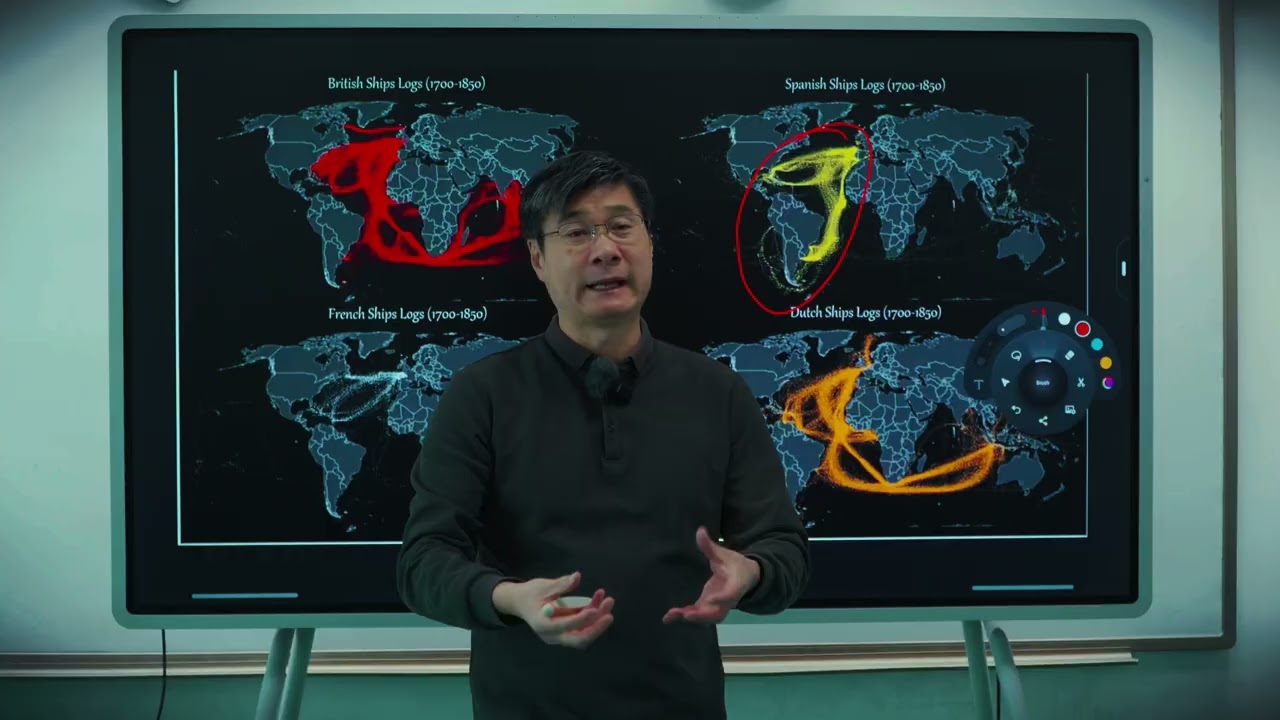
Spain subcontracted labor and trade to other nations—Britain, France, and the Dutch Republic—who became the factories and trading intermediaries for the Spanish Empire.
The Dutch, as a Spanish colony, were forced to carry out the dangerous spice trade; the English enriched themselves through state-sponsored piracy (e.g., Sir Francis Drake under Elizabeth I), stealing Spanish silver.
The Protestant divergence and the Glorious Revolution
Spain remained Catholic and focused on controlling the Vatican; Britain and the Dutch Republic became Protestant (Calvinist) to differentiate themselves.
Calvinist religion emphasized hard work, energy, and wealth accumulation, in contrast to Catholic obedience to authority.
The Thirty Years’ War (ostensibly religious, but also about Spanish control over the Dutch) killed millions and created anxiety among wealthy merchants about how to protect their wealth from armies and unstable monarchs.
In 1688, the Glorious Revolution: the British nobility invited William of Orange (leader of the Dutch) to become king of England, making Parliament the sovereign power and reducing the monarch to a figurehead.
The real purpose was to protect capital: Dutch wealth was transferred to England, and in 1694 the Bank of England was created.
The Bank of England and the invention of offshore finance
Before the Bank of England, merchants lent money to kings who could lose wars, die, or simply refuse to repay—forcing merchants into revolutions.
The Bank of England changed this: merchants lent to the nation, not the king, so the debt survived any individual monarch; the people as a whole were liable.
England was safe from invasion (protected by the Royal Navy and being an island), making it a secure place to store wealth.
The Dutch were willing to transfer their wealth to England because of intermarriage, shared Calvinist religion, and secret societies (e.g., Freemasons) that built trust.
Britain developed systematic contract law, influenced by John Locke’s philosophy that government exists to protect life, liberty, and private property—regardless of how that property was obtained.
This created the world’s first offshore financial center (OFC): a place where the origin of money did not matter, and the legal system would protect it absolutely.
Examples of modern OFCs include Hong Kong, Singapore, Dubai, and Switzerland—all former British territories or influenced by British legal traditions.
How Britain conquered India and China through elite co-optation
Britain colonized India and de-industrialized it, destroying its textile industry and turning India into a source of raw materials and a captive market for British goods—extracting enormous wealth.
The same pattern played out with China through the opium trade: opium flowed into China, silver flowed out to Britain, and that capital helped industrialize the United States.
The key mechanism was incentivizing local elites to cooperate: Britain offered elites protection, wealth laundering, and escape routes.
Local elites were already in conflict with each other; Britain offered them a way to transfer stolen wealth and their children abroad, making them immune to domestic consequences.
Three mechanisms enabled this system:
Finance and money laundering: Britain allowed elites to transfer stolen capital to OFCs, disguising its origins (drugs, gambling, prostitution) as legitimate income from restaurants or real estate, then investing it in Western real estate (Australia, Canada, etc.).
Schooling and soft power: British-run schools taught English, British history, Shakespeare, and philosophy, making local elites believe British culture was superior; this created a pipeline where the brightest students won scholarships (e.g., Rhodes Scholarships) to Oxford or Cambridge, forming a secret society of global elites loyal to the British Empire.
Navy: British military supremacy ensured compliance; any resistance was destroyed (as in the Opium Wars with China).
The British Empire today: from overt military to covert financial control
The British Empire no longer exists in its overt military form, but the game continues under American leadership.
The global drug trade (cocaine from Colombia, etc.) is used as an example: it is only possible because the British-created financial and legal system allows illicit money to be laundered and protected through OFCs.
All major offshore financial centers—Caribbean, Panama, Northern Europe, Middle East, Southeast Asia (Hong Kong, Singapore, Japan)—are former British territories.
The system has transformed from overt military control to covert financial and legal control.
Corrupt money from China, India, Malaysia, and elsewhere flows through OFCs and is then invested in Western real estate and banking (Australia’s largest industry is banking, which means money laundering; same for Canada and the US).
The entire global system is based on stealing from the developing world and transferring wealth to the developed world.
The moral and civilizational cost: over-financialization and collapse
Offshore finance is profitable but immoral; societies built on it (like Hong Kong) become depraved, unethical, and culturally empty—the speaker calls it a “demonic system” and “the work of Satan.”
The West has become a victim of its own success: the stolen wealth has led to over-financialization, making Western people lazy, corrupt, arrogant, and insular—the same fate that destroyed Spain.
This has created massive inequality, political systems that serve only the rich, and a culture where people care only about money, not community.
The Western world is therefore facing collapse; the current game is unsustainable, and a game reset is imminent.
Why the game persists despite its destructive nature
A student asks: if success leads to corruption and collapse, what is the point of success?
The speaker explains that in the short term (decades, not centuries), this game makes a nation-state energetic, open, cohesive, and capable of defeating rivals—even though it destroys the nation in the long term.
It is analogous to doping in sports: athletes know drugs will destroy their bodies, but if one competitor dopes and wins, all others are forced to dope as well.
The game is structured so that if you don’t play, you get eliminated; short-term survival pressures override long-term consequences.
Rich people sacrifice their own happiness and their children’s happiness because they believe it will lead to future happiness—it won’t, but they believe it.
The speaker notes that the American Empire will be discussed next, particularly how it added the US dollar to this game, making it universal and easier to play, and how capitalism conquered the world.