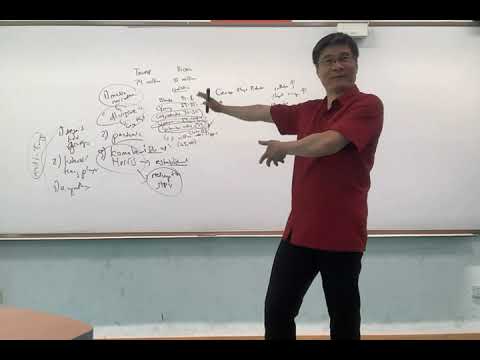
Jiang Xueqin argues in his May 17, 2024 class that Donald Trump is likely to win the 2024 US presidential election and that his optimal strategic move is to select Nikki Haley as his running mate, which would swing suburban voters and secure victory.
Why Biden won in 2020 and why that coalition is weakening
The 2020 election saw the highest voter turnout in over a century, with 81 million voting for Biden and 74 million for Trump, but the actual margin in the Electoral College was only about 65,000 votes across key battleground states.
Black voters: 91% supported Biden, largely out of loyalty to Obama and anger over Trump’s response to the George Floyd protests. By 2024, that loyalty has faded because Biden’s tenure has not materially improved black Americans’ lives. Inflation has hurt poor communities, illegal immigration has roughly doubled from 10 to 20 million (depressing wages for low-income workers), and billions are being sent to Ukraine while domestic conditions deteriorate. Polls show Biden’s lead among black voters shrinking.
Young voters: They were galvanized in 2020 by opposition to Trump and the George Floyd protests. In 2024, many are disillusioned with Biden over US policy toward Israel and the war in Gaza, and are considering sitting out the election rather than voting for either candidate.
College-educated voters: About 70% voted Biden in 2020. They will still lean Democratic but with less enthusiasm, perceiving Biden as too weak and feeble on the world stage, unable to prevent crises in Ukraine and Gaza.
Women: 54% voted for Biden, driven partly by abortion rights and Trump’s image as a divisive figure. Women are expected to continue voting Democratic for similar reasons.
Suburban voters: These are the decisive swing voters. In 2016, only 45% backed Clinton, handing Trump the election. In 2020, 54% flipped to Biden, a shift of roughly 2 million voters. Trump needs to win them back in 2024.
Why the suburbs swung to Biden in 2020
Media narrative: The mainstream media portrayed Trump as a Russian asset and a dangerously divisive figure. Suburban voters, who tend to be middle-class, well-educated, and status-quo-oriented, wanted a unifier. Biden came across as steady, establishment, and capable of bridging both parties, especially in contrast to the polarization and street protests during the George Floyd moment.
COVID-19 pandemic: Suburbs, with schoolchildren and older residents, were alarmed by what they saw as Trump’s incompetent handling of the pandemic. His outsider status meant he could not effectively manage the federal response.
Kamala Harris as VP pick: Biden’s selection of Harris was strategically powerful for three reasons. First, she came across as articulate, well-educated, and relatable to suburban sensibilities. Second, she had a tough-on-crime record as California’s Attorney General, which appealed to suburban voters prioritizing safety. Third, her 2019 debate attack on Biden over his past opposition to school integration, followed by Biden choosing her anyway, created a redemption narrative: Biden appeared forgiving, empathetic, a team player, and someone who listens. These qualities are the antithesis of Trump’s image and were especially persuasive to suburban women.
How Trump can win the suburbs in 2024
Jiang argues Trump can replicate Biden’s 2020 suburban strategy by picking Nikki Haley as his vice president. Haley is the Republican analogue to Kamala Harris: she is of South Asian immigrant background, served two terms as governor of South Carolina, and was Trump’s UN Ambassador from 2016 to 2018.
Haley ran against Trump in the 2024 Republican primary and was overwhelmingly supported by college-educated suburban women, the exact demographic Trump needs to win. Even after dropping out, she continued receiving 25–33% of Republican primary votes, showing her enduring popularity as an establishment figure.
The obstacle is that Haley and Trump had a bitter primary fight. Haley called Trump divisive and said the country needs a unifier; Trump called her a “bird brain.” On the surface, this makes her selection seem impossible, given Trump’s reputation for demanding loyalty, holding grudges, and lacking empathy.
However, if Trump picks Haley at the Republican convention in August, the dramatic reconciliation would reframe Trump’s image: he would appear to have grown, let go of grudges, and learned empathy. This narrative shift could be enough to swing suburban women to Trump and win the election.
Who Nikki Haley is and what she would do as VP
When Haley left Washington in 2018, she had no money. She now has $1 million in the bank and lives in a $5 million mansion. Her wealth comes primarily from “United Against a Nuclear Iran,” an organization dedicated to creating conflict between the US and Iran by targeting companies and individuals doing business with Iran. Its main donor was Sheldon Adelson, the pro-Israel casino billionaire and chief patron of Benjamin Netanyahu.
Haley also sat on Boeing’s board (a major weapons manufacturer) for $300,000 and gave speeches at “Christians United for Israel,” a 7-million-member evangelical organization that believes war between Israel and Iran will bring about the Second Coming of Christ.
Jiang’s conclusion: if Haley becomes VP, her primary role would be to push for war against Iran from within the White House, acting on behalf of anti-Iranian and pro-war interests in the US.
Why Haley would accept despite the past conflict
Haley and Trump actually had a strong working relationship during her time as UN Ambassador, and Trump reportedly considered dropping Pence and putting her on the 2020 ticket.
Successful politicians are fundamentally opportunistic: they have no fixed principles and will do anything to gain power. Being vice president puts Haley one step from the presidency and positions her as the natural Republican nominee in four years.
Jiang frames the primary fight as political theater, similar to WWE-style staged conflict, designed to make the eventual reconciliation more dramatic and impactful.
Why Biden has no effective counter-strategy
Biden won in 2020 without a clear strategy, relying on surrogates (Obama, the Clintons) to energize the base while he stayed out of sight. His only message was “I’m not Trump.”
In 2020, voters had four years of Trump and knew what they were rejecting. In 2024, voters have also seen four years of Biden and are dissatisfied with his performance as well. The election becomes a question of “who sucks more,” and the side with the more passionate base wins.
Republican voters (rural, conservative, Christian, white) feel more intensely about Trump than Democratic voters feel about Biden, giving Trump an enthusiasm advantage.
Biden is 81 and lacks the energy or charisma to reinvent himself. He is stuck repeating the “I’m not Trump” strategy and hoping it works again.
Broader analytical purpose
Jiang frames this prediction as a test of an analytical model. If Trump picks someone else (such as the loyalist JD Vance) or loses in November, the model must be revised. The exercise is about building testable frameworks for understanding politics and refining them against reality.
Next week’s class will examine how a potential US war against Iran would unfold, given that Haley’s likely agenda as VP would be escalating conflict with Iran.