-
This lecture introduces a course on “great books” as a path to spiritual liberation, arguing that true reality is conscious and vibrational rather than material, and that humanity’s purpose is to access divine consciousness through love and imagination.
- The instructor frames the class as an alternative to what he calls the “great lie” taught in schools: that humans are purely material beings produced by evolution, with no soul or spiritual dimension.
- He claims that 99% of human DNA matches chimpanzees, but that this materialist framework cannot answer fundamental questions about consciousness, thought, or what it means to be human.
- He argues that being human involves two dimensions: a material body and a soul connected to the divine, with a “spark from God” inside each person that enables love and imagination.
- Love and imagination are presented as the two fundamental forces of the universe.
- Love is the unifying force, the “God force” that allows connection with the divine.
- Imagination is the animating force that allows participation in and creation of reality itself.
- The universe is not material but conscious, and human imagination is what sustains and shapes reality.
- The instructor frames the class as an alternative to what he calls the “great lie” taught in schools: that humans are purely material beings produced by evolution, with no soul or spiritual dimension.
-
The lecture builds a metaphysical framework drawing on Kant, Julian James, and ancient mysticism to explain how humans perceive reality.
- Immanuel Kant’s framework distinguishes between the “noumena” (things-in-themselves, objective reality beyond perception) and “phenomena” (reality as it appears to us, filtered through time and space).
- The brain translates the spiritual into the material: the right hemisphere connects to the noumena, and the left hemisphere translates it into the phenomena we experience through our senses.
- The noumena is described as pure consciousness arising from energy vibrations.
- A metaphor is offered: a “monad” (the one, the center, God) breathes in and out, creating vibrational fields that structure the universe.
- These vibrations produce “diads” and other entities; as frequencies slow, physicality and the material universe emerge.
- The material world is always connected to the spiritual; everything is interconnected, simultaneously everything and nothing.
- Human consciousness is infinite-dimensional: at one level each person is unique, but at higher levels consciousness connects with others and ultimately with the entire universe.
- Immanuel Kant’s framework distinguishes between the “noumena” (things-in-themselves, objective reality beyond perception) and “phenomena” (reality as it appears to us, filtered through time and space).
-
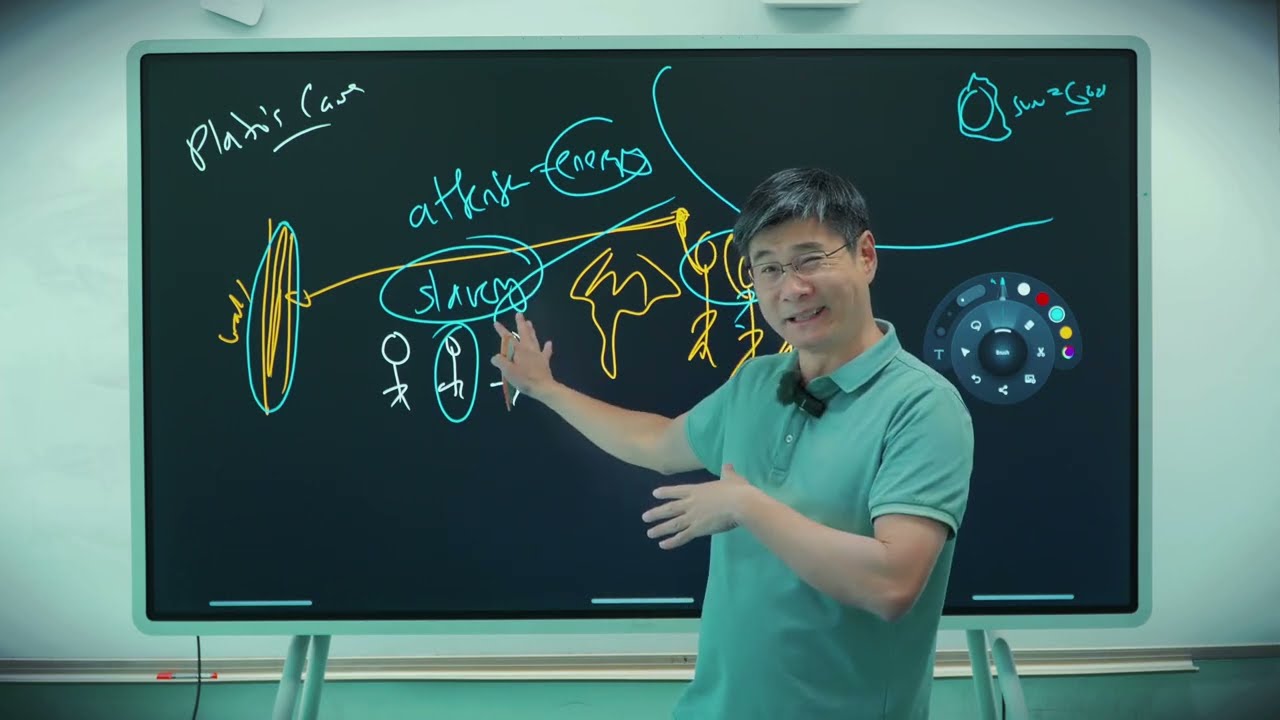
Plato’s Allegory of the Cave is used as the central metaphor for the human condition and the path to freedom.
- Prisoners are chained in a cave, watching shadows projected on a wall by figures behind them, believing the shadows to be reality.
- The shadows represent movies, the internet, social media, AI, and the educational system, all of which are tools of enslavement.
- The “powers behind” the figures (elites, demons, or unknown forces) seek to capture human attention and imagination, because attention is energy and imagination creates reality.
- Slavery in this framework is not physical coercion but the capture of imagination: people are tricked into believing the false reality is the only reality, and thus they create and sustain it.
- Freedom means escaping the cave: one prisoner breaks free, is initially blinded by the sun (God), but eventually sees the true world as infinite, diverse, and alive, recognizing the cave world as a “dead zombie world.”
- The freed person can then look inward, connect to the spiritual, and perceive the noumena (vibrations and energy) behind the phenomena.
- The instructor emphasizes that those who speak the truth will be rejected or killed by those still enslaved, so one should seek personal freedom without trying to convince others.
- Prisoners are chained in a cave, watching shadows projected on a wall by figures behind them, believing the shadows to be reality.
-
The lecture outlines methods for escaping the cave and accessing true consciousness.
- Meditation is the primary method proposed by all religious traditions (Buddhism, Hinduism, Taoism, Christianity, Judaism).
- The universe flows according to sacred geometry, and meditation (especially breath work) allows consciousness to harmonize with the vibrational flow of the universe.
- This process can take decades of practice, but it enables one to see the false material world and connect with the true spiritual universe.
- “Hacks” are offered as faster but imperfect alternatives to decades of meditation.
- Psychedelics (magic mushrooms, ayahuasca, peyote) disrupt the left hemisphere and allow the right hemisphere to perceive the noumena, experienced as intense colors and vibrational energy.
- Self-denial (fasting, exposure to extreme cold) collapses the body and shifts consciousness toward the spiritual as one approaches death.
- Near-death experiences (NDEs) produce consistent reports across unrelated individuals: upon clinical death, people enter a spiritual realm of compassion, love, and forgiveness, meeting God, which mirrors Plato’s world outside the cave.
- Death is reframed not as something to fear but as a release and return to the spiritual, part of a natural cycle.
- Meditation is the primary method proposed by all religious traditions (Buddhism, Hinduism, Taoism, Christianity, Judaism).
-
The lecture explains the Christian concept of Christ consciousness as a model for how consciousness, imagination, and memory create reality and immortality.
- Humans are not passive observers but active participants in reality: as we receive vibrations and form memories, we implant those memories into universal consciousness, changing the universe (analogous to how a computer both receives and uploads information to the internet).
- Each person is like a pebble dropped in an ocean, creating vibrations; the purpose of life (eudaimonia) is to “create as much splash as possible,” to flourish, imagine, and vibrate at one’s creative best.
- If enough people imagine something simultaneously, it becomes true and manifests in reality.
- Jesus is the most famous example: two billion people love and imagine him constantly, keeping him alive at a high vibration.
- Christians believe in the second coming of Jesus; mystics believe Jesus can return by inhabiting a person who makes their body a vessel through love, generosity, and especially forgiveness.
- Forgiveness, even in extreme cases (such as someone killing one’s child), opens a person to divinity and allows the Christ consciousness to flow in.
- The broader secret: by living in the memories of others, one becomes immortal; by constructing one’s consciousness to welcome great figures, one can resurrect them within oneself.
- Humans are not passive observers but active participants in reality: as we receive vibrations and form memories, we implant those memories into universal consciousness, changing the universe (analogous to how a computer both receives and uploads information to the internet).
-
The lecture defines the three goals of human life and how the great books serve as the path to achieving them.
- The three goals are immortality, reincarnation, and godhood, powered by love fueling imagination.
- Reincarnation means that after death, consciousness returns to the spiritual realm and may come back to the material world centuries later in a continuous cycle of growth.
- Great books are “captures of the universe in a state” and contain entire universes within them.
- By embracing the great books and entering them, a person can travel through and create their own universe.
- The instructor proposes doing what Christians do with Jesus, but with the greatest minds of human civilization: Homer, Plato, Dante, Goethe, and others, welcoming them into one’s consciousness.
- The instructor is explicit that this is a lifelong journey requiring total commitment and sacrifice.
- Students must abandon the pursuit of money, power, sex, and fame, and dedicate themselves fully to the great books.
- The class is only a sample and a framework; it cannot provide all answers, and most people will fail, but consciousness is eternal so there is always another chance.
- The semester will cover the Iliad, the Odyssey, the Republic, the Aeneid, and the Divine Comedy, with the possibility of adding other works like Kant’s Critique of Pure Reason.
- The three goals are immortality, reincarnation, and godhood, powered by love fueling imagination.
-
The lecture addresses student questions about the nature of slavery, free will, and suffering.
- On slavery and free will: the instructor insists that being a slave is always a choice, not a result of coercion.
- People choose to come to school, accept lies, and pursue money because they fear social isolation and condemnation, not because they are forced.
- The “powers that be” lack imagination and must trick humans, who have the power of God through imagination, into creating the reality the powers want.
- Recognizing oneself as a slave and refusing to comply is the hardest thing in the world because it means social rejection, but it is the only path to freedom.
- On pain and suffering: the material world includes pain, suffering, and evil because these are necessary for imagination and meaning to exist.
- Without struggle, loss, and the possibility of failure, nothing would have meaning; pain focuses the mind and enables humans to reach their full imaginative potential.
- Monks who meditate in extreme conditions understand that suffering is a tool for spiritual growth; without evil, there can be no good, and choosing good in an evil world gives life meaning.
- On slavery and free will: the instructor insists that being a slave is always a choice, not a result of coercion.