-
Dante’s Divine Comedy is presented as the third pillar of Western civilization, following Homer’s Iliad and Odyssey and Virgil’s Aeneid, and is credited with ending the Dark Ages and becoming the blueprint for the Renaissance, the Reformation, and modernity itself.
- The central conflict across these three poets is how each defines what it means to be human: Homer taught that love is the unifying force of the universe and that the individual’s connection to the divine source lights up the world; Virgil, serving empire, replaced that with piety and obedience to authority, cutting humanity off from the source and causing civilization to stagnate for over a thousand years; Dante’s task in the Divine Comedy is to reconnect humanity to the source, restoring love and imagination as the fundamental animating forces of the universe.
- Throughout human history, two countervailing forces compete: empire, which demands obedience and severs us from the source, and civilization, democracy, and love, which reconnect us to the source and let us animate the universe through imagination. The Divine Comedy is fundamentally a conflict between Virgil’s worldview and Dante’s, and Dante must defeat Virgil’s framework to restore humanity.
-
Paradise is not the end of the journey but a more arduous intellectual one, structured as an ascent through nine spheres toward God, guided first by Beatrice and then by Bernard.
- Dante’s journey through Inferno and Purgatory was not about cleansing sin or redeeming oneself for heaven’s sake; it was about gaining the knowledge and intellectual preparation necessary for the higher learning of Paradise. Heaven is fundamentally about debate, dialogue, and philosophy, not passive bliss.
- Beatrice becomes Dante’s guide through the stars, and rather than a romantic reunion, their encounter is a deep philosophical dialogue about the nature of the cosmos.
-
The moon episode establishes that truth cannot be reached through observation and reason alone; faith, love, intuition, and imagination are required.
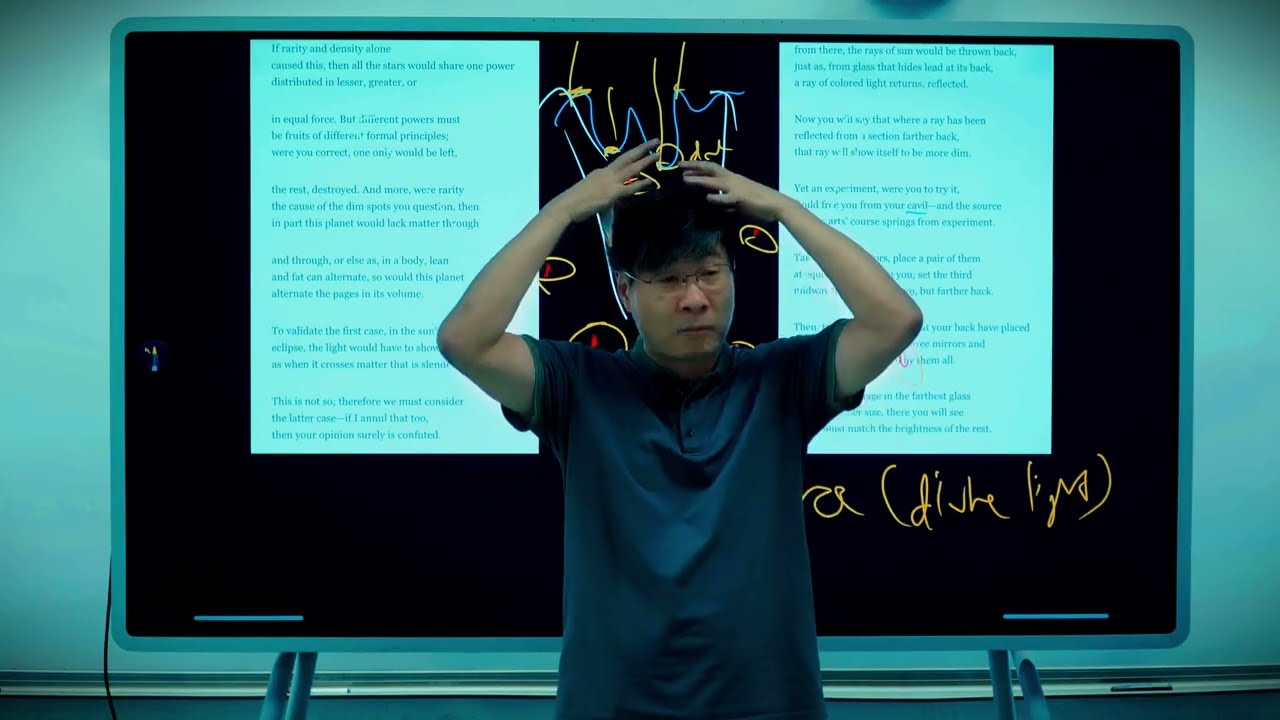
- Dante’s first question in Paradise concerns the dark spots on the moon. He offers the conventional explanation that they are caused by varying density and rarity (hollow spots through which light passes through rather than reflecting). Beatrice systematically refutes this using scientific reasoning and experiment.
- She points out that if the moon had hollow spots, a solar eclipse would not be completely dark, light would break through. She then proposes an experiment with three mirrors at varying distances from a light source: even though the farthest mirror produces a smaller image, its brightness matches the others. This demonstrates that brightness does not diminish with distance or depth, refuting the density-rarity theory.
- The mirror experiment carries a deeper implication: light reflected through mirrors extends to infinity, and the light at the farthest end of the universe burns as brightly as the original source. This becomes a key metaphor for the nature of God and divine light.
-
Beatrice explains that the universe is animated by a single divine source whose light shines differently through different beings based on their capacity to receive it, not based on physical properties like density.
- The universe works like a body animated by a single consciousness: just as your mind unifies your organs, hands, and eyes, the divine source unifies all of creation. The light glows throughout the universe, and our responsibility is to receive it through love. Once we receive the light, imagination allows us to shine brightly. Love and imagination together are what allow beings to glow with divine light.
- Differences in brightness among celestial bodies come from different formal principles and the varying capacity of each being to receive and express the divine light, not from physical matter being rare or dense.
-
At the climax, Dante reaches the Empyrean, the seat of God, where Beatrice departs and Bernard becomes his final guide. Dante’s unique mission is to help God know something God cannot know about itself.
- God is perfect and therefore lacks imagination, because imagination requires pushing beyond the boundaries of what is known. God created humanity specifically so that a human could know what God is and tell God about itself. Dante is the individual chosen for this task.
- Only a human can accomplish this because a human has both a soul (which connects to the divine source) and a body (which connects to the material world, experiences limitation, suffering, pleasure, and therefore has imagination). The combination of body and soul gives humans a uniquely divine imagination that neither angels nor saints possess.
- Bernard prays to the Virgin Mary, celebrating her as the mortal who first expanded the possibility of humanity by containing God in her womb, making it possible for God to enter the material world. Dante is completing a mission that Mary began.
-
Dante’s ability to see God depends not on physical sight but on imagination, which is activated through virtue and love.
- Dante’s virtue is his eternal love for Beatrice; his imagination is expressed through his poetry. These two qualities enable him to perceive God and allow God to know itself. Bernard, who lives alongside God, admits he cannot see God the way Dante can.
- Before Dante can sustain the vision of God, Bernard prays that Mary disperse the clouds of his mortality, specifically his fear and ego. To truly understand God, one must abandon mortal passions entirely and be filled with virtue, imagination, and love.
-
When Dante finally sees God, the vision overwhelms his mind and memory. He can retain only the feeling, not the content, and spends the rest of his life trying to reconstruct what he saw.
- God appears as pure, infinite light. Dante’s mind is blown; memory fails in the face of such excess, like a dream that leaves only an impression. Twenty years later, he is alone in Italy, using his imagination to reconstruct the vision.
- His mission is not only to understand God for God’s sake but to report what he saw to humanity, revealing the true nature of God so that people may know themselves and become better.
-
After twenty years of meditation, Dante finally perceives the essence of God as three concentric circles of different colors but the same dimension: the Holy Trinity.
- One circle reflects the second as a rainbow reflects a rainbow, and the third seems like fire breathed equally by the two. They reflect each other in an eternal, self-sustaining unity.
- But Dante discovers a paradox at the heart of the Trinity: inside the three circles, he sees a human effigy, a human likeness. This is deeply puzzling because God is supposed to be beyond humanity, distant and mysterious. Why are humans at the very heart of God?
-
The Divine Comedy ends not with an answer but with a question: why are we inside God? The answer is revealed through the mirror experiment Beatrice described earlier.
- When you hold a candle before three mirrors, the candle is reflected infinitely, but so is your own image. The candle represents God, the divine light burning inside every person. What the candle is, what burns inside us and reflects throughout the universe, is love.
- God is love. The candle burning inside each person is the memory of God, God within us. When you love someone, you feel God, and your imagination expands, allowing you to see the world through the mind of God and reunite with the divine. This is the great secret of the universe.
- The final line of the poem, “the love that moves the sun and the other stars,” now becomes clear: Dante has figured out that love is the fundamental force that unifies and animates the entire cosmos.
-
The Divine Comedy is not meant to be read once like a textbook; it is meant to be reread throughout one’s entire life, with each reading revealing deeper truths and changing how one sees oneself and the world.
- On a first reading, the ending is confusing and leaves the reader with a question. On subsequent readings, armed with the understanding that God is love, the entire poem reveals itself in a new way. The Divine Comedy is a portal into the mind of God, which is what makes it a great book.