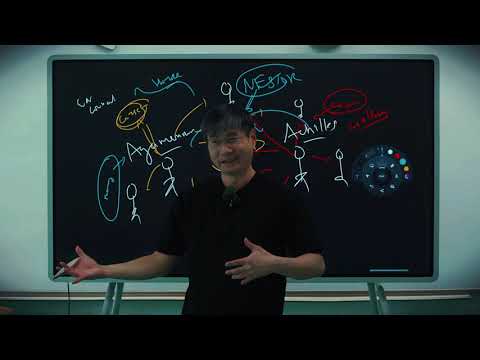
The episode explores what makes a great book by using Homer’s Iliad as the central example, arguing that great literature excites the imagination, deepens self-understanding, and makes fictional characters feel as real as living people — and that this capacity is what gave rise to Greek civilization itself.
What a great book does
A great book is not just a story; it is composed of characters so real that they make the world more real to the reader.
Through reading the Iliad, students were able to imagine Achilles’ childhood, project themselves into his emotional world, and even transpose him into the present day — recognizing that what he truly craves is fame and admiration, not merely warfare.
This exercise revealed that arrogance and insecurity are two sides of the same coin, and that reading great literature gives readers insight into the complexity and darkness of their own hearts.
The core function of a great book is to excite the imagination so that readers can think more deeply about themselves and more creatively about the world.
Harold Bloom’s definition: “Hearing yourself speak”
The literary critic Harold Bloom defined a great book as something that helps us become human, meaning its characters are able to hear themselves speak.
To hear yourself speak means that as you talk, a part of you steps back and analyzes what you are saying — it must make sense to you and to others.
This is consciousness itself: a form of imagination in which you dissociate from the immediate moment, observe yourself, and simultaneously model what is happening in the minds of those you are speaking to.
Great literature captures this multi-layered consciousness, making characters feel alive.
Consciousness in action: the quarrel of Agamemnon and Achilles
In Book 1 of the Iliad, Agamemnon and Achilles argue over a captured girl, and both characters demonstrate extraordinary self-awareness.
Agamemnon is doing three things at once: responding to Achilles, managing how the other generals perceive him (to avoid losing face and authority), and internally ensuring his own words form a coherent rationale — he claims he loves the girl more than his own wife, so taking Achilles’ girl is justified vengeance.
Achilles is similarly multi-layered: he responds to Agamemnon, appeals to the sympathy of the onlookers, and asserts his own worldview — he came to Troy under orders, risks his life for Agamemnon’s profit, and is now being robbed of even his small share.
Both men are trying to control reality through speech — to impose their version of events on everyone present.
Agamemnon then uses his own memory and experience to attack Achilles’ character, calling him a narcissist who came to Troy only for personal glory, not out of loyalty.
Achilles responds by withdrawing from battle — and even when the Greeks are later desperate, with Hector’s forces burning their ships, Achilles refuses to return unless Agamemnon personally apologizes, showing how far both men will go to defend their narrative, even at the cost of self-destruction.
Every character in the Iliad — Odysseus, Hector, Priam, Nestor — has this same depth, with real emotions, memories, and independent inner lives, all constructed by a single mind: Homer.
The mystery of Homer
Almost nothing is known about Homer personally; the Greeks called him “the teacher” and considered him the father of their civilization.
Scholars have long debated whether Homer was one person or many, and how a single mind could construct an entire universe of psychologically real characters.
To explain this, the episode examines how personality and consciousness are formed:
Experiences become short-term memories, which the brain filters by emotional intensity; these emotionally indexed memories form identity.
Different contexts (school, home, a foreign country) activate different identity configurations, which together constitute a person’s worldview.
But modern psychology leaves three major problems unsolved:
The sorting mechanism: Why do different people respond to the same experience with different emotions (optimism vs. pessimism)? Genetics and parenting don’t fully explain it — children often have personalities entirely unlike their parents.
Storage of memories: Neuroscience knows where breathing and language acquisition occur in the brain, but not where memories are formed, stored, and accessed.
Empathy (theory of mind): We cannot fully explain how we perceive and feel the emotions of others.
A theory: the brain as antenna to universal consciousness
The episode proposes that we have two components: the material body (from evolution) and consciousness (from interaction with the universe).
The brain is not a storage facility but an antenna for the vibrations of a conscious universe — analogous to a laptop that stores little locally but accesses vast information via the cloud.
Memories and identity are stored in this universal consciousness, not solely in the brain.
Different emotions implant themselves at different wavelengths or dimensions in this consciousness, creating a unique imprint for each person.
Shared imprints across people with similar personalities are what Carl Jung called archetypes — which is why people of similar character often resemble each other in appearance and behavior.
Homer, on this theory, opened his mind to the universe and accessed all archetypes at a level far beyond ordinary people, then transplanted them into the Iliad.
This explains how characters written 2,500 years ago in a completely different culture can speak directly to a Chinese student in the 21st century as though they were real.
Poets as prophets
The word “prophet” does not primarily mean someone who predicts the future; it means someone who speaks the truth.
Truth is the universe itself — eternal, beyond space and time, encompassing past, present, and future.
Moral truth functions as prediction: if you do evil to others, evil will return to you — as when Achilles’ betrayal of Patroclus leads to his own downfall.
A poet is recognized as speaking truth because the work is beautiful and resonates deeply; a teacher uses that truth to help others understand themselves.
In Homer’s illiterate culture, the Iliad was performed orally, and its beauty — its poetic music combined with psychological truth — is what convinced listeners of its authenticity.
All major Greek thinkers who followed — Plato, Thucydides, Isocrates — operated within the universe Homer created, applying its insights in different domains (philosophy, history, rhetoric), but always derivative of Homer’s foundational achievement.
In literature, prediction and truth are the same thing: to speak eternal truth is to describe what has happened, what is happening, and what will happen.
Reading assignment
Students are to read through Book 16 of the Iliad by Friday.