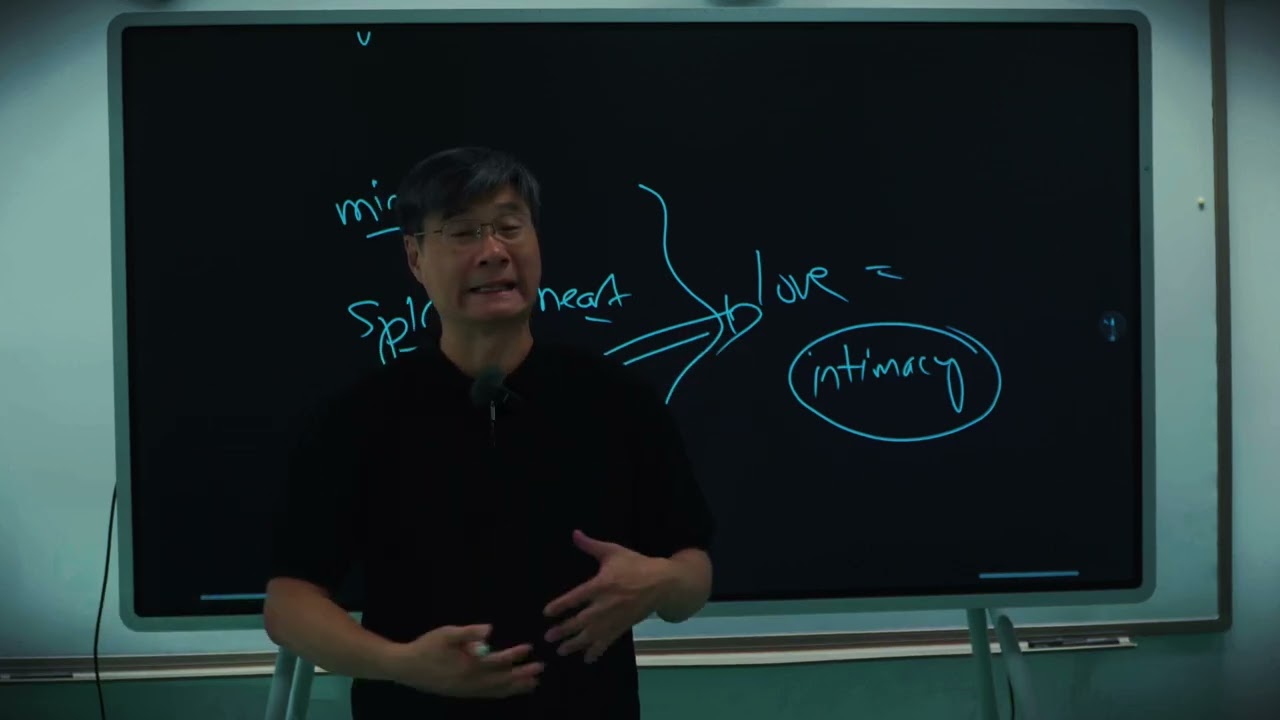
The Odyssey concludes with the reunion of Odysseus, Penelope, and Telemachus after 20 years of separation, each suffering from depression rooted in disconnection: Odysseus from PTSD and a shattered identity after the Trojan War, Penelope from grief and uncertainty over her husband’s fate, and Telemachus from being unable to inherit his father’s legacy or his mother’s household. Their reunion is framed as a resurrection made possible by love, understood not as obsession or possession but as intimacy—a deep, mutual understanding expressed through a private, coded language that only the beloved can decode.
Love as Unity Across Three Planes of Consciousness
Consciousness is described as infinite and unified, but the ego creates the illusion of separation through time and space. Love is the force that draws people back into unity.
Human consciousness operates on three planes:
Mind – the conscious, logical, narrative self
Spirit – the emotional, feeling self (the heart)
Soul – the deepest core, which knows truth beyond logic
Happiness and wholeness come when all three planes align. Trauma and depression arise when they conflict.
Odysseus, Penelope, and Telemachus each have soul-level knowledge that the family will reunite, but their spirits are weighed down by grief and their minds are trapped in narratives of loss and impossibility. The Odyssey’s arc is the reunification of these three planes within each person and across the family.
What Love Is Not: Helen and Menelaus
Helen and Menelaus in Sparta illustrate the absence of love. They speak at each other, not to each other.
Helen tells a story of her own cleverness at Troy, ignoring that Menelaus lost his brother Agamemnon, his friend Achilles, and countless comrades because of the war she helped cause.
Menelaus responds with a counter-story in which Helen nearly doomed the Greeks by mimicking the voices of their wives from inside the Trojan Horse.
They are physically together but emotionally deaf to each other—trapped by circumstance, not bound by love.
What Love Is: The Coded Conversation Between Odysseus and Penelope
Odysseus returns to Ithaca disguised as a beggar. His home is overrun by suitors who consume his wealth and court Penelope. He cannot reveal himself openly without being killed, and he does not know if Penelope still loves him after 20 years.
Penelope arranges a private meeting with the stranger, who claims to know Odysseus. Their conversation operates on three simultaneous levels:
Soul level: They recognize each other immediately through a deep, multidimensional connection.
Spirit level: They feel longing and fear but are drawn together.
Mind level: They must maintain the disguise for survival, speaking in a way that servants and spies cannot understand.
Odysseus describes in vivid detail the clothing Odysseus wore when he left for Troy—a heavy purple cloak fastened with a golden brooch depicting a hound strangling a fawn, and a tunic like dried onion skin.
To outsiders, this is just a description. To Penelope, the word “brooch” is the key.
The brooch was a parting gift Penelope gave Odysseus 20 years ago, along with a prophecy that he would be gone two decades. She made him promise to bring it back. He lost everything at sea but carried the memory of their departure.
The detailed poetry of the description proves the speaker was present at that private moment—only Odysseus could know these details.
This coded language moves Penelope’s spirit to tears. Her heart, dormant for 20 years, comes alive. She now feels that her husband is alive, even before her mind accepts it.
The Bow Contest: Resurrection of the Soul
Penelope announces a competition: whoever can string Odysseus’s great bow and shoot an arrow through a line of axes will win her hand. Only Odysseus can string the bow.
All the suitors fail. Odysseus, still disguised, asks to try and succeeds effortlessly.
The act of stringing the bow is a metaphor for the resurrection of his shattered identity—the alignment of mind, spirit, and soul.
Zeus sends a thunderbolt as a divine sign of approval, confirming that Odysseus now fights for justice and family rather than for hollow glory.
Odysseus and Telemachus, though heavily outnumbered, then kill all the suitors.
The Bed as Proof: Reconciling Mind, Spirit, and Soul
After the slaughter, Odysseus must still prove himself to Penelope at the level of the mind. She remains guarded, still depressed, and keeps emotional distance.
Odysseus tells a servant to move their bed outside for him to sleep on. Penelope responds by testing him: the bed cannot be moved.
Odysseus reacts with fury and reveals that he built the bed himself around a living olive tree that grew through the bedroom floor. He carved the bedposts from the tree’s trunk, inlaid it with ivory, gold, and silver, and strung it with red leather.
On the surface, this is proof of identity—only the real Odysseus would know this.
On the deeper level, the bed is a metaphor for Penelope’s heart and their love: it was built with years of loving care, it is rooted in something alive and permanent, and it cannot be moved.
Odysseus is telling her: I will never leave again. My home is here with you forever.
Penelope’s knees go slack. She recognizes the signs, dissolves in tears, rushes to embrace him, and acknowledges that her husband has returned. Her mind, spirit, and soul are finally aligned. She is resurrected.
The Purpose of Life: Achilles’s Regret in the Underworld
Earlier in the Odyssey, Odysseus travels to the underworld and meets the ghost of Achilles.
Odysseus tells Achilles he must be happy—he was honored like a god in life and now rules over the dead.
Achilles rejects this entirely:
He would rather be a poor, unknown laborer alive than rule all the dead.
Looking back on his life from death, what he regrets is not the glory but the loss of his father and his son. Those memories—of love and family—are what give life meaning.
This is the ultimate moral of the Odyssey: love and family give life meaning, not fame or empire.
Legacy
The Odyssey’s message—that the purpose of life is to build and love a family rather than to pursue glory—became the philosophical foundation of Greek civilization, which the episode presents as humanity’s greatest civilization.