-
The Divine Comedy as a revolutionary democratic epic
- Dante wrote La Commedia around 1300 in Tuscan (the language of Florence) rather than Latin, because he believed epic poetry should be accessible to ordinary people, not just the elite. This democratic impulse is what made Dante, like Homer and Shakespeare in their own languages, the greatest poet of his tradition.
- He called it “comedy” (low style) deliberately, rejecting the convention that epic poetry had to be written in Latin and treat elevated, tragic subjects. The work is structured in three parts: Inferno (an inverted triangle, descending underground), Purgatory (a mountain climbed upward), and Paradise (structured like a solar system leading to the Empyrean, where God resides). This mathematical symmetry is unique in poetry.
- The poem operates through paradox and cognitive dissonance: it is designed to be read aloud and memorized, and the more you return to it over decades, the more it disrupts your normal way of seeing the world and remakes you from within. Dante never states his truths directly; he plants clues and contradictions that the reader must unravel through intuition and imagination.
-
The Divine Comedy as a response to the Aeneid and the Catholic Church
- For roughly 1,000 years before Dante, Virgil’s Aeneid was the dominant literary work in Europe and the intellectual foundation of the Catholic Church. The Aeneid elevated duty and piety above love, teaching that individuals cannot access God directly and must obey the Church to receive salvation. Dante saw this doctrine as the source of massive corruption, wars, and the splintering of Christendom.
- La Commedia is Dante’s direct rebuttal: in his poem, love is God itself, and individuals can access God directly, bypassing the Church. The poem contains many direct criticisms of the Catholic Church. Dante’s project is to defeat the worldview of the Aeneid—to move from a universe governed by duty, obedience, and reciprocity to one governed by love, free will, and grace.
-
Dante’s biography: political exile and undying love
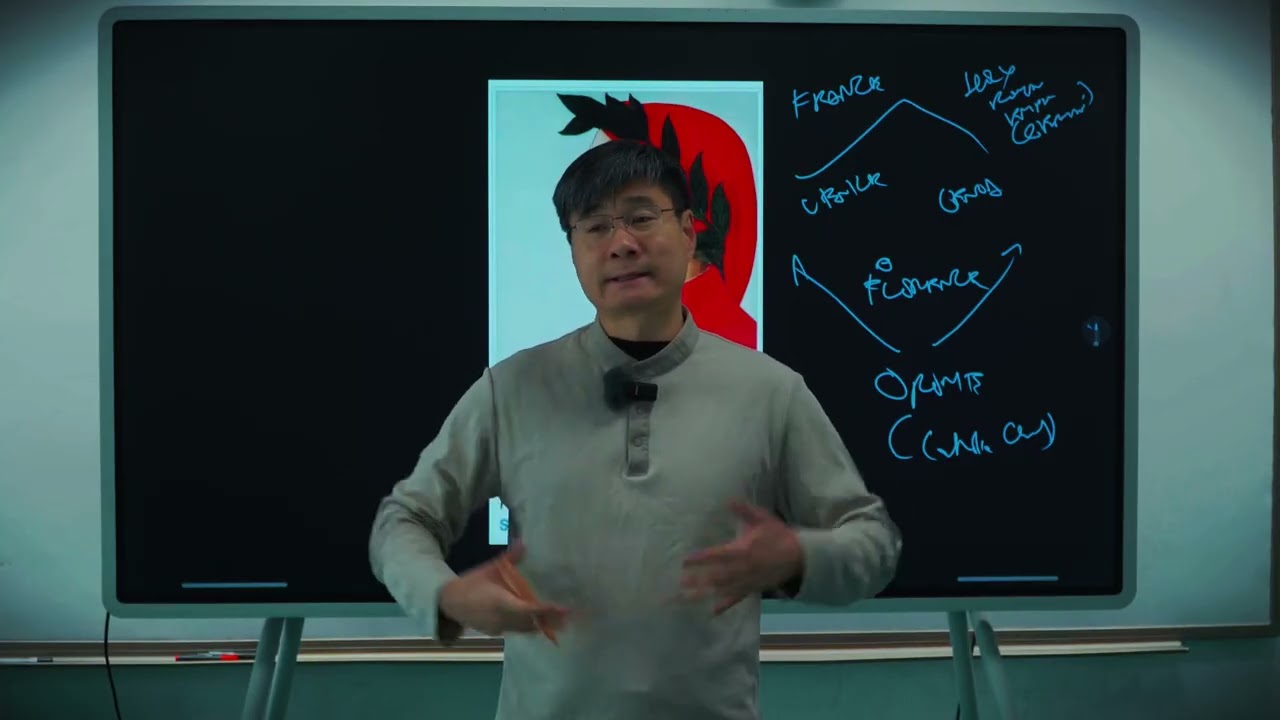
- Dante lived around 1300 in Florence, one of many warring Italian city-states caught between the papacy (Guelphs, Dante’s faction) and the Holy Roman Empire (Ghibellines). After the Guelphs won, they split into Black and White sub-factions, and Dante, disgusted by endless political violence, exiled himself from Florence permanently. The Divine Comedy is saturated with references to these conflicts.
- He fell in love with Beatrice when they were children (he was nine, she was eight), but due to class differences, both married others. Beatrice died young, perhaps in her mid-twenties giving birth, but Dante never forgot her. She becomes the spiritual center of the poem—the figure who redeems him from earthly hatred and leads him to God.
-
The opening: lost in the shadowed forest
- The poem begins with Dante in middle age, lost in a “shadowed forest”—a state of deep depression and confusion caused by the hatred and violence he has witnessed. He has lost his connection with God. Virgil, the poet Dante most admires, appears and promises to guide him. Dante sees Virgil as a father and teacher.
- This is the first layer of paradox: Dante must elevate Virgil to a pedestal in order to eventually recognize Virgil’s limitations and reject him. Virgil represents the Aeneid’s worldview, and for Dante to fully embrace God and love, he must first understand and then overcome that worldview.
-
The paradox of Beatrice’s mission: reciprocity vs. grace
- Virgil explains that Beatrice came to him in Limbo and asked him to rescue Dante because Dante loves her so much. This sounds like reciprocity—Beatrice helps Dante because he loves her—which contradicts Dante’s own theology that God is pure generosity requiring nothing in return.
- Two possible explanations are offered:
- Virgil is misinterpreting what happened through the lens of the Aeneid’s worldview (duty, contract, reciprocity). In reality, God sent Beatrice freely, without conditions, because Dante’s heart was calling out for God.
- Beatrice deliberately framed her mission in terms Virgil could understand, knowing he would not grasp unconditional grace. Either way, Virgil is established as an unreliable guide from the very beginning.
-
Crossing into Hell: Charon and the paradox of obedience
- Charon, the ferryman, refuses to carry Dante because he is still alive. Virgil insists, saying their passage is “willed above,” and Charon obeys. The paradox: Charon is in hell precisely because he rejects God’s authority, yet he obeys God’s command.
- The resolution is that Charon is not obeying God—he is obeying Virgil, the speaker. This suggests Virgil is the true master of hell, because the Aeneid’s emphasis on piety, obedience, hatred of enemies, and empire created the emotional and spiritual conditions that make hell (and the corrupt Catholic Church) possible. The Catholic Church, Dante implies, is based not on the Bible but on the Aeneid.
-
Will and desire: why people choose hell
- Two key words recur throughout the poem: will and desire. Together they constitute the soul—you are what you want and what you move toward.
- The souls in hell line up obediently to cross the river. Virgil explains that “celestial justice spurs them on so that their fear is turned into desire.” They are in hell not because they committed bad acts but because they desire to be there—they believe hell is where they belong. Free will is fundamental: no one is forced into hell; they choose it.
-
Limbo and Virgil’s self-deception
- In Limbo, Virgil tells Dante that he and other virtuous pagans (Homer, Plato) are here through no fault of their own—they simply lacked baptism or lived before Christ. He claims there was only one exception: when Jesus descended to hell after his death to rescue figures like King David, Noah, Abraham, and Rachel.
- This is later revealed to be untrue. It is entirely possible for non-Christians to ascend to heaven through will and desire. Virgil’s claim that he is here by bad luck is a lie he tells himself—he chooses to remain in hell, and the poem will gradually reveal why.
-
Minos warns Dante: don’t trust Virgil
- At the second circle of Hell, Minos (who judges sinners) tells Dante: “Be careful how you enter, whom you trust. The gate is wide, but do not be deceived.” This is a direct warning not to trust Virgil, the person closest to him.
- Virgil immediately silences Minos: “Do not attempt to block his fated path.” This defensive reaction confirms that Virgil has something to hide. Dante is planting clues that in Hell, nothing is what it seems, and the person Dante trusts most is the one he should least trust.
-
Virgil refuses to name Dido: the unacknowledged wound
- As Virgil catalogues the lustful souls in the second circle—Semiramis, Cleopatra, Helen, Achilles, Paris, Tristan—he pointedly refuses to name Dido, referring to her only as “the other spirit who killed herself for love.” Dido is Virgil’s own creation from the Aeneid, the character readers most sympathize with, and the one Virgil condemned to hell.
- The suggestion is that Dido was based on a real woman Virgil loved and who rejected him (possibly because he was physically unattractive). Virgil condemned her to hell out of spite and has carried guilt and embarrassment about it ever since, which is why he cannot bring himself to name her.
- This contrasts sharply with Dante, who elevates Beatrice to heaven. Where Virgil destroyed the woman he loved, Dante exalts his.
-
Dante’s act of rebellion: naming Dido
- Dante asks to speak with the souls near Dido, and when they approach, he names Dido himself—“those spirits left the ranks where Dido suffers.” This is an act of rebellion against Virgil, his acknowledged father and guide.
- By naming Dido, Dante resurrects her in the reader’s memory and implicitly accuses Virgil of injustice. It signals that Dante is not passively following Virgil but actively questioning and resisting him. Hell is an illusion and a deception; the reader must use heart and mind to see through it.
-
The deeper method: truth through paradox and intuition
- The *Divine Comedy**cannot be understood by reading alone. Dante constructs a universe of layered paradoxes that reveal truth only through repeated engagement over time. The reader must trust intuition, imagination, and the belief that a connection to God will illuminate what the text conceals. The poem is ultimately a journey into the reader’s own heart and faith.