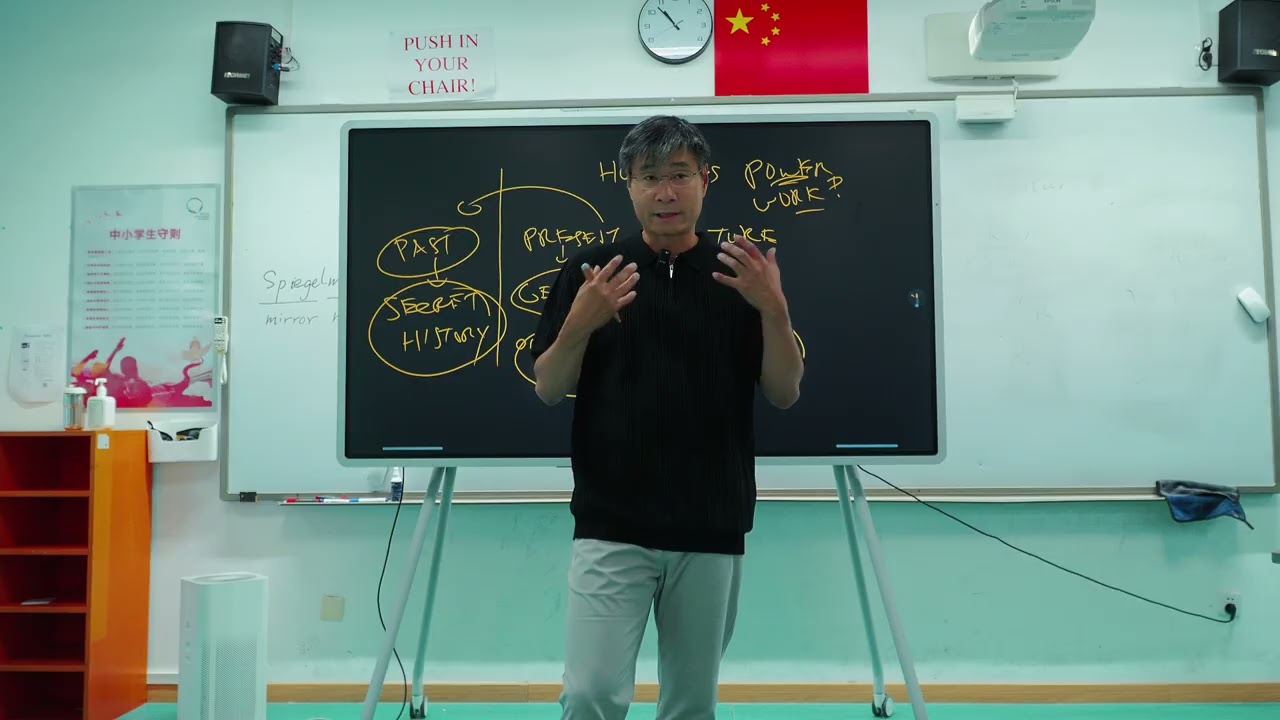
- This is the first lecture of a semester-long course that aims to teach students how power works by training them to think critically about the world. The instructor frames the entire course around a single question: How does power work? The answer, he argues, is that power operates by implanting false concepts into people’s minds—concepts so deeply embedded that most people never question them. The course will examine the past, present, and future to build an analytical model of geopolitics, test it against reality, and ultimately uncover what the instructor calls the “secret history” of humanity—a history he claims is deliberately falsified by those in power.
Kant and the Nature of Reality
- The instructor opens with Immanuel Kant’s epistemology as the philosophical foundation for the course.
- Kant argued that we can never know objective reality (the noumena, or “things-in-themselves”) because our senses warp everything into a structure our minds can process, called the phenomena.
- Time and space, for example, do not exist in reality—they are mental frameworks we impose on the world in order to understand it.
- The key takeaway: reality is what we imagine it to be. There is no accessible objective reality; life is a constant act of imagination.
- The course’s purpose is to augment students’ imagination so they can see the world more clearly—not to tell them what to think, but how to think.
The Course Structure: Past, Present, Future
- The semester is organized around three timeframes:
- Present: Study current geopolitics (e.g., wars in Ukraine, the Middle East) to build an analytical model.
- Future: Use the model to make predictions; if the predictions are correct, the model is validated.
- Past: Apply the validated model to reinterpret history and uncover the “secret history” of humanity.
- The instructor compares this process to artificial intelligence: a model is only as good as its ability to predict reality.
- He claims that all history taught in schools is false—a system implanted by powerful people to control how we understand the world.
How Power Works: Three Examples
1. Money
-
The instructor uses a thought experiment to explain how money works:
- A bank receives $5 million in deposits, promising 1% interest. It lends $5 million to a borrower at 10% interest, keeping the 9% spread as profit.
- Logically, the bank should have zero dollars on hand after lending out the deposits (or a small reserve under fractional reserve banking).
- In reality, the bank now has $9.5 million—the original $5 million in deposits still exist on paper, and the $5 million loan is also counted as an asset. Money has been created out of nothing.
- He cites Chinese banks (Bank of China, ICBC, Agricultural Bank of China) as real-world examples: over the past 20 years, they became the largest banks in the world not because Chinese people deposited vast wealth, but because the banks created money out of nothing to finance infrastructure projects.
- Banks are allowed to print money—they create it from nothing.
-
The origin of the system:
- It began with merchants who stored gold in banks and received receipts (contracts) in return.
- These receipts became a more convenient medium of exchange than gold itself, facilitating global trade.
- Banks realized they could lend out receipts (not actual gold), effectively doubling the money supply—creating money from nothing.
- The risk: if everyone demanded their gold back at once, the bank would collapse (bank run).
- To mitigate this, banks formed cartels (partnerships, often through intermarriage) to support each other and enforce repayment—even by force against kings who refused to repay loans.
- This cartel system is the origin of central banking, which the instructor claims controls the world today.
-
Why poverty exists if money is infinite:
- The instructor argues that money is not scarce—it is infinite, just a number that can be printed at will.
- Poverty persists because powerful people want it that way. The purpose of money is not to enrich everyone but to create the illusion of scarcity so that people will work hard to obtain it.
- Artificial misery (poverty) is necessary to make people desire wealth. Without poor people, no one would strive to be rich.
- Similarly, economic crises (stock market crashes, recessions) exist to destroy excess money in the system so that people continue to feel money is scarce and must work.
- Wars serve the same function: they destroy wealth to maintain the illusion of scarcity.
- He compares the world to World of Warcraft: players grind for credits that have no real value, but the illusion of scarcity makes them play. If credits rained from the sky, no one would play.
- The real value is not money—it is the work people do. Money is just the mechanism to extract that work.
-
Addressing the scarcity objection:
- A student asks whether physical resources (food, land, oil) are genuinely scarce even if money is not.
- The instructor responds that food waste (e.g., in Beijing garbage dumps) proves food is abundant, not scarce. Hunger is an artificial crisis.
- He acknowledges that resources are finite but argues they are more than sufficient to feed everyone—scarcity in physical resources is also artificially maintained.
2. The Individual
-
The instructor asks: What makes us happy?
- Students list: money, power, freedom, relationships, love, video games, vacations.
- The instructor notes that all of these are individualistic answers—and that this individualism is historically new.
- For most of human history, happiness was understood collectively: you could not be happy unless your family and community were happy.
- In ancient societies, if someone became wealthy, the first thing they did was hold a big feast for the entire community—spreading the wealth to enhance their reputation for generosity.
- This practice was common in China for most of its history: a person who made money in the city would return to their village and host a feast.
- The modern idea of saving money for yourself or your children is a recent development.
-
The concept of the individual did not always exist:
- The worst punishment in ancient societies was not death but exile (banishment)—being cut off from the community was considered worse than dying.
- The idea that a person is an independent entity, separate from family and community, is a modern invention.
-
Two worldviews compared:
- Worldview 1 (Polytheism): Humans have no individual agency. Powerful gods (Apollo, Dionysus, fate, fortune, anger, pride) control everything. You might get rich, but the god of pride will make you arrogant and destroy you. You have no control over your fate.
- Worldview 2 (Modern Science/Psychology): Humans are synapses generating memories. Our behavior is determined by DNA and environment. Through therapy, reflection, and self-work, we can control our emotions and therefore control our fate. We have full individual agency.
- Students overwhelmingly choose Worldview 2 as more accurate—which the instructor says is exactly what they have been trained to believe.
- He argues that Worldview 1 (polytheism) is actually more accurate and gives a better account of how the world works.
-
Why powerful people prefer Worldview 2:
- Individual responsibility: If you fail, it’s your fault—not society’s, not the system’s. This makes people easier to control.
- Incentive to work hard: If you believe you control your own fate, you will work harder. If you believe the gods will punish you for success, you might just relax. Hard work generates real wealth for the powerful.
- Powerlessness and inability to organize collectively: Worldview 2 makes people believe all problems are internal/individual. This prevents collective action—the only way to actually change the world. People who feel miserable and powerless turn to video games and porn instead of organizing.
- Dependence on authority: Worldview 2 teaches people to defer to scientists, psychiatrists, and experts rather than trusting their own judgment or community.
- The instructor gives a striking example: if you feel sad, you’ve been taught to see a psychiatrist who will prescribe drugs—making you dependent on the system. The better answer (walk, talk to a friend, rest) is ignored because it doesn’t create dependence on authority.
-
The difference between the two worldviews regarding authority:
- A student asks: aren’t the gods in Worldview 1 also a form of authority?
- The instructor responds that the gods in polytheism are not benevolent authority figures—they are flawed, vengeful, and petty. They can get away with hubris because they are gods; humans cannot.
- The modern concept of benevolent authority (the king rules because he is just; the scientist speaks truth) is a modern invention. Ancient people assumed kings ruled because the gods favored them—not because they were good.
- This leads to the concept of eudaimonia (flourishing): since you cannot control fate, you should live your life to the best of your ability today. Seize the day. Be excellent now.
- The instructor argues that the ancients (Greeks) were superior to modern people because they pursued eudaimonia, whereas modern people pursue mere pleasure and comfort.
3. School (Education)
-
The instructor asks: Why do we have school?
- Students answer: to learn, to get a degree, to gain knowledge.
- The instructor’s answer: brainwashing. Everything else is a lie.
-
How learning worked for most of human history:
- If you wanted to be a doctor, you found a mentor and became an apprentice. You learned through experience—washing floors at first, then observing, then treating patients.
- The instructor poses a choice: a 12-year-old who spends 10 years apprenticing in a hospital vs. a 12-year-old who goes to Harvard and Harvard Medical School. At age 30, the apprentice is the better doctor because they have actual experience.
- In the old system, anyone could learn anything—you didn’t need to be “smart.” You just needed a teacher.
- The modern system sorts people into “smart” and “stupid,” sending smart people to good schools and stupid people to wash dishes. This was not the case for most of human history.
-
The three societies that first introduced mandatory public schooling:
- Sparta (Greece): Children as young as 5–6 were put into schools led by older children (9–10).
- Aztecs (Central America): Provided free compulsory education to all children.
- Prussia: The model used by virtually every country today.
- What do all three have in common? They were all war societies dedicated to defeating their neighbors.
- Schools exist because they are excellent at preparing people for war.
-
Why schools are effective at brainwashing:
- The worst thing that can happen to a parent is to have their child taken away.
- School is designed to separate children from their parents.
- A child who is with their parent feels secure—and a secure child is willing to question authority, think critically, and disobey.
- A child who is separated from their parent feels insecure, anxious, and afraid. Such a child will trust whatever the teacher says.
- The instructor acknowledges that parents are also brainwashed (they went to school too), but the presence of a parent still provides a buffer against full indoctrination.
- He notes that in his own class, students are free to leave—he doesn’t give grades, it’s pass/fail. In regular school, if you don’t attend, your parents get arrested.
-
What school brainwashes you to believe:
- The concept of the nation-state.
- School implants the idea that the nation-state is a real entity—“Mother China,” “the United States,” “France”—that you must love, sacrifice for, and die for.
- This is done by teaching language, history, and geography—all designed to create a false memory of the nation-state.
- For most of human history, the nation-state was absurd. People identified with their local community (Beijing, Haidian, Chaoyang)—places where they actually knew the people.
- Today, a Beijinger is told they are the same as someone from Yunnan or Tibet, despite having nothing in common. This is the nation-state illusion.
- History, as taught in schools, is the false memory of the nation-state.
The Origin of Money, Individual, and Nation-State: Monotheism
- The instructor argues that three concepts define the modern world:
- Money (infinite, created from nothing)
- The Individual (happiness as personal, not collective)
- The Nation-State (a false entity demanding loyalty and sacrifice)
- These concepts are beyond natural human experience. No one could arrive at them from first principles. They had to be implanted through brainwashing.
- A person from 1,000 years ago, upon hearing these three concepts, would conclude: “You are all slaves.”
- The origin of all three concepts is monotheism—the idea of one true God.
- The three great monotheistic religions—Judaism, Christianity, and Islam—are essentially the same religion.
- Monotheism was such a powerful idea that it turned nothing into everything—it created money, the individual, and the nation-state, and thereby created the modern world.
Power as Alchemy
- The instructor defines power as alchemy:
- Alchemy was the ancient pursuit of turning lead into gold—nothing into everything.
- Modern power has achieved this: it turns nothing (money, the individual, the nation-state) into everything (the entire structure of modern life).
- Power is the capacity to make people believe that money is valuable, that the individual can achieve happiness, and that the nation-state exists.
- As a result, people live extremely miserable lives—believing life keeps getting better when it actually doesn’t.
- But this system was an accident—an accident of the human imagination. We didn’t know what we were doing when we created it.
- The hopeful note: if we can control the human imagination, we can create a new system that allows for eudaimonia—the flourishing of the human intellect.