-
This is the first lecture of a course that aims to reveal the “secret history” of how power works, arguing that the world is structured by powerful illusions designed to control people and extract their labor.
- The instructor frames the entire semester around a single question: how does power work?
- The answer, he argues, is that power operates by implanting false concepts into people’s minds, making them believe in things that do not objectively exist, and thereby controlling their behavior.
- The course will examine the past, present, and future: geopolitics in the present, predictions about the future to test analytical models, and a re-examination of the past to uncover hidden history.
- The instructor explicitly states that all history taught in school is false, implanted by powerful people, and that understanding this system is the path to liberation.
-
The course is built on a philosophical foundation drawn from Immanuel Kant, which holds that objective reality is unknowable and that what we call “reality” is a construct of human perception and imagination.
- Kant’s framework: there is an objective reality (noumena, or “things in themselves”) that humans can never directly access; instead, we perceive the world through our senses, which warp it into phenomena (“things as they appear to us”).
- Time and space, for example, do not exist in objective reality but are structures humans impose to make sense of the world.
- The key takeaway: “Reality is what we imagine it to be.” Life is a constant act of imagination, and the course aims to train students to augment their imagination to see the world more clearly.
- The instructor stresses that this class is not about what to think but how to think.
-
The instructor presents three core illusions that power uses to control people: money, the individual, and the nation-state. He argues all three are human constructs that do not exist in objective reality but have been made to feel real through systematic brainwashing.
-
Money is an illusion created by central banking.
- A thought experiment: if a bank takes $5 million in deposits and lends out $5 million, standard economics says the bank should have zero (or a fractional reserve). In reality, the system treats it as though $9.5 million exists, because banks create money out of nothing through lending.
- Chinese banks (Bank of China, ICBC, Agricultural Bank of China) became the largest in the world not because Chinese people deposited vast wealth, but because banks created money from nothing to finance infrastructure projects.
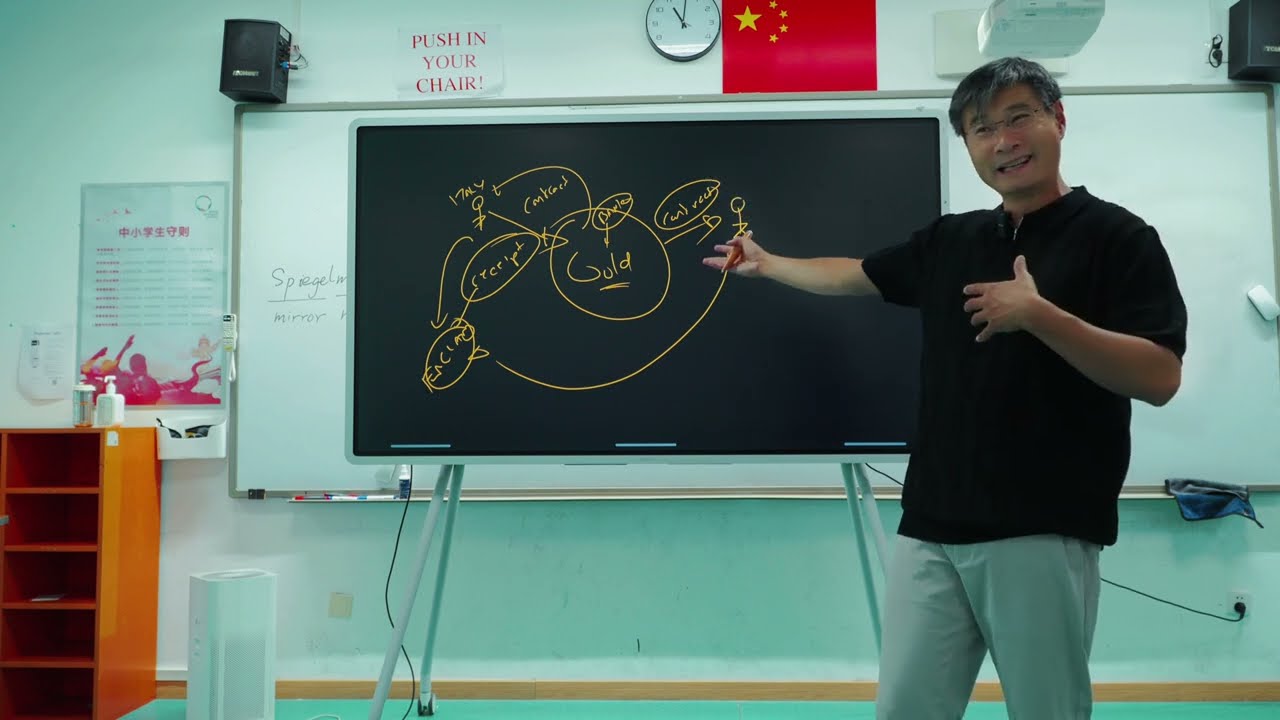
- Historically, merchants stored gold in banks and received receipts; banks then lent out receipts for gold they didn’t have, effectively doubling the money supply. This evolved into cartels of banks connected by intermarriage and mutual support, which became the modern central banking system.
- The key insight: money is infinite because it is just a number that can be printed at will. Poverty exists not because resources are scarce but because powerful people create artificial scarcity to make money seem valuable, which in turn forces people to work.
- Crises (stock market crashes, recessions) and wars serve the same function: they destroy excess money and wealth to maintain the illusion of scarcity, keeping people motivated to work.
- The real value is not money itself but the work people do; money is merely a mechanism to incentivize labor.
- When challenged on whether physical resources like food and land are truly abundant, the instructor points to massive food waste as evidence that hunger is an artificial crisis, not a natural scarcity.
-
The individual is a modern invention that serves power by preventing collective action.
- For most of human history, people understood happiness collectively: you could not be happy unless your community was happy. Generosity and reputation within the community were paramount.
- Example: if someone in an ancient or traditional society became wealthy, the expected response was to hold a feast for the entire community, not to hoard wealth. This pattern is still visible in Chinese village culture today.
- The concept of the individual as an independent entity separate from family and community is historically new and was deliberately created.
- Evidence: the worst punishment in most pre-modern societies was exile (banishment from the group), not death, showing that existence outside the community was considered worse than non-existence.
- The instructor contrasts two worldviews:
- Polytheism (the older view): humans have no individual agency because gods, fate, and forces beyond our control determine outcomes. This worldview, paradoxically, inspires people to live their best lives (eudaimonia, or flourishing) because they cannot control fate, and it enables collective action because people see shared forces acting on everyone.
- Science/psychology (the modern view): humans are collections of synapses and memories shaped by genes and environment; through therapy and self-work, individuals can control their own fate. This worldview, paradoxically, makes people powerless because it locates all problems within the individual, making collective action impossible.
- Powerful people prefer the second worldview because: (1) it promotes individual responsibility, making people easier to control; (2) it makes people work harder (they believe their fate is in their own hands); and (3) it prevents collective action by convincing people that their problems are personal, not systemic.
- The instructor argues that modern psychiatry and psychology are not designed to cure people but to make them dependent on authority. He claims that talking to a psychiatrist typically makes people feel worse, whereas walking, talking to friends, or exercising are more effective but are discouraged by the system.
- In the polytheistic worldview, gods are not benevolent authority figures but flawed, vengeful beings who can get away with hubris. Kings ruled because they were favored by gods, not because they were just. This made authority contingent and unstable, which was healthier than the modern assumption that authority figures are benevolent.
-
The nation-state is a false concept implanted through mandatory public schooling.
- The three societies that first introduced mandatory, free, public education were Sparta, the Aztecs, and Prussia. All three were fundamentally war societies dedicated to military conquest.
- School is not designed to teach knowledge or skills; it is designed to brainwash children into believing in the nation-state as a real entity worth sacrificing for.
- Before the nation-state, people identified with their local community (e.g., “I am from Haidian” or “I am from Chaoyang”), not with an abstract entity like “China.” The nation-state forces people who have nothing in common to believe they are the same.
- School achieves brainwashing by separating children from their parents. A child who feels secure with a parent is willing to question authority; a child who feels insecure and abandoned will trust the teacher and accept what they are told.
- The instructor notes that parents are also brainwashed (they went through the system themselves), but their presence still provides children with enough security to think critically.
- School teaches language, history, and geography not as knowledge but as tools to create a “false memory” of the nation-state. History, in this framework, is the mythology of the nation-state.
- The nation-state concept exists to make people obedient: if you believe in “Mother China” (or any nation), you will serve it, obey it, fight for it, and die for it.
- The instructor contrasts modern education with pre-modern apprenticeship: for most of history, if you wanted to be a doctor, you apprenticed in a hospital and learned by doing. Anyone could learn anything through mentorship. Modern schooling, by contrast, sorts people into “smart” and “stupid” categories and funnels them into roles that serve the nation-state rather than teaching genuine skills.
- When asked if he himself is brainwashing students, the instructor acknowledges the possibility but notes that his class has no grades, no tests, and is pass/fail, giving students the freedom to question or leave. In contrast, mandatory school is enforced by law (parents are arrested if children do not attend).
-
All three illusions (money, individual, nation-state) trace back to a single revolution in human thought: monotheism (the idea of one true God).
- Monotheism gave rise to the concepts of money, the individual, and the nation-state by creating a framework in which a single, abstract, invisible authority could be believed in and obeyed.
- The three great monotheistic religions (Judaism, Christianity, Islam) are, in the instructor’s view, essentially the same religion.
- Monotheism is such a powerful idea that it “turned nothing into everything,” which the instructor calls alchemy.
- Alchemy, traditionally understood as the attempt to turn lead into gold, is reframed as the real essence of power: the ability to turn nothing into everything, to make people believe in things that do not exist.
- The instructor argues that this system was not deliberately designed by a conspiracy but was an “accident of the human imagination,” created without people understanding what they were doing.
- The course’s ultimate goal is to help students understand and control the human imagination so they can create a new system that allows for eudaimonia, the flourishing of the human intellect.