-
This lecture sets the stage for the final four classes of the semester by reviewing the transformation of the Roman Republic into the Roman Empire, the split between East and West, the rise of the Catholic Church as a spiritual empire in Western Europe, the emergence of Islam, and the deepening crisis of the Catholic Church that will eventually lead to the Protestant Reformation and the rise of capitalism.
- The Roman Republic began as an oligarchy of roughly 100 patrician families, which was functional when Rome was small, poor, and at war, but became corrupt and stagnant once Rome became a vast empire.
- The oligarchic families refused to cede power to a centralized imperial bureaucracy, so the empire remained a patchwork of family-controlled territories, leading to constant civil war from Sulla through Julius Caesar and Augustus.
- Roman society was already in demographic decline, with Roman women refusing to have children, even as massive migrations of steppe peoples (Goths, Huns, Germanic tribes, Slavs) poured into Europe, driven westward by the Han dynasty’s wars against the Xiongnu in China.
- Constantine’s response was to reinvent Roman civilization by moving the capital to Constantinople, creating what became the Byzantine Empire, a Greek-speaking imperial bureaucracy that could function as a centralized state.
- The Eastern Empire was wealthy, controlling the Levant, Anatolia, and Egypt, and was defined by its wars with the Persian (Sassanid) Empire. Its capital was designed to be invincible behind sea walls, and it lasted roughly a thousand years.
- The Eastern Empire closely resembled China in its bureaucratic organization, relying on trade and diplomacy as much as warfare, and using mercenaries extensively.
- The Western Empire was the poorest part of Europe, fragmented by natural barriers (mountains, forests, rivers) into many competing cultures and societies, which prevented unification and fostered diversity.
- In this power vacuum, the Catholic Church became the dominant institution, claiming to exist outside of history as a divine, spiritual empire that spoke for God and decided who went to heaven or hell.
- The Church absorbed migrating steppe peoples by offering a path for their war leaders to join the Roman nobility, integrating them into a hierarchical Christian society with the old families on top and the migrants at the bottom.
- The Roman Republic began as an oligarchy of roughly 100 patrician families, which was functional when Rome was small, poor, and at war, but became corrupt and stagnant once Rome became a vast empire.
-
The Catholic Church’s power rested on its claim to control access to the divine, but this claim was built on a theological contradiction that the Church enforced through coercion.
- Jesus taught that every person contains a “divine spark” and can connect with God directly. The Church reversed this, teaching that the divine spark was actually the devil’s work and must be imprisoned, with the Church serving as the sole intermediary between humanity and God.
- When individuals arose insisting the divine spark was real and within them, the Church responded with crusades against them and established the Inquisition as a secret police to root out dissent.
- The Inquisition’s logic was that those who believed in the divine spark were not evil but simply ignorant and needed to be educated; if they persisted after education, they were burned as heretics before they could “pollute” others.
-
Constantine made Christianity the official religion of the Roman Empire and convened the Council of Nicaea to impose a single orthodoxy on what had been a franchise model of competing churches.
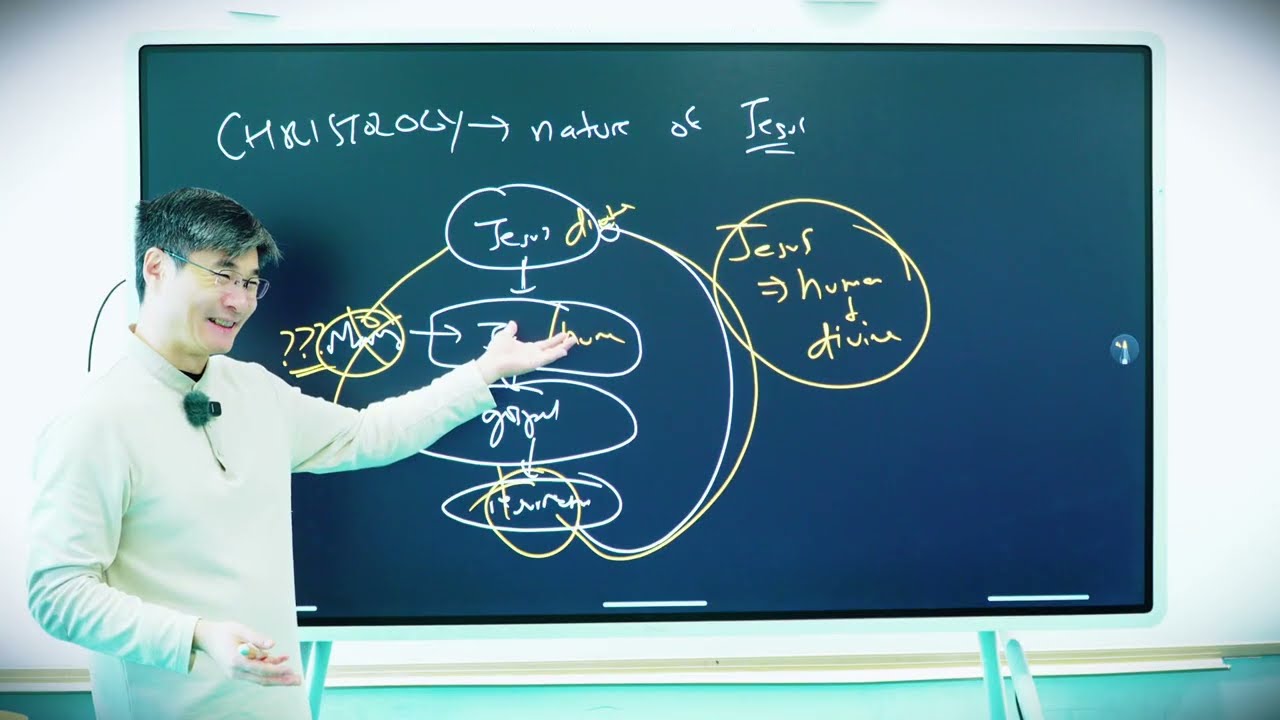
- The first major debate was Christological: was Jesus divine, human, or both? Different churches gave different answers, and the official position that emerged was that Jesus was simultaneously fully divine and fully human, a logical impossibility.
- The second and more confusing debate concerned the relationship between God, Jesus, and the Holy Spirit. Three competing frameworks existed:
- Modalism: all three are just different modes or expressions of the same single force.
- Partialism: all three are parts of a larger divine whole, like regions of an ocean.
- Arianism: God came first and created Jesus, making Jesus secondary.
- The Council of Nicaea rejected all three and proclaimed the Holy Trinity: God, Jesus, and the Holy Spirit are separate persons, yet equal, yet one being. This is logically incoherent, and the professor argues it was designed precisely to break people’s capacity for logical reasoning.
- The analogy given is mathematics: just as math formulas must be memorized and regurgitated without being tested against reality, the Nicene Creed must be memorized and accepted without question. The professor claims this is why the best mathematicians are young (the brain can still handle the cognitive load of memorizing meaningless systems) and why math ultimately makes people “stupid” by severing thought from reality.
- The purpose, the professor argues, is to empty out a layer of the brain’s logical architecture so that people cannot build coherent ideas, making them controllable. Anyone who questions the Trinity is a heretic to be burned.
-
The enforcement of the Holy Trinity created a cascade of wars and migrations that reshaped the Middle East and gave rise to Islam.
- The Byzantine Empire spent centuries fighting to impose the Holy Trinity on churches that rejected it, while simultaneously fighting the Sassanid Persians. Both empires became exhausted, over-bureaucratized, and oppressive.
- Christians who rejected the Trinity, called Nestorians (who taught that Jesus was a divine messenger, not God on earth), were persecuted by both empires and fled into the Arabian desert, along with Jews who had been expelled from Jerusalem by the Romans.
- Arabia at this time was the most energetic, open, and cohesive society in the Middle East, serving as a trade crossroads between India, Egypt, and the Levant. Arab mercenaries had learned advanced warfare from both the Romans and Persians, and the population was being exposed to both Nestorian Christianity and Judaism, both of which preached the coming of a Messiah.
- The immediate trigger was the Jewish-Roman conflict over Jerusalem: the Persians, with Jewish help, captured Jerusalem and allowed Jews to return and begin rebuilding the Third Temple. The Byzantines retook the city and massacred the Jews, who then fled to Arabia preaching that the Messiah was coming.
- Muhammad emerged in this context, declaring himself the Messiah and promising religious tolerance for all: Jews, Christians, and Arabs alike. His message was that all are children of the one God (the monad), the divine spark is within each person, and no one should be a slave. He united the Arabs, Nestorians, and Jews into a single community.
- The professor emphasizes that Muhammad did not preach Islam as it later became. He preached liberation, tolerance, and the divine spark. Only after his death did factions fight a civil war and organize his teachings into the religion of Islam.
- The professor draws a parallel to Zoroaster, Jesus, and Homer: all were poet-prophets who preached liberation, and all were later turned into the foundations of empires by successors like Paul or, in Islam’s case, later caliphs.
-
The Arab-Islamic conquests swept through the Middle East, North Africa, and Spain with remarkable speed because both the Byzantine and Persian empires were exhausted and despised.
- The Arabs retook Jerusalem, conquered Persia, and took Spain and North Africa. The only major Byzantine possession that survived was Constantinople itself, protected by its sea walls.
- After Muhammad’s death, the Muslim community fractured into competing factions and caliphates, which gave the Byzantines time to recover and Western Europe time to grow stronger.
- The Arabs established the Islamic Golden Age, a period of tremendous peace and prosperity built on global trade networks. Islam’s requirement that Muslims be trustworthy before Allah created a trust system that enabled Muslim merchants to trade reliably across vast distances, including into China.
-
In Western Europe, the Catholic Church became the most powerful institution in human history, more powerful than any empire, because it claimed authority over souls rather than just bodies.
- The Church’s power rested on three advantages over empires: its leader was God (perfect, immutable, and eternal, unlike a fallible human emperor); it demanded obedience of the soul rather than just labor; and its punishment was eternal hell rather than mere death.
- The Church established a divine bureaucracy with a strict hierarchy, conducted all services in Latin (which ordinary people did not understand), forbade laypeople from reading the Bible, and required memorization of the Nicene Creed and other doctrines without question.
- The Church became enormously wealthy, controlling one-third of all land in Europe tax-free. It sold indulgences (essentially tickets to purgatory), practiced simony (buying and selling church offices), and allowed priests to marry and nobles to appoint church leaders.
- Parishioners were forced to pay taxes to the Church rather than to their kings, creating constant tension between the Church and European monarchs, which would eventually drive kings to support the Protestant Reformation.
- The Western Roman Empire effectively collapsed in 476 when Germanic mercenaries, unpaid by the weakened state, sacked Rome. The Church, not the empire, was now the real power. Charlemagne was crowned Holy Roman Emperor by the Pope in 800, establishing the principle that the Pope anointed emperors.
-
The Catholic Church faced a series of legitimacy crises that it tried to solve through persecution and violence.
- Jerusalem was in Muslim hands, and Muslim Spain was wealthier and more innovative than Christian Europe. The Eastern Orthodox Church split from Rome in 1054. Internal reformers who believed in the divine spark continued to arise.
- The Church’s solutions included persecuting Jews (scapegoating them, expelling them from their homes, and massacring them), launching the Crusades to retake the Holy Land, and launching the Albigensian Crusade against the Cathars in southern France who believed in the divine spark.
- The Crusades attracted many criminals and violent men because the Pope promised immediate remission of all sins to anyone who fought, regardless of their past. This led to widespread massacres of Muslims and Jews during the Crusades.
- The Knights Templars emerged from the Crusades as the first multinational bank, safeguarding pilgrims’ money. They grew wealthy and, exposed to new ideas in the East, were eventually suppressed by the Church; their leader Jacques de Molay was burned at the stake in 1307, and survivors are said to have formed the basis of the Freemasons.
- The Cathars who refused to recant their belief in the divine spark were burned at the stake, some voluntarily walking into the flames. The Church responded to such movements by creating the Dominicans and the Inquisition to identify and eliminate dissent.
- The Little Ice Age, the Great famine, the Black Death (which killed a third of Europe’s population), and a split within the Church itself (rival popes in Rome and Avignon) further undermined the Church’s credibility. If the Church represented God’s will, why was God punishing Europe so severely?
- Reformers like John Wycliffe (posthumously declared a heretic, his body dug up and burned) and Jan Hus (who led the Hussite Wars) challenged Church orthodoxy but were defeated. Martin Luther would eventually succeed where they failed, leading to the Protestant Reformation, which will be discussed in the next class along with the rise of capitalism.