This episode traces the evolution of Jewish history and identity from ancient times through the emergence of a radical messianic movement called Sabbatian Frankism, founded on the teachings of Sabbatai Zevi and later systematized by Jacob Frank. The central argument is that this movement, though rooted in Jewish mysticism, ultimately rejected Judaism and developed a philosophy of liberation through transgression, egalitarianism, and material conquest—ideas that the episode claims profoundly shaped modern Western civilization, secret societies, and even the founding of Israel.
The Strategic Importance of Jerusalem and the Formation of Jewish Identity
Jerusalem has historically been the wealthiest and most strategically vital location in the Middle East because it connects all major civilizations—Egypt, Anatolia, Mesopotamia, Persia, and the Mediterranean world—making whoever controls it the gatekeeper of trade and imperial power.
Empires repeatedly struggled to hold Jerusalem because its rulers could always be bribed to switch allegiances; the Babylonians tried hostage-taking and then destruction, scattering the Israelites, while the Persians later invented a new strategy: creating a distinct Jewish identity in Jerusalem as a loyal foreign proxy, financing the Second Temple in exchange for political allegiance.
This Persian-era arrangement produced the three enduring pillars of Jewish identity:
Monotheism and chosenness: belief in Yahweh as the sole God and the covenant with Abraham promising his descendants the land from the Nile to the Euphrates.
The Law of Moses: divided into the Torah (written law, the first five books of the Bible) and the oral law, governing all aspects of life including Sabbath rest, dietary rules, circumcision, and prohibition on intermarriage.
The Bible as literal collective memory: belief that biblical events actually happened, which is itself the act of becoming Jewish.
From Temple Worship to Diaspora: Greeks, Romans, and Religious Transformation
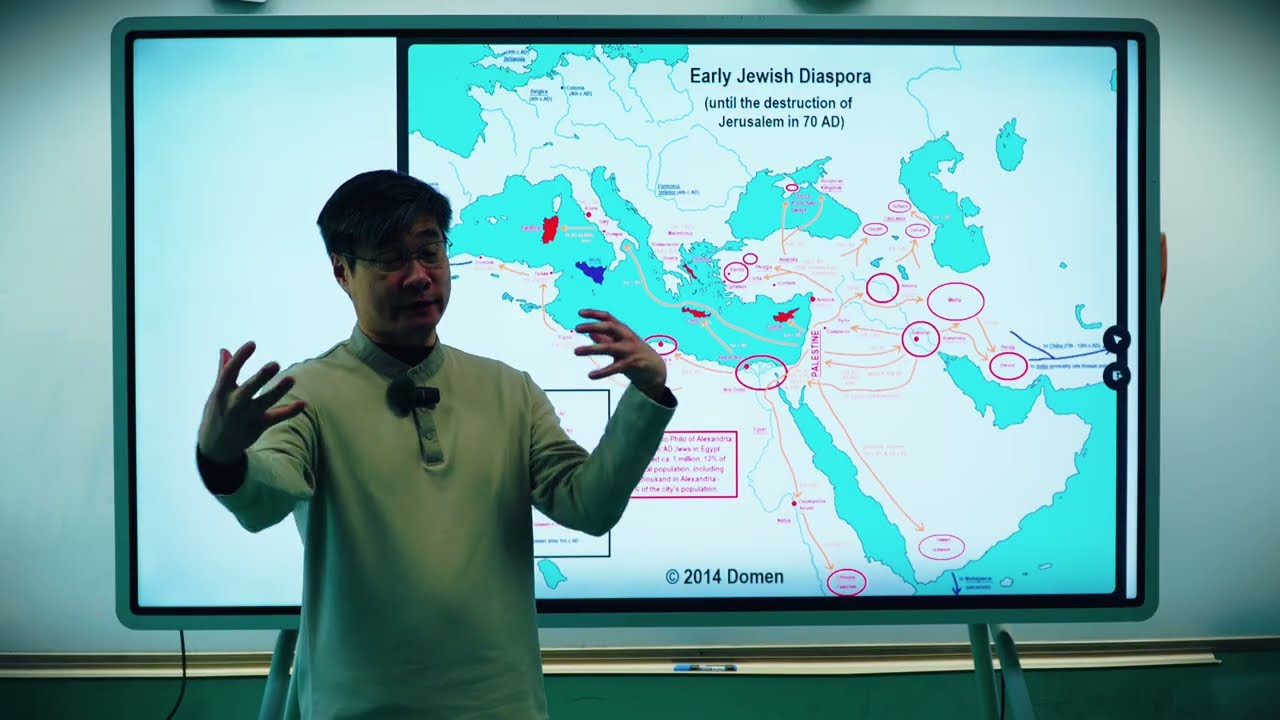
As Jews spread through the Hellenistic world as mercenaries, officials, artisans, and merchants, their strict monotheism and sense of chosenness clashed with Greek cultural chauvinism, culminating in the Maccabean Revolt—a minority rebellion driven by religious conviction that succeeded against the Greeks and is celebrated as Hanukkah.
The Maccabean kingdom was short-lived; the Romans took control and were even harsher, launching three major wars with the Jews, culminating in the destruction of the Second Temple in 70 CE.
The destruction of the Temple caused a massive religious crisis and split:
Many Jews converted to Christianity, which the episode describes as a mechanism created by Paul for Jews to remain Jewish in identity while being Roman in practice.
Those who remained Jewish became more fanatical and messianic, believing the end times were near; some fled into the Arabian desert, where they incubated Islam, prophesying a Messiah who turned out to be Muhammad.
Jewish worship shifted from temple sacrifice to study of the law; the priestly Sadducees lost power to the rabbis (Pharisees), who became the new religious elite of the diaspora.
Jews in Medieval Europe: The Implicit Contract of Exploitation
In Christian Europe, Jews entered into an unwritten arrangement with the nobility: they performed roles forbidden to Christians—especially moneylending at interest (usury), property management, trade, and medicine—in exchange for protection.
The Catholic Church also kept Jews as a spiritual scapegoat, using them to frighten Christians into faith (“if you don’t believe in Jesus, you end up like the Jews”).
This arrangement functioned during good economic times but collapsed during crises, when Jews were blamed, massacred, or expelled; the episode shows a map covered in circles marking expulsions across Europe.
Spain under Muslim rule was a notable exception: Muslims treated Jews and Christians well as fellow descendants of Abraham, and Jews rose to high positions in the Andalusian system due to their literacy, diaspora connections, and financial skill.
The 1492 Spanish expulsion—convert or leave—was traumatic; many Jews fled to the Ottoman Empire, and those who converted under duress created a bitter schism between converts and non-converts.
The Polish-Lithuanian Commonwealth and Deepening Crisis
Many Jews settled in the Polish-Lithuanian Commonwealth, which actively welcomed them for economic development and allowed religious freedom; Jews thrived there until invasions from Sweden and Russia brought devastation and massacres.
This cycle of settlement, prosperity, and violent expulsion created a profound crisis of faith among Jews, crystallizing into three questions:
Why can Jews convert to Christianity or Islam without divine punishment if idolatry is the first commandment?
Why are loyal Jews persecuted if Yahweh demands obedience?
Why don’t Jews possess the promised land despite centuries of loyalty?
Such crises were interpreted as signs of the end times and the imminent arrival of the Messiah.
Sabbatai Zevi: The Messiah Who Liberated Through Transgression
Around 1600, Sabbatai Zevi, born in the Ottoman Empire, declared himself the Messiah; about a million Jews followed him because his message addressed the crisis of faith directly.
Zevi’s core teaching was a rejection of rabbinic authority and Jewish law as a corrupt, oppressive hierarchy that served the status quo and kept Jews enslaved to European nobility.
He proposed an egalitarian society with no hierarchy, where what mattered was one’s personal relationship with God, not external laws about diet, dress, or Sabbath observance; he was, in the episode’s framing, a proto-liberal and proto-communist.
When the Ottoman Sultan gave him the choice between conversion to Islam or death, Zevi chose conversion—an act the episode interprets not as betrayal but as a self-sacrifice modeled on Jesus: by converting, he redeemed all Jews who had converted to other religions, absolving them of the “original sin” of conversion and declaring that the messianic age had arrived.
This introduced the concept of justification by sin: breaking human laws demonstrates true faith in God, because one is no longer constrained by rabbinic authority but guided by the divine spark within.
Most Jews abandoned Zevi after his conversion, but about 300 families followed him; these families became the Dönme, who the episode claims eventually came to control Turkey, citing Mustafa Kemal Atatürk as a Dönme.
Jacob Frank: Systematizing a Religion of World Conquest
Fifty years after Zevi’s death, Jacob Frank emerged claiming to be Zevi’s reincarnation; born into a Sabbatian family, he systematized and extended Zevi’s teachings into a new religion called Sabbatian Frankism, which explicitly rejected Judaism.
Frank considered himself the Messiah and his daughter Eva the female Messiah; he built a following among European nobility in Austria and Russia, and his followers became influential intellectuals, bankers, and members of royal families.
Frank’s philosophy, as recorded by his followers in Polish and translated by Harris Lenowitz, was conveyed through parables—stories designed to embed themselves in the mind and reshape how followers see reality.
Core Teachings of Jacob Frank Through Parable
Contempt for rigid legalism and the stupidity of conventional people: In the orange-and-knife story, Frank easily tricks a learned Jewish scholar by exploiting his rigid adherence to law, then refuses to let the man follow him—teaching that people governed by arbitrary rules are fundamentally stupid and easy to manipulate.
Opportunism during crisis: In the plague story, while others fear contaminated goods, Frank sends his companion to buy everything without paying because sellers are dying—teaching that fear in others is opportunity for those who see the world clearly.
Rejection of suffering as necessary for wisdom: Frank challenges the idea that Jesus came to suffer, asking why divine beings don’t also experience being kings or sultans—arguing that existing morality and religion are mechanisms of control and subjugation, not truth.
The promise of hidden knowledge: Frank claims that all the biblical patriarchs and pillars of the world failed to open a certain door, but he will open it—teaching that he alone understands the true structure of reality.
Accelerationism through sin: Frank reinterprets Jesus’ mission, saying he came to free the world from Satan’s laws; by sinning deliberately, one defies Satan, reveals the falseness of the world, and accelerates the end of the current age—a concept the episode explicitly calls accelerationism.
Fearlessness as the path to wealth: In the pearl story, all master artisans refuse to drill a hole in the world’s most valuable pearl for fear of damaging it, but an ignorant apprentice does it easily and becomes wealthy—teaching that breaking taboos and seizing opportunities without fear is how one gains power.
Love within the group as the source of power: Multiple stories (the four brothers, the bear and the brothers, the elephant and the princess) teach that love and loyalty within the “company” (Frank’s followers, called brothers and sisters) is more powerful than thousands of enemies; this bond allows them to conquer the world.
Trickery and deception as tools for power: In the rich Jew’s test, a generous wealthy man discovers that his friends, despite his generosity, will not help him when he needs it—teaching that people are inherently evil and selfish, and that staying rich requires meanness and recognizing others’ animal nature.
Money as the measure of success: Frank teaches that “silver answers everything” and that one cannot approach God without money—material victory is the proof of divine favor.
Reality as imagination: In the nun story, Frank undresses and lies in bed, and a sworn nun undresses and joins him through the power of his imagination—teaching that reality is a collective hallucination, and those who train their minds through constant learning, reading, debate, and dialogue can impose their imagined reality on others, becoming kings.
The Garden of Eden rewritten: In the pear-stealing story, Frank rewrites both the biblical Eden narrative and Augustine’s Confessions to argue that God wants humans to break rules, that creativity and boundary-testing are divine virtues, and that God will not punish those who transgress human laws as long as they don’t harm others.
Self-hatred and guilt as fuel for achievement: The episode explains that Frankist practices—including incest, wife-swapping, and sexual rituals—produce tremendous guilt, which is then channeled into relentless energy, focus, and motivation to achieve material success and bring about the messianic age.
Frankist Organizational Structure and Secrecy
Frankism is organized as a flat, egalitarian hierarchy (unlike the triangular structures of most secret societies) with all members loyal to Frank; the group is bound by a covenant of love cemented through ritual.
Their conversion to Catholicism was a strategic move to gain access to Catholic royalty and power; the conversion ceremony involved ritual nudity, group sexual relations, and veneration of a cross—but the true purpose was to swear loyalty to each other, not to the Church.
The episode emphasizes that Frankists disguise themselves and operate in silence because the world is governed by “idiotic laws,” but they can always find each other because of their covenant.
The episode claims Frankist organizational characteristics—hierarchy, unity of purpose, selflessness within the group, relentless pursuit of material victory, secrecy, discipline, and channeled guilt—made them the most resilient and powerful organization in the world.
Frankism’s Influence on Secret Societies and Modern Culture
The episode claims Frank is rumored to be the true founder of the Illuminati, arguing that Goethe’s Faust—in which a scholar sins enormously, gains wisdom, and is ultimately saved by God at the last moment—embodies a Frankist attitude toward life.
Frankists allegedly infiltrated the Jesuits, the Freemasons, and influenced the development of Mormonism and Scientology.
Famous alleged Frankists include Louis Brandeis (first Jewish Supreme Court justice in America, namesake of Brandeis University) and William Butler Yeats (Nobel Prize-winning Irish poet and member of the Order of the Golden Dawn).
The episode reads Yeats’s poem “Crazy Jane Talks with the Bishop” as evidence of Frankist philosophy in modern culture: the poem argues that one must “sink low” to find God, that beauty requires ugliness, that nothing can be whole that has not been torn apart—a direct echo of Frankist teaching.
Frankism and the Founding of Israel
When asked whether Frankist ideology influences the Israel-Palestine conflict, the episode’s speaker confirms that the founders of Israel were Frankists and that the conflict is driven by Frankist philosophy.
The episode concludes by arguing that Sabbatai Zevi and Jacob Frank together created modernity in the West, and that their philosophy of liberation through transgression, material conquest, and the rejection of conventional morality has conquered modern Western culture.