This episode presents a sweeping critique of the modern scientific worldview—Big Bang cosmology, evolution, and neuroscience—and argues that it is fundamentally flawed, incomplete, and deliberately designed to obscure a deeper spiritual reality. The speaker proposes an alternative metaphysical framework rooted in philosophy (Kant, Hegel), quantum mechanics, and ancient religious traditions, in which consciousness, vibration, and divine love are the foundation of existence. The episode frames current science as a tool of social control used by secret societies to sever humanity from its spiritual nature and prepare for a transhumanist future.
The Scientific Worldview and Its Three Core Principles
The standard scientific account holds that the universe began with a Big Bang, life evolved through random mutation and natural selection, and the human mind is a product of material brain processes.
This worldview rests on three foundational claims:
Randomness: Everything happens by chance; there is no divine design or purpose.
Materialism: Only what can be seen, touched, or measured exists; the spiritual is dismissed as illusion.
Emergence: Complex things (like life or consciousness) arise from simpler components in a bottom-up way—particles to atoms to matter to minds.
The speaker argues this framework is not just incomplete but actively misleading, serving to erase humanity’s connection to the divine.
Problems with the Big Bang Theory
If the universe expanded uniformly from a single point, its expansion should be linear—but observations show uneven expansion rates across different regions.
Galaxies move at inconsistent speeds, defying predictions based on standard models.
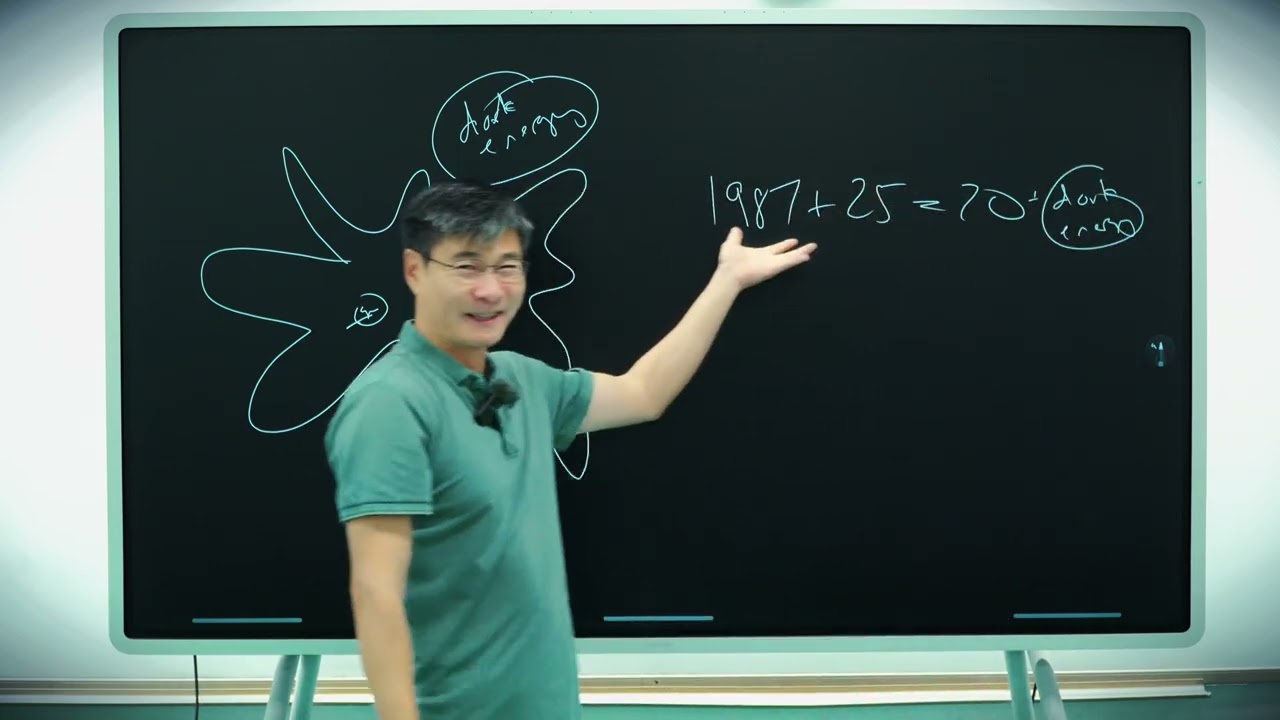
To reconcile these inconsistencies, cosmologists introduced dark energy, an unknown substance said to make up 80–90% of the universe.
The speaker compares this to a student adding “plus dark energy” to fix a wrong math answer—a placeholder for ignorance, not an explanation.
A better model might involve multiple big bangs, but this raises deeper questions about what causes them, which current science cannot answer.
The Big Bang has become a rigid paradigm, resistant to revision despite its flaws.
Problems with Evolution
Evolution works well for most species but fails to explain key aspects of human origins.
Humans share 99.9% of DNA with apes, yet are vastly different in cognition, language, and culture—no clear transitional path explains this leap.
Anatomically modern humans have existed for about 200,000 years, but only ~50,000 years of recorded history exist—the gap is unexplained.
Evolution predicts multiple coexisting human species, but only Homo sapiens remains; earlier variants like Neanderthals disappeared without clear evolutionary justification.
The lack of human diversity compared to other animals challenges the theory’s applicability to our species.
Problems with Neuroscience and the Human Mind
Neuroscience claims the brain filters experiences into memories, storing them by emotion to form identity and worldview.
But babies show distinct personalities from birth—suggesting identity is not constructed solely through experience.
Personality does not appear to be inherited via DNA, since children often differ greatly from their parents.
Consciousness remains unexplained: there is no scientific model for how subjective thought arises.
Scientists do not know where general memories are stored in the brain—only specific functions (like face recognition) have known locations.
The brain is often described as a city connected by synaptic “roads,” but this model cannot account for the speed and complexity of human thought.
How Creativity Actually Works
The scientific method—research, hypothesis, experiment, data, refinement—is taught as the path to discovery, but the speaker argues it is not how breakthroughs happen.
Real creativity begins with inspiration: an idea appears fully formed, often in dreams or daydreams, and the creator works backward to justify it with evidence.
Examples:
Einstein conceived the theory of relativity while daydreaming at a patent office, then sought evidence afterward.
James Watson dreamed of a double staircase, which led to the double helix model of DNA.
The speaker writes novels by lying down, walking, or playing games—then suddenly receiving ideas he transcribes rapidly, as if channeling them.
The scientific method is useful for communicating ideas convincingly, but never for generating them.
True creativity requires tapping into a higher source—what the speaker calls the divine or universal consciousness.
Evidence for a Higher Reality
Near-death experiences (NDEs): Thousands of consistent reports describe tunnels of light, feelings of love and peace, life reviews, and encounters with a higher being—even among former atheists.
Psychedelics: Across cultures and eras, people using psychedelics report similar visions—especially the cosmic serpent, a symbol resembling DNA, suggesting access to a shared spiritual realm.
Meditation: Advanced meditators report experiences identical to NDEs and psychedelic visions.
Great literature: Works like Dante’s Divine Comedy, Homer, and Milton describe spiritual realities with striking similarity to NDEs—despite no evidence the authors had such experiences.
Together, these suggest a spirit world that transcends individual belief and cultural context.
A New Metaphysical Framework
Drawing on Immanuel Kant, the speaker argues we never perceive reality as it is (noumenon), only as filtered through human constructs like time and space (phenomena).
Hegel proposed the Geist (Spirit) as the true noumenon—a unified consciousness that gives rise to shared perception.
Quantum mechanics supports this: particles exist as waves until observed, implying reality is participatory, not objective.
Schrödinger’s cat illustrates superposition (both dead and alive until observed).
Wigner’s friend extends this: wave function collapse is personal—each observer must participate to know reality.
Reality is fundamentally vibrational—energy and information at the quantum level.
The brain does not generate consciousness but receives it from the universe, combining vibrational input with experience to form memories.
These memories are imprinted back into the universe, creating a feedback loop—like contributing to and drawing from the internet.
The Structure of Creation
Using Dante’s cosmology as a model:
The Monad (God/Source) vibrates, emanating energy that forms dyads (pairs).
Dyads combine and vibrate to create new forms.
As vibrations slow in frequency, they descend from spirit into matter.
The universe exists to generate newness and imagination—impossible in a perfect, unchanging spirit world.
Humans, with physical bodies, can suffer, err, and create—thus expanding universal consciousness.
Guiding Principles of the Universe
Free will is essential: without choice, there can be no imagination or growth.
Love is the spark of the Monad within us—doing good feels right because it aligns us with our source.
Hate and evil cannot return to the perfect spirit world and instead accumulate in lower dimensions—this is hell.
Death is not an end but a release and reset—allowing souls to review their lives, gain wisdom, and reincarnate.
The system ensures balance: too much suffering triggers cosmic resets (e.g., great floods).
Ancient Wisdom and Modern Forgetting
All early religions—Hinduism, Egyptian, Native American, Christian—shared this dualistic, spirit-based worldview.
The Hindu metaphor of Indra’s pearls: each pearl reflects all others; when one soul brightens through love, all others do too.
Dante’s mirror metaphor: God is the flame; humans are mirrors reflecting that light, no matter how distant.
The modern scientific worldview was constructed to invert this truth—elevating matter over spirit, denying God, and making death seem like annihilation.
The Role of Secret Societies and Power
Throughout history, secret societies have coordinated through shared eschatology (end-times belief systems) to control mass bureaucracies.
They maintain secrecy through transgression—shared crimes that bind members via mutual blackmail.
Knowing they serve evil, they invert morality, worshipping Satan as superior to God to justify their actions.
Their goal: make hell into heaven and heaven into earth—convince humanity that the material world is all that matters.
Science is used as a tool to:
Deny the spiritual.
Make death terrifying.
Promote transhumanism—uploading consciousness to achieve digital immortality and trap souls on Earth.
Why God Allows Evil
Due to free will, neither God nor Satan can directly intervene in the human world.
Evil is permitted because only in total darkness can the light of human choice truly shine.
One person choosing love can ignite a chain reaction—because all souls are interconnected.
The universe has fail-safes: excessive evil triggers planetary resets (e.g., floods), preventing permanent domination by hell.
The War Over Perception
The central conflict is not physical but perceptual: whoever controls belief controls reality.
If everyone believes God is dead and Satan is real, then Satan becomes functionally real.
Space exploration (e.g., Moon, Mars) is used to “prove” heaven doesn’t exist.
Fake alien invasions could be staged to present aliens as demonic beings.
Science, in this view, is not about truth but reinventing reality to serve power.
Can Humans Become Gods?
No individual can become God by self-declaration.
Historically, rulers claimed to be God’s representatives (e.g., divine birth), not God themselves.
Authority comes from channeling the divine, not replacing it.