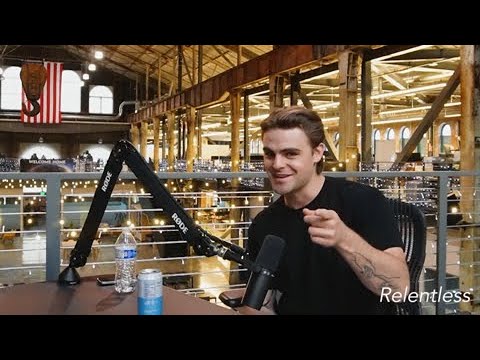
Jason Carman is the head of content at Astranis, a satellite internet company, and the creator of S³, a weekly documentary series profiling deep-tech startups at their earliest stages. He never went to college, taught himself filmmaking through YouTube, directed the most-viewed NBA 2K announcement trailer of all time, briefly pursued music video directing, and ultimately found his calling making cinematic documentaries about founders building the future. His mission is to make technology as culturally cool as sports, music, or film—and to inspire Gen Z to believe they can be part of solving humanity’s biggest problems.
His Origin Story as a Filmmaker
His father, a retired dentist, told him fantastical improvised bedtime stories every night—essentially “choose your own adventure” tales—which planted the seed of storytelling in him long before he ever picked up a camera.
Around age 9 or 10, a family friend got him a Flip video recorder. His first creative project was a book report video for fifth grade where he dressed in camouflage, threw a paper mâché bomb at the camera, and added a crude sound effect—his first taste of “movie magic.”
Star Wars (Episodes 4–6) was the first film that made him want to create something similar. He was captivated by the world-building and the blend of storytelling with visual effects, and he absorbed the cultural significance of those films through the stories adults in his life told about seeing them in theaters in the 1970s.
Steven Spielberg was his first filmmaking hero because Spielberg made short films and features as a teenager without going the traditional Hollywood route. That led him to George Lucas, who built his own visual effects company (ILM) from scratch—which showed Jason that building movie companies was as cool as making movies.
He learned CGI and 3D through YouTube tutorials—specifically Andrew Price’s Blender tutorials around 2013. He championed Blender when the industry dismissed it as unserious, and he still insists any future film company he builds will use Blender exclusively.
By middle and high school, he was getting paid to make videos for local businesses and individuals, earning an estimated $40,000–$60,000 by the time he graduated. He never advertised—people just knew him as “the film kid” through word of mouth.
Skipping College and Going Pro
After watching Film Riot in sixth grade, Ryan Connelly’s message that film school wasn’t necessary resonated with him. He compared his own portfolio—visual effects shorts, music videos—against undergraduate film school graduates’ work and concluded his was already better, partly because he had grown up fully digital while many film students were still transitioning from DV tape.
He set a goal to win an Oscar by age 16 to prove to his parents he didn’t need film school. He didn’t come close, but the ambition drove him to make 20–30 short films with a recruited group of friends by the time he graduated high school.
He briefly attended community college and fell in love with philosophy, but by then he had already landed a job at 2K Games.
The NBA 2K Breakthrough
His first manager at 2K, Kenny, took a chance on him specifically because he hadn’t gone to college and had obvious talent. Kenny said if his own kids had skill, he wouldn’t want them forced into school.
Within months, Kenny entrusted him with directing the NBA 2K announcement trailer—the yearly kickoff for the franchise, the second-biggest sports game in the world. Jason came up with the concept, led motion capture shoots, picked the music, and edited the final piece.
He was inspired by the Kendrick Lamar “Humble” music video’s robotic camera movement with high motion blur. He devised a technique of pausing the game, swiveling the camera around a frozen moment, and resuming—creating a Matrix-like stop-motion effect. The motion capture artists thought it was stupid, but he pushed through.
That trailer is still the most-viewed NBA 2K announcement trailer of all time. Comments praised the trailer itself, not just the game, which was a revelation to Jason: people can tell when extra artistic effort goes into something.
Around this time he discovered Ronnie 2K, an employee who had been at 2K for 15 years, starting as a community forum manager before social media existed. As platforms emerged, Ronnie took pictures with NBA athletes at launch parties, rebranded himself as “Ronnie 2K,” and became the internal and external brand ambassador for the entire franchise—eventually becoming a character in the game itself.
Jason ended up filming behind-the-scenes content for Ronnie’s motion capture shoot, then became his personal content guy for a Hollywood-scale release party with famous musicians and NBA players.
The Music Video Detour
While at 2K, Jason made a music video called “Splash” for friends making a rap album. It went mini-viral after he paid an Instagram account $50 to repost it. A music label executive reached out offering him a pick of artists from their roster—an unusual approach that, in retrospect, didn’t follow the normal bidding process for music video directors.
He picked Rico Nasty, a female rap artist whose music he genuinely loved. He directed a music video for her and a featured artist for the album Nightmare Vacation, putting enormous effort into it. The label and artists ultimately rejected the video and never released it.
He left 2K in February 2020 thinking the music video career would take off. Instead, the video was killed, he lost money, and COVID hit weeks later.
During COVID, he maintained his relationship with Rico Nasty and her manager, attending studio sessions and editing social content. He pitched an album cover concept that the label paid $10,000 for—more than the rejected video—which stunned him.
He served as her pseudo creative director for about a year, making released music videos (including one featured in articles as the first remote-shot music video during COVID), an album trailer, and merch. But he ultimately left the music industry, citing widespread drug and alcohol problems and generally unhealthy culture, along with label people he found to be not great.
Returning to 2K and Becoming Ronnie’s Brand Manager
He went back to 2K and essentially became Ronnie 2K’s full-time brand manager for about nine months. He helped grow Ronnie’s following from roughly 2.5–3 million to close to 5 million across platforms by analyzing trends and creating content strategically.
A major challenge was that Ronnie absorbed all consumer hatred directed at 2K the product. When gamers were unhappy with features, they blamed Ronnie personally—even though he was just an influencer with no control over the game. An online petition to fire Ronnie gathered 50,000 signatures in two weeks.
Jason worked to make Ronnie’s brand more authentic and human, countering the negative optics (like Ronnie posting pictures with a rented McLaren while gamers complained about expensive in-game currency).
During this time, Jason became fascinated by ad agencies after reading The Copy Book, a collection of great advertising copywriting. He was drawn to the intersection of psychology, writing, and creativity.
Choosing Astranis Over a Dream Advertising Job
He applied to around 200 companies in a single month-long sprint, had over 20 interviews, and received an offer from TBWA\Chiat\Day—Apple’s former ad agency—which he’d dreamed of working for. They created a new role for him as a creative producer with a team of two.
Simultaneously, he interviewed at Astranis, a satellite internet company based in San Francisco. In his second-round interview with Mickey (VP of Ops), he learned that 3.5 billion people lack access to affordable internet—a fact that had never occurred to him.
Three realizations hit him at once: (1) he hadn’t known half the world lacked internet, (2) he wouldn’t have his own skills without the internet (YouTube University), and (3) half of humanity is unable to reach their full potential without this utility. He views internet as more foundational than other utilities because it enables education, healthcare, job access, government services, and even helps prevent war by allowing atrocities to be documented and shared.
Astranis had no marketing department and was essentially asking him to build it from scratch. He turned down the advertising agency offer—terrified he’d regret it—and hasn’t regretted it for a single second since.
Building Astranis’s Content Engine
By the end of his first full week at Astranis, he’d already traveled to a remote part of Alaska to film the setup of ground monitoring sites for their satellites. The first few months were “Operation Fowl” (secret code for “Operation Shotgun”)—throwing ideas at the wall to see what felt right.
They tried various formats: “What’s your favorite Starbucks drink?” personality series, “Rocket Scientist React” (engineers reacting to movies and real missions), and engineering vlogs. They eventually realized that general educational content from an aerospace company’s perspective had the biggest pull.
When he started, Astranis averaged about 200 applicants per role. Now it’s over 1,200, with 98% of applicants citing the videos as how they heard about the company. Some people discover Astranis through the YouTube algorithm and then apply for jobs. Nearly every new hire brings up the videos.
S³: The Weekly Deep-Tech Documentary Series
Jason created S³ (S-cubed) initially for selfish reasons: he wanted to learn about deep-tech companies beyond the well-known ones like Tesla and SpaceX. He theorized that if Astranis was amazing and no one knew about it, there must be other incredible companies flying under the radar with no content teams yet.
He realized no one was making video documentaries about early-stage deep-tech startups, and the only way to find them was through VC portfolio listings or word of mouth. He decided to do it himself—not as a choice but as a compulsion.
The first ~10 episodes were about meeting founders and asking them questions. He also wanted to help these companies, since many are too busy building to tell their stories—and a good video can help them raise funding by making the company feel real to investors.
By episode 4 (filmed in LA with Rangeview and Ambercycle), he had a breakthrough realization: just as half the world lacks internet and can’t reach their potential, a huge percentage of society doesn’t realize they could work in deep tech—whether as founders, researchers, or in business ops and facilities. He saw S³ as potentially “the solution to all of humanity and Gen Z’s problems” by inspiring more people to participate in building the future.
The Mission: Inspiring Gen Z to Build
Jason believes Gen Z has been told by media, government, and entropy that they’re screwed—climate change, nuclear war risk, a stacked economy. He calls this a lie. The internet creates echo chambers, and humans have negative bias, making it easy to believe things are hopeless.
He argues that technology can supersede government and regulatory failures: direct air capture, artificial volcanoes for climate intervention, microbes that eat petroleum-based polyester to create circular materials. These are real companies run by everyday people, not just billionaires.
His goal is to raise the percentage of people actively trying to change the world. He wants no one in Gen Z to accept the status quo. He points to a founder in his 60s who left an oil executive career to start a deep-tech company that will dramatically reduce emissions—proof that it’s never too late.
He’s also aware that many S³ founders will likely become billionaires, and he’ll have footage of them when they were broke—showing that what got them there was conviction and relentless hard work, not luck or connections.
How He Chooses Startups and Makes Episodes
His bar for featuring companies is “low yet high”: (1) Is the ambition absurdly ambitious? (2) Is it deep tech (hardware, novel engineering, software built from scratch)? (3) Will it have a huge impact on humanity if it works? He also goes with his gut on whether the founders have the right motives.
He sometimes features companies with near-zero odds of success because the idea is important to capture, and the footage might inspire others or even the founders themselves.
His preferred process: the founder sends him materials, he quickly reviews them, then shows up for a 2.5-hour filmed interview with minimal prior research. He’s found that going in blind (when he already understands the tech) lets the founder teach him, which produces more authentic and compelling content than a heavily researched interview.
He’s about to upgrade cameras and production quality. His goal is for every episode to be so cinematic that viewers feel compelled to watch—“Jason put too much directorial effort into this for me to scroll past it.”
His Inspirations
Elon Musk was a major inspiration (Ashworth Vance and Isaacson biographies, plus stories from people who worked with him).
Every S³ founder inspires him because he obsesses over their company for a week or two while making each episode. He doesn’t have a favorite episode—it’s always the one he’s currently working on.
Strauss Zelnick, CEO of the parent company of 2K, gave him what he considers the best life success advice: “Know what you want.” The deeper you sit with it, the more profound it becomes—knowing what you want is itself the hard part, but once you do, you can achieve it.
He’s been surprised by how naturally deep friendships have formed through S³—with Cameron Schiller of Rangeview, Augustus, Harris, and others.
Companies He Wishes He’d Covered Earlier
Apple would have been the most epic early S³—two guys, one a carrot-eating drug user annoying the other, pre-selling hardware they didn’t have. No one would have taken it seriously, which is exactly his point: you can’t judge early-stage companies by their surface appearance.
He wants to feature massive companies too—Intel, TSMC, Lockheed Martin’s Skunk Works—to show that big companies are just run by people, same as garage startups. His ideal cadence alternates between huge companies and tiny ones to blur the perceived gap.
He specifically wishes he could have covered Skunk Works, Lockheed Martin’s legendary advanced development division.
Long-Term Thinking and Timelessness
Jason thinks in 50–100 year horizons. He treats S³ as something that will exist for a long time, which hedges against short-term temptations to chase clicks or trends.
He watches low-effort clickbait YouTubers blow up overnight and reminds himself: will this matter in 100 years? Usually not. He initially hated Mr. Beast for being purely viral-chasing, but came to respect him once he realized Mr. Beast is genuinely obsessed with being the best YouTuber in the world—that’s a real mission he can get behind.
He acknowledges that most S³ episodes currently suck in his eyes—maybe a 3 or 4 out of 10 in quality. He’s sacrificing episode quality for the quality of the weekly cadence, which he believes is more important for the mission right now. The story of him “breaking his neck” to produce weekly is itself an inspiring narrative that will draw people in.
He’s archiving all footage, estimating only 30% makes it into episodes. With founders’ permission, this archival material could one day be used by documentarians and editors to tell the full story of these companies’ early days.
Stage Two: Becoming the Nike of Technology
Stage one of S³ is the weekly documentary series. Stage two is becoming “the Nike of Technology.”
He references Steve Jobs’s observation that Nike doesn’t sell shoes—it celebrates great athletes and athletics. Before Nike, basketball players looked geeky and weird. Nike made sports cool and sexy.
S³ will do the same for technology. He wants to make tech as cool as it deserves to be—not an evil, mysterious force, but something humanized and empowering.
The marketing strategy for stage two: tell the story of an “anonymous filmmaker dude” killing himself week after week, flying around the world, staying up late editing—set to cinematic music. That narrative will draw Gen Z in on Reels and TikTok, and they’ll discover the deep-tech stories from there.
He plans to create merch that’s cool on its own terms—worn by skaters and art kids—some of it made using the actual products of featured companies. The goal is for people to fall in love with the merch, then fall in love with the story behind it, and realize: “Technology has humanity.”
Why Today Is the Coolest Period in US History
When asked his favorite 10-year period in US history, Jason says right now. Early Silicon Valley (Zuckerberg, PayPal) was cool in a deep-cut nerd way, but this generation is cooler: people with mullets making it rain, weekly documentary makers, founders using microbes to eat petroleum and create new materials.
He believes by the end of this decade, today’s deep-tech founders will be as culturally iconic as the actors and actresses of old. “We are going to win, and we’re going to make technology as cool as it’s always deserved to be.”
The Hardest Thing He’s Overcome
Leaving 2K the first time to pursue music video directing was his lowest point. He was confident—not cocky, just certain he had everything figured out. He was wrong about almost everything: his ideas, his execution, his resilience. The rejected video, the timing with COVID, and the financial fallout left him in a very dark mental place.
He’s grateful it happened because success in the music industry would have trapped him in a world that wasn’t right for him.
His lifelong struggle is a deeper existential one: what is he supposed to do on Earth with his time? This question has eaten him up and continues to. He deals with cycles of under-confidence and over-confidence that affect his personal life, relationships, and business. His best answer is iterative: keep making motion, keep moving forward, and clarity comes through action.