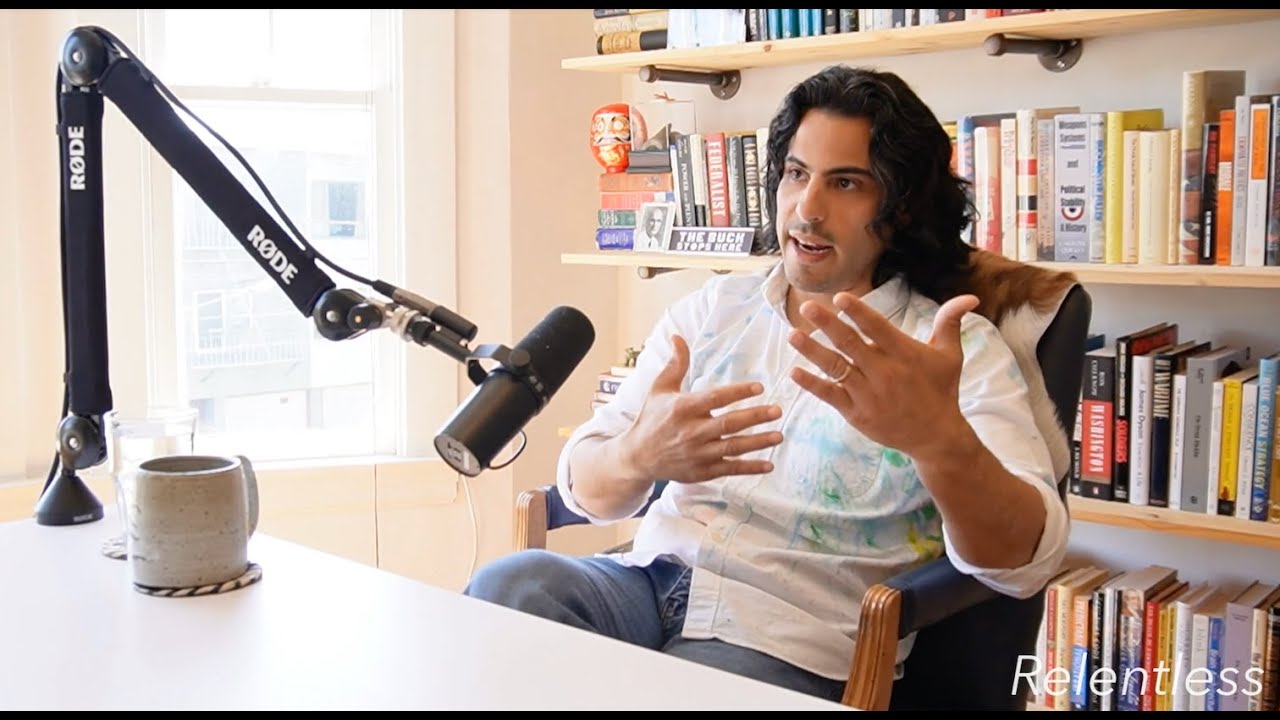
Andrew Arruda is a serial entrepreneur and angel investor who moved from Canada to the U.S. to build AI companies — first Ross Intelligence (AI for legal research, founded 2014) and now Flexa (healthcare data infrastructure, founded 2021). He is a YC alum, a former lawyer, and a deeply mission-driven founder who believes transformational change comes from small teams of people who genuinely want to be doing the work they’re doing.
Growing up: storytelling, hustle, and the internet
His parents immigrated from the Azores (a Portuguese island archipelago) to Toronto, where he grew up surrounded by a rich storytelling culture shaped by fishermen and seafarers.
His grandfather was a legendary fisherman who funded the family’s immigration through dangerous Arctic fishing expeditions — his stories of icebergs, narwhals, and trading with Inuit people instilled in Andrew the idea that doing hard things is where the best stories come from.
He was an entrepreneur from childhood: running a soda stand at local softball games (where he built rapport by remembering people’s favorite drinks), selling classmates’ notes as study aids (which also helped his own grades), and reselling Valentine’s Day cards and novelty gifts.
He got online extremely early (~1994–95) through a public library terminal, spending hours on pre-Google search engines (AltaVista, WebCrawler) and manually typing URLs like www.basebaseball.com — he describes it as “I just never got off.”
His parents wanted him to pursue a professional career (lawyer, doctor, engineer), which led him to law school — but he always intended to be an entrepreneur.
Law school and the leap into AI
He paid his way through undergrad and law school, growing up blue-collar (his father worked in an aluminum foundry, his mother at a bank).
Even as a first-year undergrad, he talked his way into a job at a neighborhood law firm by convincing the founder he’d work harder for less pay — he worked every role at the firm, from front desk to filing to supporting lawyers across practice areas, learning both law and how businesses actually run.
He chose law because he was obsessed with fairness and justice and saw law as “the board game rules of life” — ironically, his worst mark in law school was Business Organizations.
After graduating and working at a firm, a friend studying computer science told him about Jeff Hinton’s breakthrough work on deep learning in Toronto (2014). Andrew immediately saw the inevitability of AI given cloud compute and abundant digital data — he quit law, sold everything, bought a one-way ticket to the U.S., and never looked back.
Ross Intelligence: building AI for law before it was cool
He co-founded Ross Intelligence in 2014 with Jimo — a friend who had transferred to Toronto specifically to work with Hinton because he believed self-driving cars were already happening and wanted to be part of something earlier.
They were surrounded by the “Mount Rushmore of AI” — Hinton in Toronto, Sutton in Edmonton, Bengio in Montreal — all within a few hours of each other, a cluster of talent that had kept AI alive through its unfashionable years.
Their vision: an AI system that could answer legal questions, draft documents, and eventually represent individuals — ultimately democratizing access to legal services.
They got into YC in 2015, when Sam Altman was president — pitching AI to someone who actually understood it was a rare advantage at the time.
At YC, office hours with Paul Graham were pivotal: when Andrew described Westlaw as a monopoly, PG immediately identified it as a “duopoly” and tweeted it — showing the kind of clarity of thought Andrew deeply admires.
Ross grew 15–20% month-over-month with near-consumer-tech NPS scores — lawyers who had never loved software before were saying it felt like “going from a Model T to a Tesla.”
In 2020, Thomson Reuters sued Ross for copyright infringement, which forced the company to shut down. Andrew also filed an antitrust lawsuit against them. The loss was devastating — “like losing a child” — but investors, employees, and customers were supportive, and the experience reinforced his belief in the U.S. justice system and free markets.
A trial is coming up in August, and they’re waiting on the antitrust ruling. Success, for Andrew, means opening the law — making it forkable, buildable, and accessible to everyone, the way open-source code is.
Flexa: building the rails for healthcare data
Flexa was founded in 2021, originally as an AI company for the medical vertical — the idea was AI agents pre-drafting doctor’s notes and interpreting tests before a human MD reviewed them.
They quickly discovered the real problem: healthcare data is fragmented across systems with no central repository, no real APIs, and still shared via CD-ROM or printed hard copies — it’s like the banking system running on COBOL, except worse because at least COBOL is digital.
They pivoted to data infrastructure: Flexa lets patients sync their health insurance data into any application via APIs, using legislation that gave individuals on government health plans the right to access their own data.
The founding team — Andrew, Tom (employee #1 at Ross), and Josh (who built OAuth rails for financial data at Universe, sold to Ticketmaster) — have known each other for 15 years and bring complementary legal, AI, and authentication expertise.
Flexa is patient-directed: the individual chooses what data to share and with whom — whether it’s switching insurance plans, qualifying for a clinical trials, or reviewing medical billing (one user immediately found thousands of dollars in overbilling).
Andrew sees Flexa as having a multi-decade arc — like the iPod was to Nest, or Nvidia’s GPUs went from gaming to AI, Flexa will be the foundational data layer that unlocks every future wave of healthcare innovation (wearables, implantables, AI agents).
He thinks in 25–50 year time horizons: Flexa will be there for all the waves to come because every healthcare innovation will require data to flow first.
On co-founders and hiring
Co-founders are like a marriage — you want complementary skill sets (especially where each person is weakest) and you need to know them for a long time before founding together.
His key values at Ross were “grab a shovel” (do the hard work); at Flexa, it’s “put away the shopping cart” (do the unglamorous but necessary thing).
When hiring, he looks for people who are already doing the thing they want to do but don’t have a place to do it with others — not people who are casually interested or just think it’s “cool.”
He tells candidates in interviews: “We’re here for the rest of our lives — do you want to work at a company that transforms an industry over the next 25–50 years?”
He’s moved away from only hiring founders — instead seeking people who want to join early, after some things are figured out, and who are missionaries (driven by mission) rather than mercenaries.
He believes the startup world over-celebrates individual founders and under-celebrates founding teams — pointing to Xerox PARC as an example where the team (Engelbart, Ted Nelson, etc.) invented the mouse, hyperlinking, GUIs, and remote collaboration.
On angel investing
He’s made 50+ angel investments, mostly personal checks of $5K–$25K through AngelList and scouting.
He makes most decisions after one meeting (often within 15 minutes) — he believes as an angel you shouldn’t waste a founder’s time.
He looks for founders who will build regardless of circumstances — “this person will do it for bread money” — and who are building a future he wants his children to live in.
He learned the hard way to back the founder, not the idea: he once loved a founder but not their initial space, passed on the original idea, and had to invest at double the valuation after they pivoted into something he loved.
Angel investing has been his best education — it’s like playing poker while watching dozens of other founders play their poker games simultaneously, learning from all of them.
On designing products people love
It starts with respecting your users — if you respect them, you’ll design something high-quality, and they’ll feel it.
Early on, don’t let the pursuit of beauty prevent you from shipping — Ross at the beginning wasn’t great, but users loved seeing rapid iteration in response to their feedback.
In law especially, no software had ever iterated before — lawyers were used to “fully baked” products that never changed, so showing them weekly improvements was a revelation.
“Beauty for beauty sake” is different from a beautifully designed product — users care about function first, then beauty.
He admires Tony Fadell (iPod, Nest) as a design role model — the iPod combined multiple existing transformational innovations (miniaturized compute, battery life, digital music) into one beautiful product, and that’s how he thinks about Flexa’s role in future healthcare innovation.
On the hardest thing he’s overcome
School was his biggest challenge — he was self-taught and hated the pace, the structure, and being grouped with people (including teachers) who didn’t want to be there.
He was frustrated by the performative nature of schooling — being tested on things that didn’t feel tied to reality.
He persevered because he knew the credential (especially law) would give him credibility, and he’s glad he did — but it was a slog every day.
He sees AI as eventually solving this: a future where humans get to spend their time on exactly what they want to do, which he calls a “true Renaissance for humanity.”
What excites him most
Watching his two sons grow up and spending time with his wife — family is the most important thing.
He’s passionate about having more kids and fighting depopulation — “humans solve problems, and the best way to solve future problems is having more humans working with machines.”
Watching healthcare modernize into a truly digital system (not just analog with a screen on top).
Watching AI democratize access to essential services — law, health, education — and seeing “open law” become a reality.
He feels like he’s participating in and watching “the greatest of all time” — the transformation of every industry through technology.