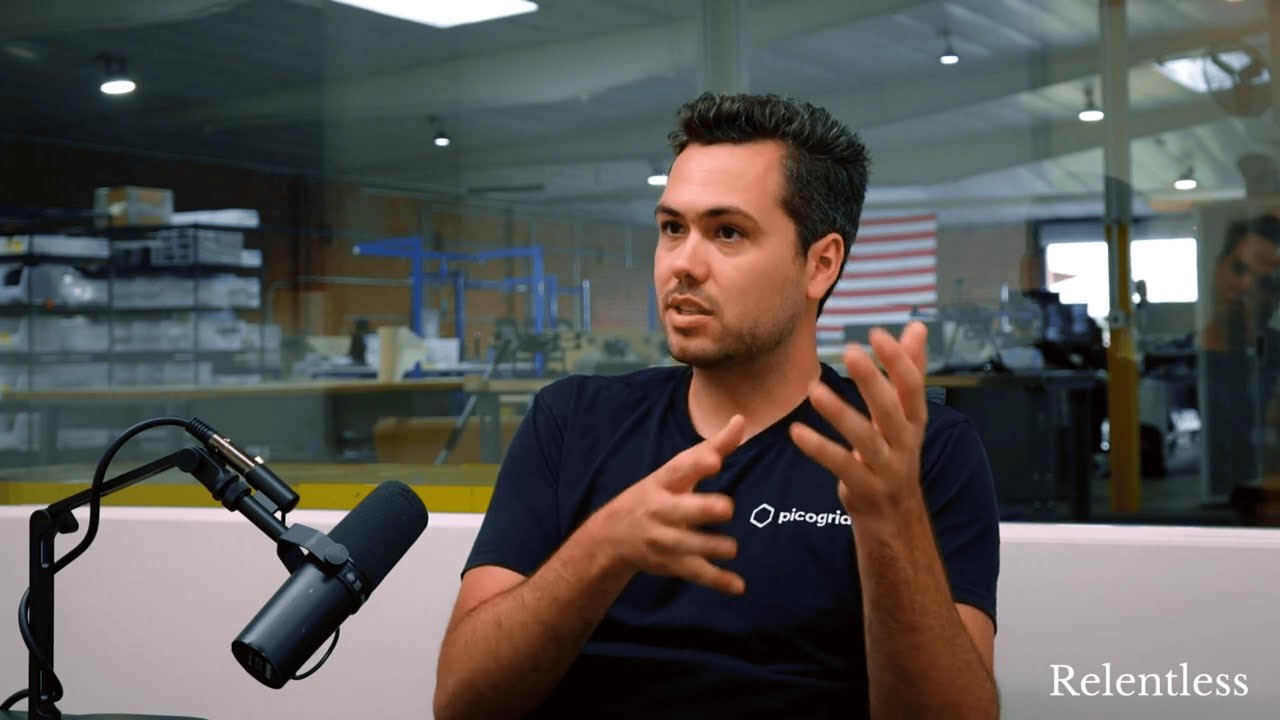
Picogrid, a defense technology startup, builds hardware and software to integrate disparate military systems — sensors, drones, robots, cameras, and even satellites — into a unified operational network. Co-founder and CEO Zane Mountcastle discusses how the company has grown over the past year, the shifting defense landscape catalyzed by the war in Ukraine, and the challenges of scaling a hard-tech business in a relationship-driven, slow-moving government market.
Picogrid’s growth and current state
The company moved into a 25,000-square-foot facility in El Segundo, California, about two miles from its previous location, after outgrowing the old space where production was literally happening on the sidewalk.
The team has grown to about 30 people, up from a small founding team that stayed lean for roughly 9–12 months by necessity because they couldn’t raise funding.
Much of the past year’s work has involved supporting sensitive US military missions, which limits what Mountcastle can say publicly. The focus has shifted from counting units deployed to measuring mission impact.
The company is beginning to work with the intelligence community, expanding beyond the Department of Defense into even more classified mission sets.
How the war in Ukraine reshaped US defense thinking
Before Russia’s invasion of Ukraine, drones were used on a very small scale in conflict. Ukraine essentially invented a new way of war — using cheap, commercially derived drones as everyday munitions to destroy expensive equipment like tanks.
This demonstrated that future conflicts will look fundamentally different from the wars in Iraq and Afghanistan. A potential conflict in the Pacific, for example, would rely heavily on distributed, networked, low-cost systems rather than large legacy platforms.
The US military recognized it would not be ready for this kind of conflict today. This realization has become broadly accepted in the Pentagon and is driving urgency to modernize.
The shift has catalyzed real change in how the DoD approaches procurement: new companies are being taken seriously, billions of dollars in venture capital are flowing into defense tech, and there is genuine demand to buy, deploy, train with, and build tactics around new technologies.
Why Picogrid took the “chew glass” path
Rather than becoming a subcontractor or subsidiary to a large prime contractor (Lockheed, Raytheon, etc.), Picogrid chose to sell directly to the government — a path Mountcastle describes as the “chew glass approach.”
Large primes are trusted by contracting officers because they are safe bets: they are expensive, slow, and less cutting-edge, but they get the job done. For decades, the DoD shifted toward these incumbents and away from smaller, newer players.
Mountcastle’s early experience working with the Army Corps and Navy right out of college showed him that the standard advice — go work through a small business program at a prime — would limit the company’s ability to control its own trajectory.
Raising money for this approach was extremely difficult. Many VC firms had LP agreement clauses prohibiting defense investments. Others carried a “war is over” mentality rooted in the drawn-out conflicts in Iraq and Afghanistan, which made defense tech feel uninspiring and morally fraught.
That resistance has quieted significantly since Ukraine, as the capital community recognized both the market opportunity and the genuine national security need.
How Picogrid builds trust and gets its first contracts
The company’s first contract came from relationships Mountcastle had built working with specific military units right out of college on early autonomous systems programs. It was small and not profitable, but it served as a foot in the door.
The defense community is small and relationship-driven. People move between installations and bring trusted contacts with them, creating a network effect for companies that prove themselves.
Building trust requires demonstrating technology in real operational environments, being honest about limitations, and bringing customers into the product roadmap — something Mountcastle says very few companies do.
The bar for demos is much higher in defense than in commercial tech. In Silicon Valley, a failed demo is almost expected; in defense, it can permanently damage a relationship. The technology needs to work reliably because users need to depend on it on their worst day.
Mountcastle looks for people inside the military who see their job as genuinely supporting the warfighter — people who stay late, push for better solutions, and are willing to put their reputation behind new technology.
Scaling challenges and the importance of hiring
Scaling a hardware-and-software defense company is “perennially hard.” Mountcastle says the human brain is bad at understanding exponential growth, and the organization must reinvent itself every few months.
The single biggest lesson from the past year: underestimating the importance of hiring truly exceptional people. It is not just about technical skill — it is about people who think like founders, identify bottlenecks before they become crises, and operate with high agency without micromanagement.
Former founders are especially valuable because they have “chewed glass” — they have failed, learned hard lessons, and developed the ability to cut through noise and act decisively. This is nearly impossible to train.
Hiring mistakes are costly, especially at the senior level. Mountcastle hired a very senior, experienced leader at the end of last year who looked perfect on paper but could not adapt to the company’s culture and pace. The person needed a team around them to be effective, but no team existed yet. The hire didn’t work out.
Mountcastle has learned to trust his gut faster when someone isn’t fitting, rather than giving too many chances.
How Picogrid filters for high-agency candidates
For one role, the company didn’t respond to any candidate who didn’t reach out directly to the CEO outside the formal application process — a deliberate filter for agency.
Mountcastle conducts short 15-minute intro calls for nearly every hire and can quickly assess whether someone genuinely cares. He drills deeply into projects candidates describe, asking “what specifically did you do?” repeatedly to distinguish real contributors from people taking credit.
Candidates who light up when discussing obscure technical problems they solved are the ones who truly care. Those who did things “because they were told to” or “because it was hard” are not the right fit.
Former military hires are especially valued because they understand the multi-level implications of decisions in ways that outsiders often don’t.
Product strategy and customer closeness
Picogrid’s product decisions come from being extremely close to end users — going to army bases, talking to operators on the ground, and listening to what they struggle with.
Key areas of focus include drone swarming, counter-swarming, and electronic warfare at the backpack scale (as opposed to the massive, vehicle-mounted systems of the past).
Many military personnel understand abstractly that they need these capabilities but don’t know what it means to operate them day-to-day. Picogrid’s job is to make that practical — simpler software interfaces, clearer hardware, and training-ready systems.
The company builds multiple hardware products to serve different missions, which creates manufacturing complexity. The old facility couldn’t handle the tear-down and set-up required for high-mix production, causing delivery delays that directly constrained revenue growth. This was the forcing function for the move to the new factory.
Financial philosophy and business model discipline
Mountcastle’s business philosophy traces advice from his grandfather: “Got more money coming in than going out.” He is deeply skeptical of the venture-backed pattern of selling dollars for 90 cents to show revenue growth.
He believes many defense tech companies scale too quickly without a sustainable business model, and that raising venture capital is a tool to scale a proven business — not a substitute for one.
Picogrid stayed lean for 9–12 months because it had to. This forced discipline around cash flow and made the company stronger.
The new 25,000-square-foot factory was chosen carefully: it had to be in El Segundo, reasonably priced per square foot, and feel right for the company’s culture. Mountcastle expects it to be outgrown in roughly 12–18 months if growth continues on its current trajectory.
What keeps Mountcastle up at night
The constant tension between spreading resources too thin and concentrating on the right opportunities. Defense sales cycles are long — often multi-year — and require intensive relationship management.
His primary job is identifying and putting out fires before they become existential. Ironically, he is most anxious when everything seems fine, because he knows problems are smoldering somewhere.
The other major focus is growth: seeing around corners, anticipating bottlenecks three months before they hit, and hiring ahead of the curve.
Senior hires are expensive and often need teams around them to be effective, so the timing of organizational expansion is a constant balancing act.
What excites him most about the next 6–12 months
Supporting some of the most critical US military missions, even if the details can’t be shared publicly.
The cultural shift within the military — particularly the Army, which has historically been the most conservative branch — now actively seeking modernization and new technologies.
Being ahead of that curve positions Picogrid to capture opportunities that are just opening up, helping military units meet needs they know they have but don’t yet have good solutions for.
Ultimately, what excites him most is driving real missions forward and adapting the product to help operators succeed.