-
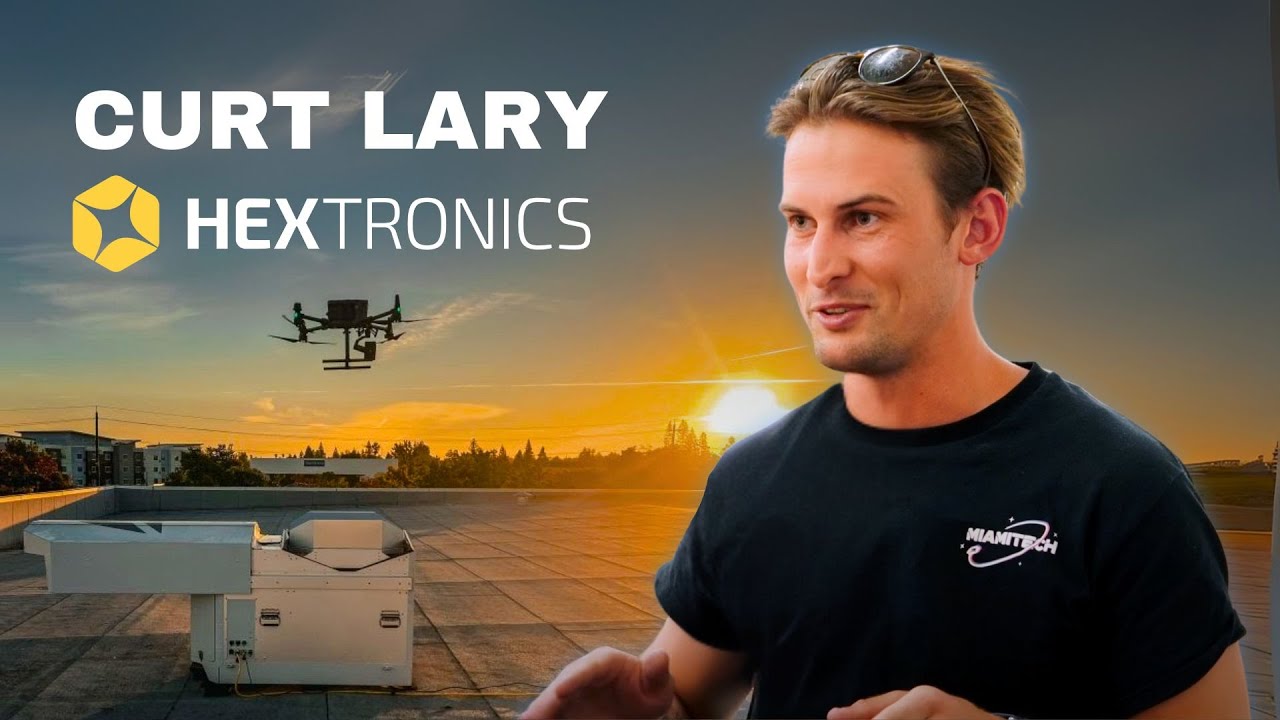
Hextronics is scaling fast: from garage startup to global drone station manufacturer
- Curt Lary, founder and CEO of Hextronics, discusses the company’s rapid growth over the past year — from 28 to over 45 employees, doubling factory space by literally smashing through a wall, and scaling production of their two main products: the Universal and Atlas drone stations. These are automated “drone-in-a-box” systems that land, swap batteries, and relaunch drones without human intervention, enabling continuous autonomous operations for industries like oil and gas, railways, public safety, and government.
- The company has moved well beyond proof-of-concept: businesses, governments, police departments, and countries now rely on Hextronics stations daily, with hundreds of thousands of battery swap cycles logged across deployed units worldwide.
-
Customer-driven product evolution: from Global to Universal to Atlas
- Hextronics started with the Global, their first drone station, built in Curt’s garage. Product development has been almost entirely customer-driven: a customer asked them to adapt the Global for a bigger drone (leading to the Atlas), and another asked them to support multiple drone types (leading to the Universal).
- Curt describes the daily tension between optimizing existing products (adding more “nines” to 99.999% reliability) versus inventing something entirely new. He sees it as a spiral — each product teaches lessons that feed the next — and argues you must do both simultaneously.
- Deciding when to build a new product often starts with a single customer asking for one or two units, not a thousand-unit order. The government of Croatia, for instance, has expressed interest in a thousand stations, but Curt’s philosophy is they need to start with one.
-
Reliability is built through field experience, not just design
- Achieving consistent reliability requires designing for quality, tracking manufacturing procedures so every unit is identical, and — critically — learning from how products fail in the field under real-world conditions.
- Components that meet spec in testing sometimes fail under sustained real-world use. Hextronics uses field data from tens of thousands of cycles to identify weak points and feed them back into engineering. They’ve now passed half a million total swap cycles across their fleet.
- Curt personally embodies the commitment to reliability: in the early days, he pulled an alternator nearly every week to fund hardware builds, and he still operates on a “mini sprint” sleep schedule (bed at 2–2:30 a.m., up at 7:30 a.m.), keeping a couch in his office.
-
Hex Ops: the rapid-response team that parachutes in to fix anything
- Hextronics maintains a dedicated field operations team called Hex Ops that will fly anywhere in the world — on Sundays, at midnight — to fix a station if something breaks. Customers are sometimes stunned by the speed (“Dude, it’s Sunday at 9 a.m., I called you last night”).
- The team is composed of people who built the original products and understand every way they can fail. One member is Curt’s best friend since age two, Dylan. Another, Tito, was the best at assembling the Global’s hardest-to-reach components and now troubleshoots globally.
- Notable field stories:
- Italy: While deploying stations along a major roadway (Autostrada) with a partner who had been flying their first-generation Global ten times a day for a year, Curt diagnosed a loose crimp on a motor wire. Without proper tools, he stripped the wires with his teeth, reconnected the connector, and secured it with super glue. The customer bought three more units on the spot.
- Saudi Arabia: Curt shipped a disassembled drone station in multiple checked bags (paying $500 in baggage fees). TSA damaged some parts, and upon assembly, an HVAC copper pipe was fractured. He found an HVAC repair shack in the middle of nowhere, where the local technicians brazed the pipe using a vacuum pump plugged directly into a wall socket with exposed wires (“no OSHA here”). The repaired system achieved a 50°F temperature differential in the desert — 110–120°F outside, 70°F inside the box.
-
Supply chain and scaling challenges
- Scaling hardware production involves navigating complex supplier relationships, fluctuating tariffs, and geopolitical uncertainty. When tariffs hit mid-production run, Hextronics scrambled to lock in prices and has been strategically shifting toward US-made components.
- They maintain a supply stash in the Dominican Republic as a buffer. Curt describes supply chain management as “another dimension or level” of hardware manufacturing on top of the already difficult task of building reliable electromechanical systems.
- The biggest growing pains come from customers using the technology in unanticipated ways — most notably, repeatedly asking to mount drone stations on boats. Hextronics has had to physically simulate boat conditions (two people shaking a Universal in the parking lot while a drone lands) to test feasibility.
-
Hiring for drive and dedication in Miami
- Hextronics looks for people who want to “blast through walls” — those with relentless focus and dedication who aren’t going to leave early. Curt leads by example, and he says new hires quickly see the level of commitment expected.
- Being in Miami is both a blessing and a curse: the city lacks the density of tech hubs like SF or Austin, but that seclusion helps the team hunker down and focus. People who come to Hextronics in Miami are there to build Hextronics, not for the scene.
- The company culture includes beach volleyball on Sundays and a strong sense of community. They recently hired what Curt calls a “10x’er” — someone whose capabilities dramatically exceed the role — and are ramping up hiring strategically around product development, manufacturing, and certification work.
-
Building toward a real-time map of the world
- Curt’s ultimate vision is a constantly updated, real-time map of the world fed by autonomous drones — a concept Hextronics previously pitched as the “Miami verse.” The idea is that anyone could see what’s happening anywhere: construction progress, ecological studies, city repairs (like 400 potholes fixed last week), events, and infrastructure monitoring.
- Battery swapping is central to this vision because “birds don’t make money on the ground” — drones need to fly as much as possible, and automatic recharging is what enables persistent autonomous operations.
- The path from today’s stations (which are essentially smart landing pads with battery swapping) to a full fleet with drones involves deeper partnerships with drone manufacturers. Hextronics is launching a new SKU of the Universal at the Paris expo that works with a Blue UAS-compliant drone made by Parrot — the first portable, Blue UAS battery-swapping drone-in-a-box station with significant payload capacity, targeted at public safety and industrial users in the US.
-
Changing how people think about drones
- Curt wants to shift public perception of drones from fear (spying, warfare, emergencies) to excitement and utility (deliveries, construction updates, community events). The key is making drone technology accessible and visible to ordinary people — a 16-year-old ordering a burrito delivery, a construction worker seeing the building plan for their site.
- Hextronics is coordinating a large drone light show for the Fourth of July in Coconut Grove, Miami, synchronized with the Miami Symphony Orchestra. Curt is handling logistics, safety, flight paths, and city approvals. The goal is to make drone technology feel fun and present, and to open doors for more city partnerships.
-
Regulatory landscape and the mechanics of scaling
- Curt is thinking carefully about how airspace regulation will evolve over the next three years, particularly around Part 107 and beyond-visual-line-of-sight (BVLOS) rules. Rather than lobbying, Hextronics focuses on building the mechanical and software systems that can comply with whatever rules emerge — in a documented, automated, and public way.
- He notes that the FAA doesn’t have radar everywhere, so enforcement is limited, but for the industry to truly scale, compliance mechanisms need to be built into the technology itself.
-
What’s next: new product launch, software, and scaling
- A new Universal SKU launches the following week at the Paris expo, paired with a new Parrot drone — a significant milestone as the first Blue UAS portable battery-swapping station.
- Hextronics is developing software that lets users pilot a deployed drone from anywhere in the world via their phone — “Where does Hextronics have a drone station? I want to go fly it.”
- The company is also focused on manufacturing documentation, higher-level approvals, and figuring out what certifications drone stations may need as the regulatory environment matures.
- Curt spends roughly 60% of his time on product, 30% on customers, and the rest on logistics and team management. The critical path for the next 6–12 months centers on launching the new SKU, continuing to add reliability “nines,” and scaling the team and manufacturing to meet growing global demand.