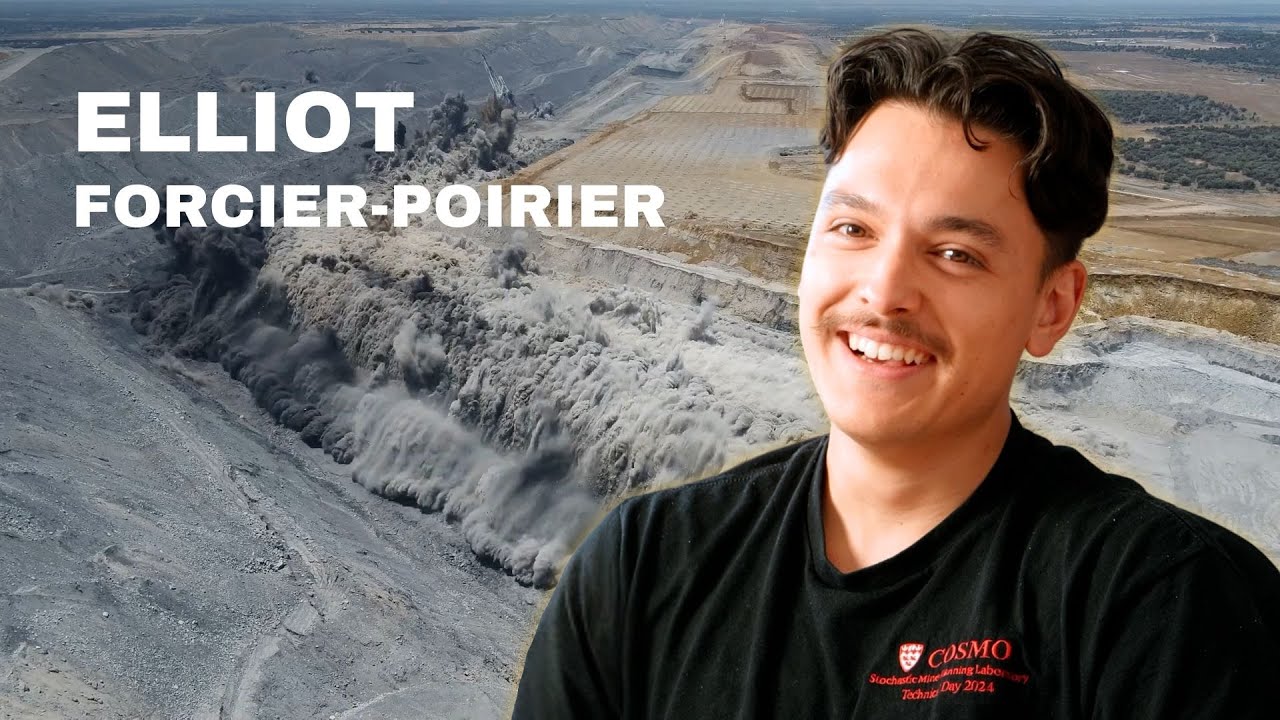
Watoga is building an AI operating system for the mining industry, starting with drill-and-blast optimization and grade control. Co-founded by Elliot F. Poirier (math background, CEO) and Sam (mining engineer), the company is based in Montreal to be close to customers, talent, and mining engineering expertise. Their first product, Rockhound, automates blast planning and simulation, helping mines avoid costly mistakes in one of the most critical and irreversible steps in mining.
How Elliot got into mining
As a kid, Elliot loved automation in games like Minecraft, where he built systems to route minerals to processing units.
He initially pursued politics and economics, even campaigning for the Liberal Party in Canada, but gradually shifted toward math, engineering, and company building.
A turning point came when a friend in consulting told him the mining industry was facing a massive wave of retirements—by 2030, 30% of mining engineers in the US would be retiring—and that young people were avoiding the sector.
He began auditing graduate-level mining engineering classes at McGill (which has one of the top mining programs in the world), fell in love with the field, and did research in mine planning optimization with Professor Aleandro Navara, who became an advisor to Watoga.
Why mining is strategically important
Critical minerals like copper, nickel, and lithium are overwhelmingly processed in China, creating supply chain vulnerability for Western countries.
Even if defense manufacturers are built domestically, without secure access to raw materials, those capabilities are at risk.
Mining is also a natural fit for Elliot’s interests: it combines statistics, optimization, and industrial-scale automation in a high-stakes environment.
The problem with current mining software
Mining operations rely on fragmented, outdated legacy software with poor integration across departments.
Engineers often use 10+ different tools in a single workflow, requiring heavy manual data entry under tight time constraints.
Models for predicting rock fragmentation and movement are often empirical and require extensive calibration.
Departments like drill-and-blast, geology, and milling are siloed, even though optimizing one (e.g., blasting) can reduce costs in another (e.g., milling) by up to 10x.
What Watoga’s first product does
Rockhound automates drill-and-blast planning by generating multiple blast scenarios with forecasted performance, reducing the need for manual analysis.
It integrates with existing mine data and OEM systems to build a digital twin that dynamically updates predictions.
The software handles ~90% of the work, but a human engineer still reviews and approves the final plan for safety and liability reasons.
A bad blast is irreversible: it leaves behind a massive pile of poorly fragmented rock (a typical bench is 10–15 meters high and 60–100 meters long), which is expensive to move and process.
Why drill-and-blast is the right starting point
It’s a discrete, high-impact step—mines are essentially built one blast at a time.
Mistakes are costly and permanent, so even small improvements have large financial effects.
Sam’s expertise in drill-and-blast (he placed second in a major North America-wide competition) made it a natural fit for the founding team.
Long-term vision: from software to services to asset ownership
Watoga plans to move beyond SaaS into offering full drill-and-blast execution services using their own software.
Eventually, they may take ownership of mining assets, following the pattern of other successful mining startups that capture more value through services or ownership.
They also plan to develop automated surveying using drones equipped with probes that drop into drill holes, providing higher-resolution data than current methods.
Why they’re based in Montreal
Proximity to major mining company headquarters (e.g., a nickel mine operator is in the same building).
Access to top-tier ML research and mining engineering talent from McGill and other local universities.
Government grants and support for startups are stronger in Quebec than in the US.
The main downside is a more relaxed local work ethic, so they seek team members with mining industry experience who are used to intense, disciplined work environments.
Building relationships in a risk-averse industry
Early outreach was brutal: Elliot cold-emailed entire departments (e.g., Jonathan Peek’s team at Caterpillar) until someone responded.
They used McGill school emails to bypass corporate firewalls, which led to one company (Alamos Gold) emailing the university to ask them to stop.
Conferences and warm intros are now more effective than cold outreach, especially after raising funds, which gave them credibility.
Going through Discipulus
Watoga joined the second cohort of Discipulus (a residency/accelerator in El Segundo) after being recommended by Ted from Duran.
The experience was transformative: the cohort was highly mission-aligned, and Jacob (the founder) helped them set up a successful fundraise with strong inbound interest.
Speakers like Isaiah Smith emphasized the urgency of modernizing Western mining to maintain supply chain resilience and strategic independence.
Finding talent in Quebec
While Quebec’s general work ethic is more relaxed, the mining industry has a culture of intense discipline (e.g., 84-hour work weeks on-site).
Watoga recruits people with mining industry exposure who thrive in high-ownership, fast-paced environments.
They benefit from being one of the few mining tech startups in the region, attracting outliers who want meaningful work without moving to the US.
Personal challenges and motivation
Elliot struggled with depression and bipolar disorder in his late teens and early twenties, including suicidal ideation.
He credits discipline (regular sleep, exercise, routine) and working on something he genuinely cares about as key to managing his mental health.
He also felt pressure to prove himself, especially in the shadow of his older brother, a successful entrepreneur, which drove him to pursue his own path in mining.
Next 6–12 months
Finalize and launch the first version of Rockhound within 1–1.5 months.
Complete a case study with a mining site to benchmark performance and prove the software’s value.
Develop the automated surveying product using drones and probes to collect high-resolution data from drill holes.
Convert warm leads into paying customers once the first successful case study is published, since most mines prefer to be “first to go second.”