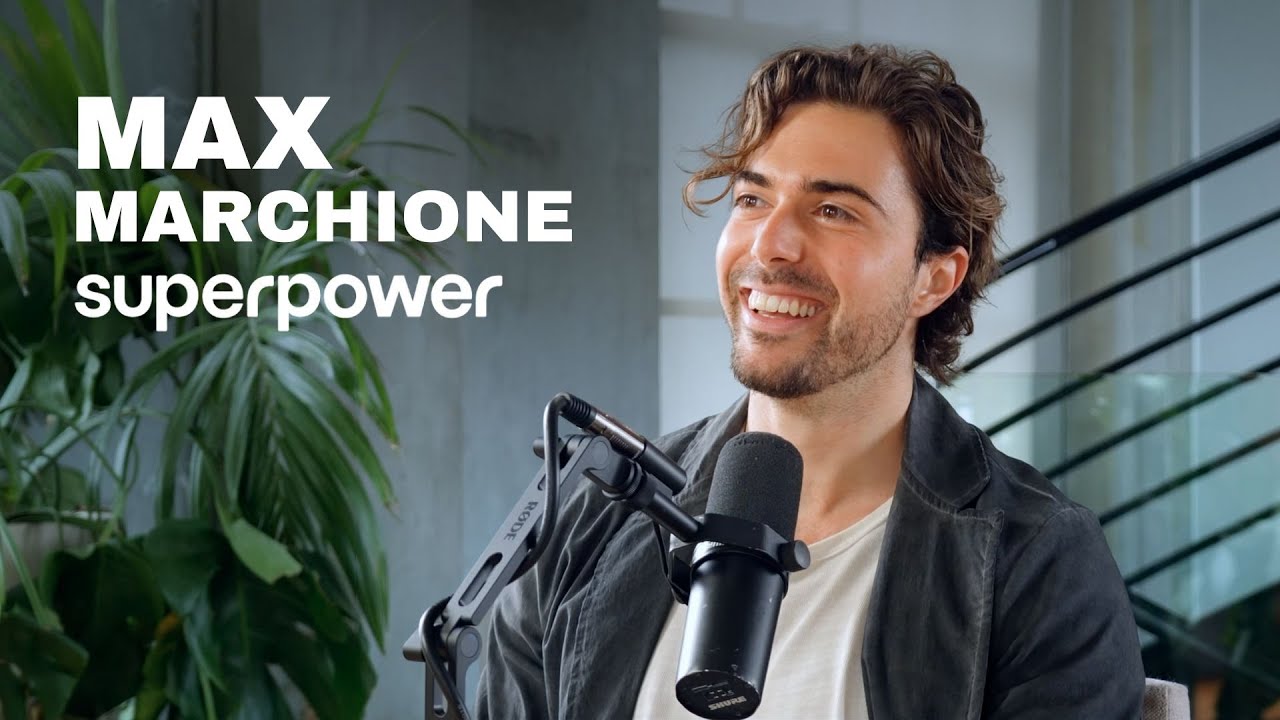
- Max Marchione is the co-founder of Superpower, a company building an AI-driven healthcare platform that combines blood testing, wearable data, wearables, and continuous monitoring to create personalized health protocols — with the long-term vision of building an “AI doctor” that outperforms human physicians.
- He is a serial entrepreneur who started businesses as a child, took a learning gap year at 18 instead of attending university, and moved to the US at 22 to build Superpower.
- The conversation covers his personal health optimization routines, his philosophy on experimentation, how he thinks about building a $100 billion company, and the structural problems in the US healthcare system.
Personal Health Optimization
-
Max follows a highly individualized daily health routine centered on subjective feel, first principles reasoning, and targeted supplementation.
- He wakes up around 9 a.m., jumps out of bed for an instant energy boost, scrapes his tongue, does oil pulling with coconut oil for oral hygiene, and drinks green tea brewed at 64°C for about 50mg of caffeine.
- He takes a carefully chosen multivitamin brand that uses high-quality forms of each vitamin, proper dosing (e.g., 3,000 IU vitamin D), and all three necessary forms of vitamin K (K1, K2 MK-7, K2 MK-4) for absorption — a combination he says no other brand gets right.
- He delays eating until around 3–4 p.m., when he makes a large smoothie with 60g protein (goat whey, plant protein, and collagen for a balanced amino acid profile), 30g fiber including resistant starch from green banana flour, colostrum, glutamine, and high-polyphenol cacao.
- His sleep stack includes theanine (200mg), glycine (3g), inositol (100mg), and magnesium (600mg), with optional additions of pharmagaba, low-dose melatonin (~1mg), and L-tryptophan when he needs help falling asleep — he deliberately avoids high-dose melatonin because he finds it disrupts his sleep and may suppress natural production.
-
He uses targeted nootropics situationally: nicotine or alpha GPC for deep focus, L-tyrosine for verbal fluency before podcasts.
- He describes a “pro-autism stack” (nicotine plus a cholinergic like alpha GPC) for intense focus and an “anti-autism stack” (GABA or serotonin boosters like pharmagaba, theanine, or psychedelics) for relaxation.
Injections and Experimental Compounds
- Max and his team inject each other every Friday with research compounds they believe enhance human potential.
- Thymosin alpha-1: Used at the first sign of illness; Max reports it eliminated his worst sore throat within 36 hours, with a brief period of heavy excretion at 24 hours. Used in Russia, China, and Italy but only for research purposes in the US.
- NAD+: Used for cellular energy and longevity; injected subcutaneously.
- Retatrutide: A triple agonist (GLP-1, GIP, and glucagon receptors) that improves insulin sensitivity, carb metabolism, and resting calorie burn with reportedly fewer side effects than similar compounds.
- Max’s philosophy is that before clinical data exists, anecdote and empirical evidence are valid first steps in the scientific method — but he emphasizes subjective assessment alongside data, criticizing Brian Johnson’s purely data-driven approach as flawed because the human body cannot yet be fully measured.
Living in the Future
- Max has a pattern of adopting practices years before they become mainstream: the Oura ring at 16, blue-light blocking glasses, mouth tape, CGMs, and now peptides and experimental compounds.
- He believes most things he does that people call “crazy” become mainstream within a few years.
The AI Doctor and Superpower’s Vision
- Superpower aims to build an AI doctor by combining three types of data that no single company currently has:
- Multiomic data: Genome, blood biomarkers, proteomics, metabolomics — collected repeatedly over time.
- Longitudinal clinical data: What actually happens to a person’s health over time (the “label” on the omic data).
- Continuous wearable and environmental data: From wearables, phone sensors (typing speed, facial scans), and environmental sensors — enabling continuous rather than episodic prediction.
- The company that tried something similar, Forward, burned $400 million because healthcare infrastructure and APIs didn’t exist. Superpower can now build a comparable system in a year with $10 million because the infrastructure has been modularized.
- Enabling trends: falling cost of biological assays, rising wearable adoption, language models that can connect disparate data points, and growing consumer willingness to pay for health optimization.
Superpower’s Business Model
- Superpower offers a $499/year membership that includes:
- 100+ blood markers (that would cost ~$2,000 in a hospital), all medical records in one place, AI-driven recommendations, 24/7 medical team access, primary care, urgent care, prescriptions, referrals, care navigation, a personalized protocol, and an ecosystem with 20% off supplements, pharmaceuticals, and diagnostics.
- The company deliberately priced at $499 to create a forcing function against hiring humans in the loop and to build technology instead — they believe pricing at $5,000 or $10,000 would trap them in a local optima of concierge medicine that can’t scale.
- If just 10% of people owned the membership and routed 10% of their health spending through Superpower’s ecosystem, it would be a $200 billion company.
- The long-term vision is a platform that enhances human capability (not just prevents disease), which then creates derivative impact as enhanced people do more things.
Thinking in Exponentials
- Max believes most things in the world follow convex (exponential) distributions: 9/10 is 10x better than 8/10, and most things in the world sit at about 4/10.
- This applies to talent, brand, sales, and company outcomes. The implication is that you should obsess over getting to 6/10 or 7/10 because the returns are exponentially distributed, and you should copy nothing that already exists because the best of what exists is only 4/10.
- He applies this to hiring: talent is exponentially distributed, so there are only a few hundred or thousand people in the world who are truly exceptional, and you should be willing to overpay dramatically for them. He would give 5% equity to the right person at Series A/B.
Two Types of People to Hire
- Best or second best in the world at solving a specific business function.
- “Spiky” young people (typically 19–21) with 3–4 sigma work ethic, IQ, and creativity who have already done extraordinary things in idiosyncratic ways — they will eventually exceed the first category and start their own billion-dollar companies.
- Max’s team includes 15 former founders, six of them former YC founders, more than half with reasonable exits.
- He practices “radical empowerment” — giving young people far more responsibility than they ostensibly deserve because they grow into it extremely fast.
Hiring and Sales
- Max can identify talent within 10 minutes; every subsequent interview is a sales process.
- He deeply understands what a candidate wants and constructs an interview process that shows how Superpower can genuinely give them what they want — he believes in making Superpower the selfish best option for the person, not manipulating them.
- He uses two sales approaches: subtle vision-planting (anchoring a huge vision with minimal words, like Elon Musk) and hardcore transparent selling (“I’m going to sell you until you join”).
- He is generous with equity because he believes talent is exponentially distributed and the world is anchored to linear compensation thinking.
Brand
- Max believes brand is fundamentally a set of beliefs — everything else (name, colors, language, website) is just expression of those beliefs.
- Superpower started with a manifesto before anything else. He sees religion as an analogy: core beliefs are the foundation, and everything builds on top.
- People chronically underinvest in brand. Early Superpower branding was designed more for talent and capital acquisition than customer acquisition — it was distinctive and cool, which attracted the right people.
Intuition and Decision-Making
- Max believes intuition is access to experience stored in the subconscious and that top performers (George Soros, Masayoshi Son) rely heavily on it.
- He trains his intuition by: seeing and learning obsessively (he took a gap year at 18 attending conferences with 45-year-olds), being aware of what comes up in his body when evaluating things, and tracking where his intuition has been correct over time.
- He has high “believability weight” on talent decisions (he’s made many contrarian calls that proved correct) but low believability weight on things like Facebook ads, where he defers to teammates.
- He is wary of retroactively justifying decisions with logic when the real reason is intuitive — he’ll say “vibes” to stay honest about this.
Masayoshi Son and Dreaming Big
- Max admires Masa Son because he is one of the only people who dreams big enough — at 65, Masa said he fears he’s wasted every year and hasn’t dreamed big enough yet.
- When raising his $100 billion fund, Masa decided mid-flight to ask for $100 billion instead of $15 billion, and in the meeting asked for $45 billion — 4x his original plan — because “you don’t get what you don’t ask for.”
- Max applies this thinking with three frames: (1) What has to be true to be a $100 billion company in ~10 years? (2) How do we be a $1 billion company in 3 years? (3) How do we get to $10 million revenue in 1 year?
Company Building Philosophy
- Max simultaneously holds two seemingly contradictory views: strong empiricism (ignore reasons, look at what the data says) and first principles reasoning (question all dogma, reason from fundamentals).
- He works backward from an ambitious end state while staying consensus and market-driven in the short term — the long-term view requires strong opinions about how markets evolve, while the short-term view says focus on what works today.
- He believes in taking action to create information rather than overthinking — start executing and modify based on what you learn.
Nicotine
- Max is pro-nicotine as a nootropic: it’s one of the most effective compounds for increasing focus and IQ, very safe at low doses, well-studied, and potentially neuroprotective.
- He was anti-nicotine until he actually researched it himself, illustrating his broader point about not accepting conventional wisdom without investigation.
- He recommends gwern.net’s nicotine article for a comprehensive research summary.
Alcohol
- Max believes red wine and small amounts of alcohol have been overly demonized.
- Empirically, low alcohol consumption shows no negative correlation with lifespan, and blue zones all include small amounts of alcohol. Mechanistically, arguments against a half-glass of red wine are weak, and for every negative mechanism there’s a counterargument (antioxidant, stress reduction, social, antiviral).
- He personally drinks small amounts when it brings him joy but never excessively.
- He also sees a potential case for getting intentionally drunk once a month: it can reduce fear by showing you what having no inhibitions feels like, and that state can be accessed even when sober — effectively a superpower for taking action. He frames this as a game-optimal move: if lowering fear and increasing creativity helps you build something great and make more money, and deep biotech (which requires money) is what actually extends lifespan, then moderate alcohol consumption could indirectly increase lifespan.
Positive Mental Attitude (PMA)
- When Max asked one of the world’s leading cancer doctors what the number one thing to prevent cancer is, she said “positive mental attitude.”
- He believes the subjective can modify the objective — what we believe and how we choose to feel has a measurable impact on biology. He practices choosing to feel good regardless of circumstances, not because his environment is perfect, but because happiness and stress levels are malleable.
- He dislikes the question “how are you?” because it assumes your state is determined by the world; he believes the only valid answer is “really good” because you’re choosing to be.
US Healthcare Incentives
- The US spends 20% of GDP on healthcare with declining life expectancy, while OECD countries spend 7–10% with rising life expectancy.
- Under the Affordable Care Act, health system margins are fixed, so the only way to increase revenue is to increase costs — leading to excessive procedures and pharmaceuticals.
- Pharmaceutical companies are among the largest political donors, ensuring pharmaceuticals remain pervasive.
- Peptides like thymosin alpha-1 have existed for 10–20 years but can’t be patented because they’re naturally occurring, so pharma has no incentive to fund FDA approval. Pharma instead slightly modifies molecules (like semaglutide/Ozempic) to patent them — the original GLP-1 has existed since the 1990s but only became a blockbuster when it could be patented.
- The system is structured around kickbacks that aren’t called kickbacks.
Reducing Sleep to 5 Hours
- Max’s goal is to help people sleep 5 hours and feel fully rested, which would add ~15 years of productive life.
- He bases this on the fact that millions of people naturally carry genes for short sleeping (3–4 hours) with no cognitive or physical deficit — this is more reliable than trying to extend maximum lifespan beyond 120, which has almost never been done.
- He has tried headbands that use bone conduction to increase deep sleep, pulse EMF devices, supplements, and peptides like Epitalon.
- He believes the ultimate solution will come through genomics — either gene editing (CRISPR, likely first deployed in China or the US military) or introducing molecules that signal the body to produce the chemicals that short sleepers naturally overproduce (like orexin).
Revenue Obsession
- Max’s current highest-leverage focus is driving revenue, because revenue brings in capital for the next stage of the company and provides the customer data needed to build the AI doctor.
- He identifies the core constraint at any given time and says no to everything else — a month ago it was hiring, in four months it will likely be fundraising.
Building Beautiful Things and Cities
- Max’s north star is building beautiful physical and digital things that improve the world — he sees the founder as an artist, and beauty as something that changes human psychology and behavior.
- He believes the next decade’s most important things will be physical rather than digital, since software is increasingly commoditized.
- He has long cared about building a new city — he sees cities as a platform that solves health, innovation, education, and culture simultaneously, and as one of the greatest business models of all time.
- He envisions a city between SF and LA connected by Hyperloop (10 minutes to each), inheriting the network effects of both while operating as a special economic zone optimized for innovation, happiness, and health.
- He chose to focus on healthcare first because the timing is right — we’re at a turning point where a new health system can emerge — and because it’s more immediately possible for him than building a city, which he sees as a 30-year problem that will still exist and be solvable then.
IQ and Fear as the Two Variables for Success
- Max believes the two most important variables for success are high IQ and low fear, and they are inversely related — very few people are 3-sigma on both.
- He systemically tries to increase IQ using compounds (nicotine, nasal sprays like CAX or Salank, sleep optimization) and recognizes when he needs “an extra 5 IQ points” to solve a specific problem.
- He has noticed that in high IQ states, solutions simply appear without conscious effort — the same phenomenon mathematicians describe when solutions come in dreams.
The Hardest Thing He’s Overcome
- When Max moved to the US in 2022, he was broke, sleeping on a friend’s floor, unable to meet investors, and holding beliefs everyone told him were wrong: that there was a massive gap in healthcare quality, that AI would outperform doctors (before ChatGPT), and that people would care about health optimization before getting sick.
- He describes this as the “storm before the calm” — a pattern he sees in many founders where there’s a deep low with universal skepticism before the J-curve turns upward. His job now is to give belief and support to founders going through that same low.