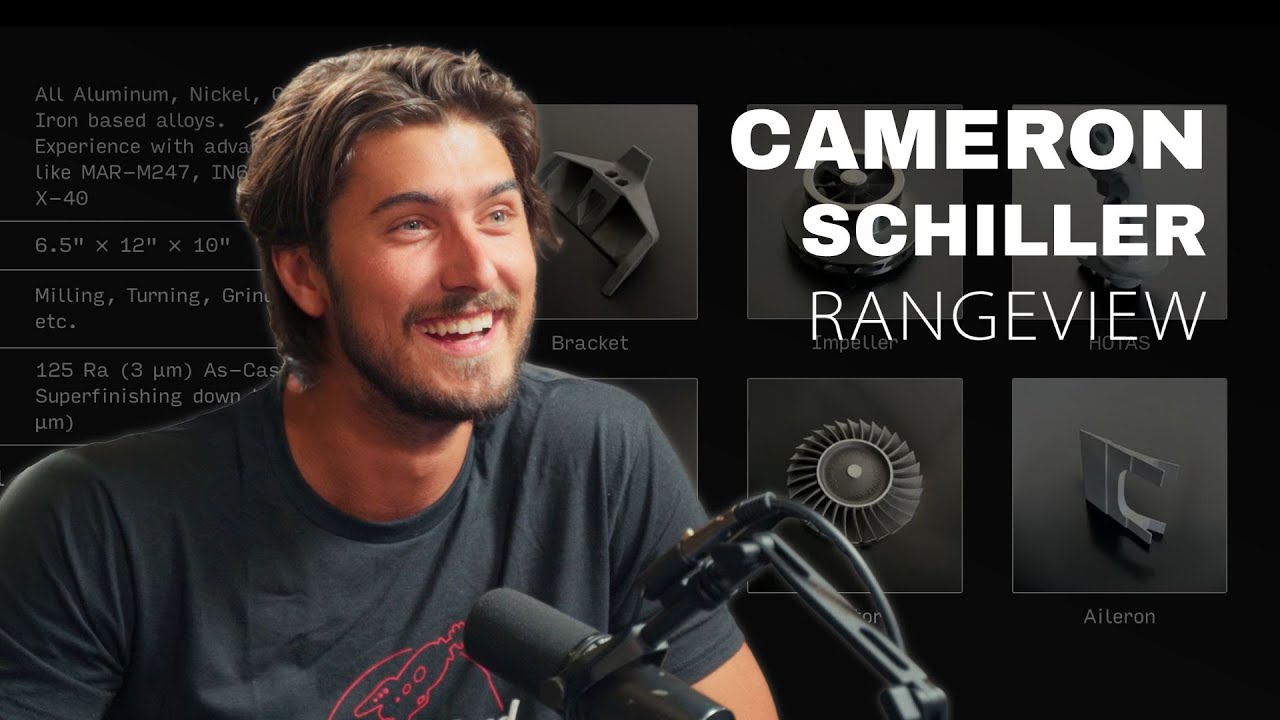
Cameron Schiller is co-founder and CEO of Rangeview, a startup in El Segundo building America’s first “cyber foundry” — a digitally controlled metal casting factory aimed at re-industrializing U.S. manufacturing. He grew up traveling to China, where he witnessed firsthand the intensity of Chinese manufacturing culture, and became convinced that America had lost something essential: the drive to make physical things. After initially building robots based on McKinsey-style advice about automation, he pivoted to casting — the most “down bad” segment of American manufacturing — and is now scaling a facility 15 times larger than his previous one to produce critical metal components for aerospace and defense.
The history and state of casting
Casting is one of the oldest metal-forming methods, originally done by hand-shaping beeswax, encasing it in sand, then pouring molten metal to replace the wax
It has scaled into one of the most overlooked but critical forms of manufacturing for components across industries
Casting is the most neglected major manufacturing process in America — it hasn’t had its “CNC moment” yet, meaning it hasn’t been modernized with motors, sensors, and computer control the way machining was transformed decades ago
The vast majority of innovation in manufacturing equipment and processes is now happening in China, not the U.S.
Why American manufacturing declined
Xi Jinping effectively weaponized manufacturing through massive subsidies, while America treated it as a secondary concern
ITAR and defense regulations kept critical components domestic but ignored how dependent defense manufacturing was on private-sector industrial capacity — so when the private sector atrophied, the U.S. lost surge production capability
America taught China how to manufacture through “Made in China” programs that required American firms to share processes and standard operating procedures with Chinese partners, who then built their own competing factories
DJI is cited as proof that China can now out-design and out-manufacture America: it nearly wiped out GoPro and produces drones an order of magnitude better and far cheaper than American competitors
Humanoid robots from Chinese companies like Unitree are already superior to American ones and cost under $10,000
America lost the art of “design for manufacturability” — designing products to be efficiently mass-produced
The screwdriver factory problem
Most American factories are “screwdriver factories” — they only assemble components sourced from overseas, with no domestic capacity to make the actual parts
This means even highly automated U.S. factories send their capital and equipment spending abroad
The real value chain is in converting raw materials into finished parts, which Rangeview aims to capture domestically
America’s manufacturing software infrastructure (ERP, MES, traceability systems) is built for assembly, not for making parts from scratch — another sign of how far behind the U.S. has fallen
Cameron’s personal path to manufacturing
Born into a manufacturing neighborhood; his father was an inventor involved in the offshoring movement who took him to China starting at age 8
Witnessed serious factory production in Shenzhen, Guangzhou, and Dongguan across consumer electronics, injection molding, rubber, and textiles
Had disturbing experiences seeing sweatshop labor conditions, including factories with safety nets — which motivated him to believe this work should be done by machines
Started his first company in high school: a textile/backpack business that grew to six figures, funded partly by charging Bird scooters at night for about a year
Was a world-champion competitive roboticist in high school, competing as a solo team against groups of 12–15 people, spending 3–4 hours every night building robots in his garage (Rangeview is named after the street that garage was on)
Dropped out of college despite being on a conventional path, driven by urgency to make an impact — the hardest thing he’s overcome was the loneliness of that decision before finding a community of like-minded founders
The robotics-to-casting pivot
Rangeview started as “Rangeview Robotics,” building cheap actuators (the core cost-driving component of robot arms: motor + gearbox + motor controller) based on the theory that cheaper robots would unlock factory automation
After about a year and a half, realized McKinsey and BCG-style generalizations were wrong — factories didn’t want cheap robots; the real problem was that nobody was building factories at all
Decided to build a factory themselves and chose casting after a sober analysis of every form of American manufacturing to find the one that was “most down bad”
The thesis: someone has to actually do the work of making things, not just build tools for other people to make things
Rangeview’s approach and facility
Building a “cyber foundry” — a digitally controlled casting facility using modern technology to command foundry operations via computer
Uses lithography to literally shape sand with light, requiring clean-room retrofits inside a former aerospace engine manufacturing hangar
The new facility is 15 times larger than the previous one, housed in a building that was part of the Space Shuttle and Titan 4 rocket programs
Produces turnkey cast components from raw metal ingots, capturing a huge portion of the value chain
Focuses on narrow classes of superalloys for critical sectors: jet fighter engines, drone engines, and structural components
Targeting multi-decade production contracts worth tens of millions of dollars each
Philosophy: specialize in a specific box (certain sizes, certain alloy classes) and be world-class within it, rather than trying to generalize
Automation philosophy
Rejects the humanoid robotics hype — most factory tasks are better served by specialized, cheaper machines (e.g., a conveyor belt is far more efficient than a humanoid for moving blocks from A to B)
The best robot in the physical world today is a dishwasher: a black box where humans handle edge cases and the system handles the rest
Factories should put humans on the most expensive, variable problems and automate the repeatable operations
AI is good at information theory but bad at physical processes where 99% of the value is in the physical act, not information — so “GPT for factories” won’t work
Dishwashers, tractors, and CNC machines are all examples of robots that already won — they’re just not called robots
Manufacturing vs. fintech
Manufacturing is a larger share of U.S. GDP ($2.9 trillion) than the entire tech sector ($1.4 trillion)
Unlike fintech or crypto where one winner takes all, manufacturing is so vast that an injection molding startup and a machining startup are no more competitive with each other than a fintech and a healthcare startup
Each manufacturing technology is hyperspecific — the world has created more and more specialized processes over time, not fewer general ones
Competing on efficiency and cost basis within a narrowly defined production zone is the path to winning
The infrastructure gap
China wins not just on labor cost but on infrastructure: Cameron describes an 11-story building where his textile factory sat above a thread factory above a button factory, all in the same building — you’d take an elevator downstairs to choose a different clip type
Equipment lead times are a critical bottleneck: 16+ months for key manufacturing equipment in America, and the highest-performance, shortest-lead-time equipment comes from China
Workforce tribal knowledge is disappearing but can be captured through sensors and software — packaging the knowledge of experienced workers into computer systems
Cameron’s magic wand wish: more people making more parts — pipes, boxes, I-beams, hangers — the physical stuff that surrounds everyday life
National competitiveness
China can currently make the most advanced metal parts cheaper than an American firm can buy electricity and raw materials
Competing fairly requires either a national crisis that forces immediate action or a deliberate national priority to bring back manufacturing
Even if urgency strikes, it can’t be turned on overnight — the tribal knowledge and equipment supply chains don’t exist
SpaceX had to build its own foundry because the U.S. industrial base couldn’t support them — a rocket company making its own castings is “ridiculous”
Chinese factories are now setting up in America and teaching Americans how to build, an “uno reverse” on the original offshoring dynamic
Design philosophy and culture
Cameron believes design and beautiful spaces matter emotionally — well-designed environments can improve team efficiency by 1% and make factories inspiring places to work rather than places people avoid
References Disney Imagineering as world-class at “engineering emotions”
Rangeview’s office is intentionally beautiful, and their merch (designed in-house) gets constant compliments
The new facility will include a car lift in the employee lounge so people can work on their cars at work
Many team members are car people; Cameron sees cars as a lens for understanding societies — what people choose to drive reflects what they value
The Volkswagen GTI is his quintessential recommendation: practical, great chassis dynamics, spacious, simple — “the perfect people’s car”
Believes America’s SUV craze is ego-driven and wasteful compared to European wagons, which offer similar interior space with better driving dynamics
Education and the next generation
Credits VEX and First Robotics in America and DJI Robo Masters in China as the pipelines for the next generation of builders
In China, talented engineers are celebrated like quarterbacks — the state sponsors robotics competitions that align young people with the national priority of making things
America needs to invest heavily in manufacturing education today to compete in the coming years