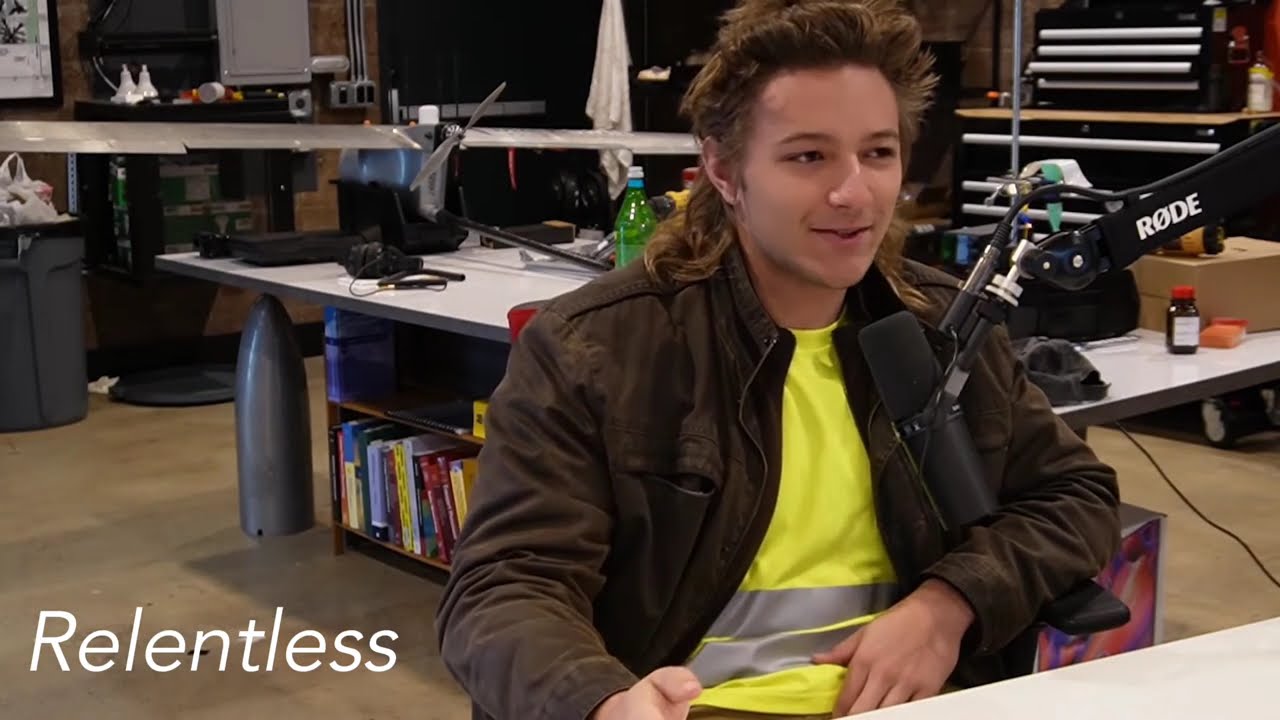
- Augustus Doricko is the founder of Rainmaker, a cloud seeding startup in El Segundo, California, working to increase water supply in the American West and eventually terraform deserts. He previously co-founded TerraSco, a groundwater compliance automation company, and has been obsessed with space, water scarcity, and frontier technology since high school. This conversation covers his path from a yeast experiment on the International Space Station to building a company that aims to make Earth more habitable through weather modification.
Early Experiences That Shaped Him
-
High school yeast experiment on the ISS
- Participated in the Student Spaceflight Experiment Program, where high school teams competed to have experiments conducted on the International Space Station
- Designed an experiment to study yeast cell wall reproduction in zero gravity, inspired by reading Scott Kelly’s Endurance
- The team contaminated the sample (he smashed a glass vial with his boot to extract the yeast), but still got useful data back showing different cell wall multiplication than on Earth
- Raised ~$88,500 through a GoFundMe and local corporate sponsorships (Mitsubishi America, local banks) led by a NASA Glenn employee and special ed teacher named Susan Dary
- The experience was seminal: he associated exhaustion with deep meaning, met astronauts and physicists, and became aware of possibilities he hadn’t previously considered
-
Why space mattered to him
- Originally wanted to become an astronaut to answer life’s deepest questions: meaning of life, whether we’re alone, whether God exists
- Was an atheist at the time; chose UC Berkeley for physics as a path toward astronaut school (Naval Academy was first choice but disqualified due to being deaf in one ear)
- Now a Christian; still values space as a frontier but is more focused on making Earth habitable first
- Believes humanity should become a Type 1 civilization (harnessing all energy available on Earth) before becoming multi-stellar
The Water Industry and TerraSco
-
How he entered the water industry
- Moved from Berkeley to Texas during COVID lockdowns; took a job as a personal trainer to get out of the house and meet people
- Met the largest water well driller in Texas at the gym; they identified that regulatory compliance for groundwater wells was a manual, automatable problem
- Most aquifers west of the Mississippi are depleted or in managed depletion; some regions face Dust Bowl-level collapse in 30–60 years
- States regulate how much water people can consume and require frequent reporting, but most wells in the American West only recently got meters
-
What he learned studying water
- Market inefficiency is everywhere: well drilling uses essentially the same equipment and methods as 100 years ago; many farmers still use dowsers (witching rods) to find water; pumps have seen little efficiency improvement in 50 years; the workforce is aging out
- 310 million acre-feet of brackish groundwater exists in the American West—over 10 times California’s annual usage of ~39 million acre-feet—but it’s too saline to use with conventional infrastructure
- The opportunity: if someone figures out how to desalinate brackish groundwater and handle the brine byproduct, the water supply could increase by orders of magnitude, and the cost advantage over ocean desalination is enormous because the water is already inland (no conveyance infrastructure needed)
-
Why he left TerraSco
- Fell into entrepreneurship without initially having venture-scale ambitions
- Became aware of hyper-growth potential through LA Tech Week events
- Wanted to build something that could scale fast and have immediate impact, especially given the existential urgency of water scarcity in the American West
- TerraSco had spiky semi-linear growth constrained by hardware costs and didn’t pattern-match well to VCs
Cloud Seeding and the Birth of Rainmaker
-
The Snowy Project paper that changed everything
- After exhausting other water production technologies (atmospheric water vapor condensation was rejected because it increases evapo-transpiration and aridification), he found cloud seeding
- Cloud seeding has been burdened with scientific criticism because of the attribution problem: even if the microphysics work (silver iodide nucleates ice in supercooled clouds), proving that human intervention caused precipitation—rather than natural variability—was impossible with old sensing technology
- The Snowy Mountain Project (2017–2021) in Australia used high-power, high-resolution radar to track aircraft flight paths and observed zigzag patterns of increased radar reflectivity (indicating ice formation and precipitation) exactly where the drones flew
- This was the first rigorous validation that cloud seeding works at scale
-
How cloud seeding works
- Water doesn’t freeze at 0°C; it only instantaneously freezes at -38°C. Between those temperatures, it takes progressively longer
- Ice nucleation agents (like silver iodide) work through two material properties:
- Crystalline structure nearly identical to ice, allowing hydrogen bonds to form and water molecules to aggregate and freeze around the particle
- Goldilocks hydrophobicity: too hydrophobic and water won’t bind; too hydrophilic and too much liquid water crowds the surface, preventing the first ice layer from forming
- The particles must be ~1 micron in size to stay suspended in clouds long enough
-
Why cloud seeding hasn’t scaled (the “idiot index”)
- Sensing is poor: operational meteorology is largely qualitative—looking at plots and guessing; rain gauges are crude and statistically insignificant for attribution
- Delivery is inefficient: ground-based generators (bonfires emitting silver iodide smoke) are wildly inefficient; planes are expensive to keep on standby 24/7 and dangerous to fly through supercooled clouds (ice accretion on wings)
- Dispersion is wasteful: flares are 95%+ metal casing and pyrotechnics by mass; they also emit heat into the cloud, reducing efficiency
- Nucleation agents are limited: silver iodide is expensive (it’s literally silver) and only works below -6°C, restricting operations to cold months and high-altitude regions like the Rockies and Sierras
-
Rainmaker’s approach
- Testing 300+ candidate nucleation agents over two quarters to find compounds that work at higher temperatures (-2°C or even +1°C), extending the geographic and seasonal range
- Dozens of iterations on atomizer designs for dispersing agents more efficiently than flares
- Dozens of iterations on atmospheric modeling
- Using drones instead of planes for cheaper, safer delivery
- Building novel instrumentation (cloud chambers, wind tunnels, spectrometers) in-house
Building the Company and Culture
-
El Segundo’s supportive government
- Mayor Drew Bo, Mayor Pro Tem Chris Pimel, and the fire chief have been exceptionally helpful with events, regulatory navigation, and bringing resources to the city
- El Segundo has a legacy of industrial innovation (SpaceX, LAX, Hyperion Water Treatment Plant, Standard Oil Refinery) that makes the government appreciate new technology
- The lesson: government doesn’t have to be an adversary if you provide jobs and net positive impact
-
Reiterating the mission
- Constantly restating the mission creates zealotry—team members who believe they’re doing something quasi-divine will burn midnight oil and think about problems in their free time (one engineer has dreams about hardware designs)
- Compares it to laying bricks for a cathedral: if the purpose is transcendent, the work becomes religious conviction rather than material drudgery
-
Hiring for zeal and talent density
- Rainmaker has ~7 people and what Doricko calls the highest talent density he’s seen
- Everyone is a recruiter: A-players know and attract other A-players from their networks
- Filtering for zeal: looks for people who build things unprompted—texting designs or building test stands before they’re even hired; red flags include being too busy with a Super Bowl party to take a call about the work
- Fitness matters: bench squat deadlift numbers are a filter for those able; draws parallels to Zomato weighting stock comp to fitness
-
Rapid iteration culture
- Prefers testing immediately over whiteboard math or CFD modeling; “have a bunch of good ideas, test them immediately, get real world feedback”
- Oscillates hard but converges on the right solution faster than companies that adjust narrowly and steadily
- References Jeff Bezos’s framework: most decisions are correctable, so act fast; only a few grand strategic choices warrant deep preparation
-
Winning and failure
- Loves “the taste of blood in your mouth”—if you’re afraid of getting punched, you won’t take swings
- Crashed their drone on the first launch in front of friends; immediately identified a center of gravity issue and iterated
- Every win is “a brick laid on the Stairway to Heaven”—significant not as material gain but as spiritual progress
- Short-term losses are acceptable when executing against a long-term vision faster than anyone else
Vision: Terraforming and Hurricane Mitigation
-
Hurricane mitigation
- Long-term goal: reduce hurricane damage by precipitating water out of storms over the Atlantic before they hit land (reducing flooding)
- Freezing water in clouds is exothermic (releases heat), which can widen the hurricane’s circulation and lower peak wind speeds, reducing wind damage
- Insurance claims from hurricanes are hundreds of millions to billions per event, with second-order effects (shipping delays, rebuilding, industry closure) compounding the cost
- Doricko takes personal responsibility: “every day that you haven’t solved the problem of mitigating these hurricanes is actually on you”
-
Creating artificial atmospheric rivers
- Atmospheric rivers are massive currents of water vapor over the Pacific with ~10x the flux of the Nile
- Theoretically, by creating a pressure gradient (precipitating clouds to lower pressure in a target area), you could induce atmospheric rivers to flow hundreds of millions of acre-feet into the continental interior
- Acknowledges this is far-future, Neal Stephenson-level sci-fi territory
Influences and Philosophy
-
Key influences
- Jordan Peterson: credited with leading Doricko to Christianity, teaching radical ownership and responsibility, and showing that meaning and objectivity exist in the world
- Napoleon: relentlessness, obsession, speed, and ambition (prefers “shoot for the stars and if you end up on the moon” over the inverted version)
- Elon Musk, Steve Jobs, Warren Buffett, Charlie Munger, Palmer Luck: examples of great men who took on hard problems
- The video game Spore (2007–2009): spent hours terraforming planets, adjusting magnetic fields, placing atmospheric generators, managing ecosystems—a seed of influence for starting a terraforming company
-
“The Right Stuff”
- Inspired by Tom Wolfe’s book about early test pilots who flew experimental machines with horrific survival rates
- The pilots didn’t blame engineers, weather, or commanders—they took radical ownership: every crash was the pilot’s responsibility to diagnose and handle
- For founders: every problem in the world that persists is your failure to solve it yet; ambition should know no bounds because humans have “the Divine image within us”
-
How to produce more great people
- Go to church, repent, believe in Jesus Christ
- Go to the gym, find aspirational people, seek mentorship
- Gen Z is bad at finding mentors and apprenticeships; building in a lab environment teaches more in 3 months than years at most companies
- Set audacious goals and compress timelines—when you hit targets, raise the bar
- Confer social status on hard problems rather than on financial speculation; make it cool and fun to solve difficult things