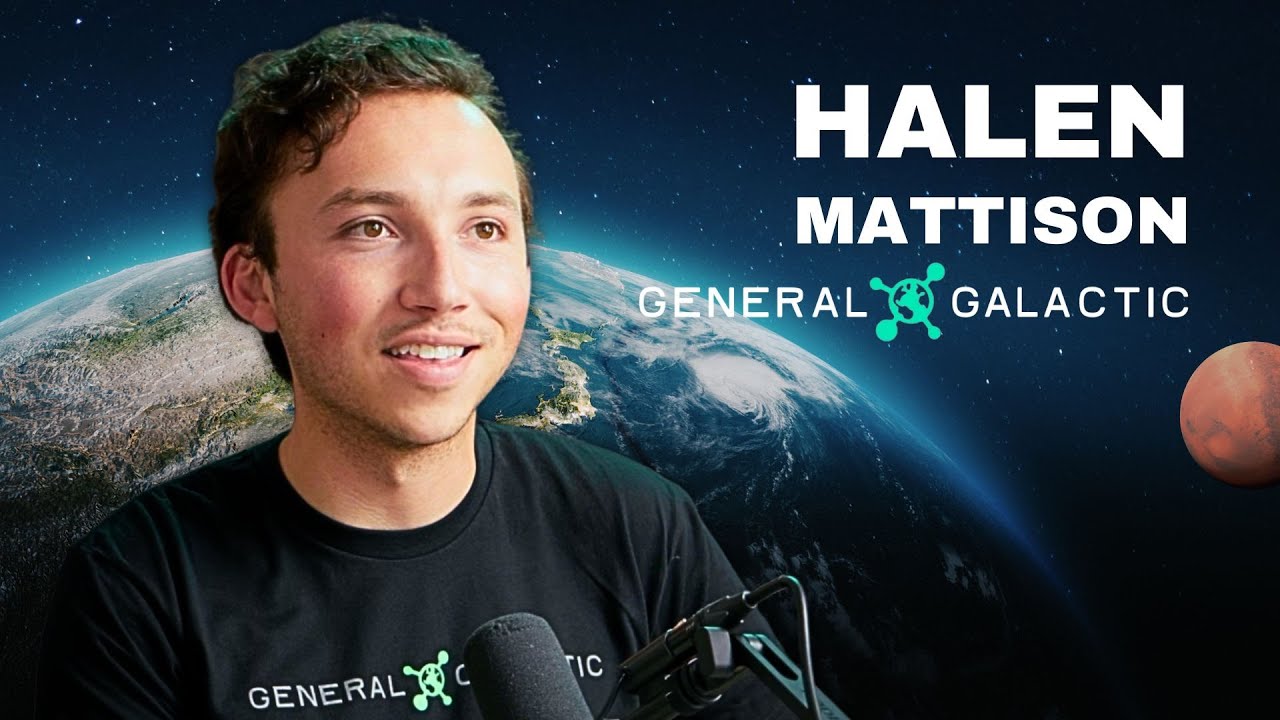
Halen Mattison spent roughly three years at SpaceX working on Dragon and Starship programs before founding General Galactic, a startup building novel hydrogen-oxygen thrusters and in-space refueling infrastructure — with the long-term vision of building the first gas station on Mars. The conversation covers his experiences at SpaceX, the technical and business reasoning behind General Galactic, and his broader views on the space industry.
Working at SpaceX
Mattison joined SpaceX as an intern in January 2019 after watching the Falcon Heavy launch during an undergrad class and applying on the spot. He had almost no prior awareness of the tech or aerospace scene — a kid from North Carolina who barely knew who Elon was.
He was present for the Demo-1 docking of Crew Dragon with the ISS, standing outside mission control in a small crowd. A woman in a floral dress next to him asked, “Is this happening in space right now?” — only after docking did he realize it was Grimes, there to accompany Elon.
During that same internship, he unknowingly told Artemis 2 astronaut Victor Glover to get out of his desk chair so he could get back to work on a propulsion issue.
He was also present when a Dragon capsule exploded during a ground test firing after Demo-1. The capsule was destroyed. He highlights SpaceX’s failure investigation process as one of the company’s greatest strengths — a style of innovation that was largely dead in aerospace before SpaceX.
How SpaceX Innovates
The ethos is derived from Silicon Valley: move fast, break things, test to failure. Constant failures on new hardware would make legacy aerospace companies “shiver,” but the learning from those failures is what allows SpaceX to outpace everyone.
Elon’s algorithm is central: first, challenge the requirement — ask whether something even needs to be done. Mattison gives the example of gold case seals used in pressurized fittings: each one costs $400–$1,000, thousands are used per vehicle, and they’re not reusable. By questioning whether every seal was truly necessary, his team found creative alternatives and saved significant cost.
The responsible engineer model means each engineer is the CEO of their product — authorized to “move heaven and earth” to make it fly, from initial design through standing beside technicians on the hundredth iteration of installation.
Development vehicles are intentionally stripped down: no nose cones, metal bricks used as mass simulators, everything descoped to only test the unknowns. The goal is to fail the test article, not the test stand.
Mattison describes working at SpaceX as playing in the major leagues of engineering — everyone around you is busting ass, and the culture of high respect means anyone can challenge anyone up and down the chain, including going directly to Elon with a first-principles case for changing direction.
The Starship Challenge
Starship carries so much methane and oxygen that a worst-case pad explosion would be the largest non-nuclear explosion in history by a factor of five.
Early Starships involve thousands of individual human actions — each a potential failure point. The path to reducing risk is automation of the assembly line, moving from bespoke clean-room manufacturing toward something resembling automotive production.
Refueling is the bottleneck for deep space missions. SpaceX has publicly indicated needing around 14 refueling events for a single lunar mission — each one a full Starship launch just to fuel the vehicle that will go to the Moon. For Mars, the numbers are even more extreme, with Elon talking about launching Starships every hour.
Mattison’s most memorable moment at SpaceX was the broader realization of how to build big things that matter — going from a lucky kid in California to someone who understood how to execute at scale on a massive vision.
If He Ran NASA
Mattison’s pick for NASA administrator would have been Jared Isaacman — an entrepreneur who aligns with NASA’s best form: a lean, mission-focused organization.
He is sharply critical of the prime contractor system (Lockheed, Boeing, etc.), which he views as a continuation of a WWII-era jobs program. The primes’ mission is to stay alive and employ people in congressional districts where they can lobby well — not to innovate.
He believes startups succeeding makes the primes look bad, creating a structural incentive for the primes to resist disruption. His view is that a rising tide lifts all ships — the better startups perform on cost and performance, the better off the country is.
Founding General Galactic
Mattison loved SpaceX but recognized it is only one part of making humanity interplanetary. SpaceX is a transportation company — it owns getting things from Earth to orbit. What happens after that — the in-space economy, habitats, fuel depots, power — is still largely unsolved.
His last year at SpaceX he worked on propellant generation for Mars, and realized the technology for splitting water into hydrogen and oxygen and converting it into fuel was being optimized for Earth’s green economy, not for the fundamentally different requirements of space.
General Galactic’s original vision was simultaneously grandiose: save the Earth and enable humans to live on other planets. The original pitch deck had energy systems as step one, in-space thrusters and ISRU as step two, and the Mars gas station as the endgame.
They pivoted away from the energy business after realizing that energy is brutally commoditized: if you can’t beat the cheapest alternative on price, you have no product. Synthetic fuels cannot compete with cheap hydrocarbons, and subsidies like the Inflation Reduction Act that might have helped no longer exist. The decision was binary — stay and go to zero, or focus on space where they dominate.
The company is now focused on space mobility: building a novel hydrogen-oxygen thruster and the infrastructure for in-space refueling.
The Propulsion Problem in Space
Current space mobility relies on two outdated options:
High thrust: almost always hydrazine, developed in the 1960s, extremely toxic (causes cancer, can kill on contact), requires space suits to handle, not produced in the US, and a major pain point for the Defense Logistics Agency.
High efficiency: mostly xenon for Hall effect thrusters — extremely expensive and difficult to deal with.
There is a clear logistics gap. General Galactic’s thruster uses hydrogen and oxygen — far more performant, cleaner, and aligned with ISRU (in-situ resource utilization) on the Moon and Mars, where water ice can be split into these propellants.
The China Factor
Mattison calls a recent development a Sputnik moment for the US space industry: China is the only nation that has demonstrated the ability to capture and rendezvous with a non-cooperative asset on orbit — meaning they can go grab, de-orbit, or destroy anything in space. The US cannot do this.
A Chinese geosatellite has also demonstrated on-orbit refueling, another capability the US lacks.
This has direct national security implications — in space, which operates like international waters, China can effectively be a “space pirate.” In response, US Space Command’s top priority list now leads with: build better novel propulsion systems.
This aligns perfectly with General Galactic’s direction and provides an early customer who desperately needs the technology.
The Launch Market and Demand
Getting a launch slot today is 18 months out on SpaceX’s website for 2027, with six flights between now and the next open slot. Demand is enormous.
SpaceX’s Transporter missions (rideshare for small payloads) are done largely out of goodwill — they allow startups, universities, and small players to get to orbit, but each mission involves coordinating hundreds of customers instead of a handful.
As Transporter slots fill up, some startups are looking at Indian launch providers and other new entrants.
Mattison expects the number of objects in space to grow exponentially as launch costs drop and cadence increases. General Galactic is already in conversations with players wanting to deploy “constellations upon constellations.”
Starship’s Impact
If Starship succeeds, it changes the equation entirely: mass and volume constraints disappear. Missions currently limited by how much solar array or payload mass can fit would suddenly have room to breathe.
Combined with General Galactic’s technology, Starship enables architectures like nuclear electric or nuclear thermal propulsion loaded with enormous amounts of propellant — reaching anywhere in the solar system for less than missions cost 20 years ago.
Mattison’s publicly stated timeline: robots to Mars in 2026, humans in 2028 (the even-year Earth-Mars transfer windows).
Personal Background
Mattison grew up in rural North Carolina, on EBT/food stamps during the recession, first in his family to go to college. His dad is an automotive mechanic; his mom worked odd jobs.
At age 8, he realized being a “poor southern kid” meant the cool engineering he saw on Mythbusters probably wasn’t accessible. He tried to build a rocket from a Dr. Pepper bottle and gasoline — his mom stopped him.
At 11, he was denied entry to a high school math class at a charter school because he couldn’t donate; wealthier kids got the spots. He switched schools.
He fixed an old CNC machine at his high school’s metal shop, built a sketchy e-bike with old batteries he rode through hallways, and developed practical metalworking skills that became his entry ticket into a university space lab.
He was invited to interview for Harvard but the interviewer asked about his national chess and tennis rankings — things inaccessible to a poor kid from the South. He didn’t go.
He maintained a 4.0 GPA from high school through Stanford (where he went on an NSF fellowship) because there was no room for failure — his funding depended on it.
He built a CubeSat in his Airbnb living room in Westchester, California during COVID, after Stanford locked everyone out of labs. The team broke into the lab, grabbed equipment, and spent two weeks pulling all-nighters building it in an unairconditioned apartment. It flew to the ISS.
General Galactic’s Technical Progress
The company’s Mark 1 GT Thruster (hydrogen-oxygen) had its first test fire: it ran for 1.2 seconds with a beautiful plume and Mach diamonds, then melted through — sparks and gas shooting sideways. The team cheered.
The failure cost far less than people expect because they design test assets to only fail the article under test, not the stand. They designed that engine in 3 weeks, had another on the stand in 3 more weeks, and a third a week after that which they fired 10 times successfully.
Even in the failed 1.2-second test, the thruster achieved higher specific impulse (ISP) than almost anything on the market.
The lesson: sometimes the data is obvious (a thermocouple reading 1,400°C tells you the cooling method doesn’t work), and you can rearchitect and be back on the stand in weeks.
The company is aiming for a demo flight as a seed-stage startup with roughly a dozen employees — something with little precedent. They’re willing to risk double-digit percentages of their resources on single demo opportunities because owning the development risk is how they break through the industry’s reliance on flight heritage.
On Risk and Founding
Mattison’s biggest lesson from the business side: economics has first principles just like physics. In energy, if you violate them, you go to zero — there’s no partial credit. In space, the value proposition is strong enough that the business model works.
He is willing to risk 100% or more (levered up) on the right technical bet — if it works, they make history and blow the competition out of the water.
The hardest moment as a founder was the pivot from energy to space — reorienting the entire company’s mindset. The “chewing glass” moments are relentless: suppliers missing lead times by weeks, first-time problems with no playbook.
He tries to emulate how Elon shoulders the drama and fear for the company — taking on the anxiety load so the team can focus on execution.
His message to aspiring founders: you don’t need to be a billionaire to start a space company or hard tech startup. The risk calculus is wrong — if you’re not going into massive debt, there’s little downside. You learn fast. Most startups today are normal jobs with higher responsibility and often better pay and benefits than legacy primes where you’re a cog in a machine with no equity.