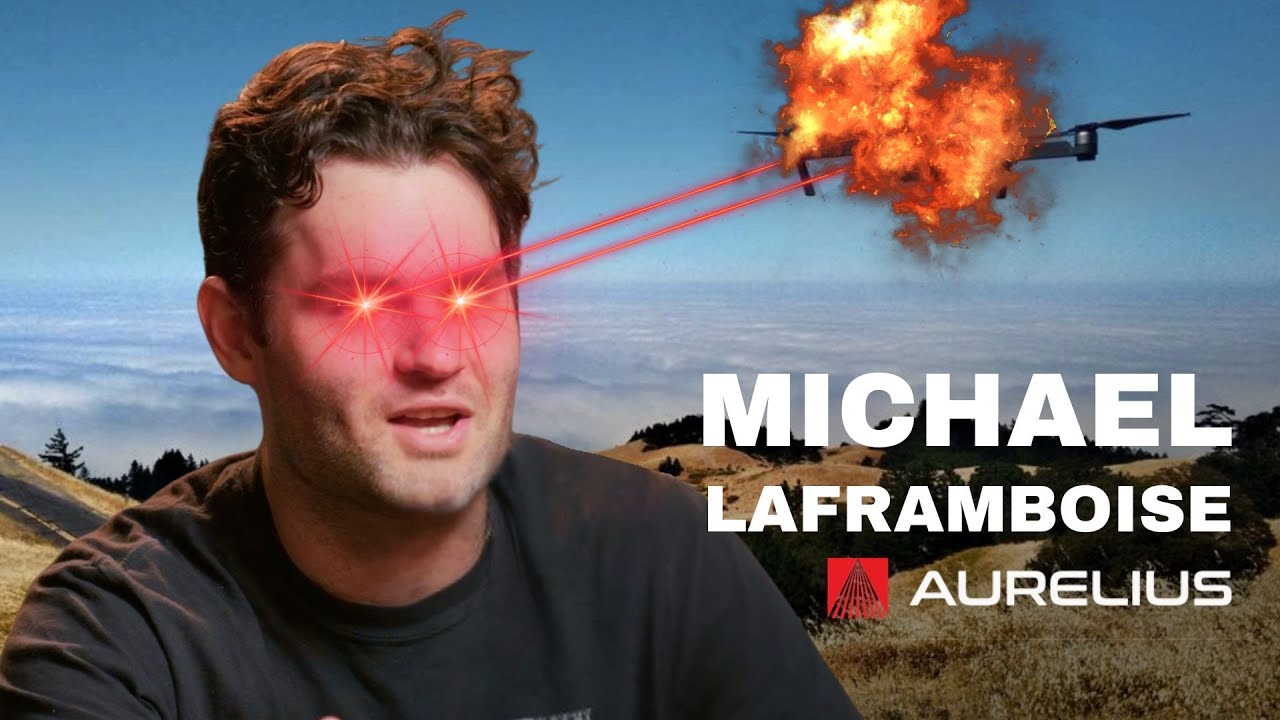
Michael LaFramboise is the co-founder and CEO of Aurelius, a defense startup building autonomous laser systems that shoot down drones at near-zero marginal cost. The company was founded in early 2024 after Michael and his co-founder John witnessed the drone warfare explosion in Ukraine, where cheap drones ($1,000–$100,000) were destroying expensive military assets and killing soldiers at scale, while militaries were forced to use million-dollar missiles to intercept them. The core thesis is simple: you cannot win a war of economics where your cost to defend is 1,000x the cost to attack. Aurelius’s answer is directed energy — high-power lasers that cost roughly 10 cents to $1 per shot in electricity, can destroy drones by cutting rotors or drilling through them, and operate silently and invisibly. The company is now raising its next round, preparing to deploy units in 2026, and building toward a long-term roadmap that extends from counter-drone turrets to orbital “death star” platforms.
The drone economics problem
The cost asymmetry is existential: A $1,000–$10,000 FPV drone is being shot down with $1–2 million missiles (Block 4, Sea Sparrow). This math collapses at scale — if an adversary sends 1,000 drones, you need $1–2 billion in missiles. The US Navy has already done this in the Red Sea against Houthi drone swarms (30–40 drones intercepted with million-dollar missiles), but it’s an emergency measure, not a sustainable strategy.
China produces ~93–94% of the world’s drones, estimated at 50–100 million units per year. The US produces on the order of 100,000 or fewer — a gap of roughly three orders of magnitude. China sells to both sides of conflicts.
60–80% of Ukrainian casualties are attributed to FPV drone strikes. Drone production on both sides was already in the hundreds of thousands per month by late 2023.
The US military was built for a different war: Post-Iraq/Afghanforce force structure was optimized for near-peer adversaries with F-35s, aircraft carriers, and tanks — not for defending against swarms of cheap autonomous drones. The defense industrial base has no answer for this threat at scale.
Why lasers and why now
Directed energy solves the marginal cost problem: A laser shot costs ~10 cents to $1 in electricity. Once the capital expenditure of the system is amortized, the cost to defeat a drone is lower than the cost to produce it — flipping the economic equation.
Aurelius’s system (Archimedes): A lightweight, edge-deployed turret that uses a high-power fiber laser to destroy drones — cutting off rotors, drilling through the body, or igniting batteries. It’s a “hard kill” (physically destroying the drone), not a soft kill like electromagnetic jamming. It’s silent and invisible — no visible beam, no sound, just a small turret.
One system can defeat 20–50+ drones in a sustained engagement before needing resupply or maintenance. Multiple systems operate in parallel and coordinate with other detection/defeat systems for layered defense.
The technology is finally ready: High-power laser tech has advanced dramatically in the last decade. Four or five of the last ten Nobel Prizes in physics have been for laser/optics breakthroughs. The industrial laser market (cutting, welding) is $25–30 billion and growing 11% per year for 30+ years, driving down costs and improving architectures that transfer directly to directed energy weapons.
Previous directed energy programs were too expensive and not autonomous: The US has spent $1–1.5 billion per year on directed energy for decades. A 2004 program put a chemical laser on a 747 (approaching 1 megawatt) — it was too heavy and expensive. Current ship-mounted systems (300 kW on USS Prebble) cost ~$80 million each and still require a human in the loop. Aurelius is targeting systems at $1 million or less with full autonomy.
Autonomy is inevitable
The future of warfare is autonomous systems vs. autonomous systems: Drones are already autonomously guided (terminal guidance via computer vision, no radio link needed — making jamming ineffective). The response must also be autonomous. Michael expects the end state to be: a commander sets rules of engagement in code, and the system operates autonomously within those parameters.
The DoD is shifting: New leadership (generals, admirals) who have seen drone integration in field exercises are much more receptive to autonomy. They’ve observed units being surveilled for days without knowing it — they understand the threat is real and current defenses are inadequate.
Counter-UAS is still nascent: While UAS companies are mature (Series B/C stage), most counter-UAS companies are at seed or Series A. The next 3–5 years will see winners picked and layered defense architectures solidified.
The threat is not just war zones
Terrorist and domestic threats: There have been multiple thwarted drone attacks on US critical infrastructure (nuclear reactors, power plants). DHS just received $21–22 billion for counter-UAS to deal with border incursions.
Soft targets are undefended: The Super Bowl had over 100 unauthorized drones; no one could do anything about them. The New Jersey drone incident showed public hysteria but also total inability to respond. If those drones were weaponized, there was no defense available.
Current US border defense is from the 1930s: Fort Funston near San Francisco has non-operational artillery emplacements from ~1930 — that’s the last time the US seriously defended its oceanic borders. “Golden Dome” is the modern equivalent attempt.
Autonomous dark drones are the real threat: Supersonic suicide drones, ultra-silent autonomous submarines, drones with no communication link that are pre-programmed and invisible. The ocean could be filled with them and we’d have no idea.
Competitive moat and scaling strategy
Lasers exploit the fundamental weakness of cheap drones: Drones are made of thin, cheap materials because the whole point is low cost. Hardening a drone against lasers would make it 100–1,000x more expensive (~$250,000+), at which point you can use missiles again. The economics can’t be escaped.
Aurelius is not going after the missile business: They focus on Group 1 and Group 2 drones (small, cheap, numerous) — the ones that current systems can’t economically address. Larger drones and hypersonics are for later products.
Make vs. buy on lasers: Aurelius initially uses commercial industrial fiber lasers but plans to manufacture their own starting early next year. This is critical because:
There are only a few US laser companies (Coherent, IPG with Russian roots, Trumpf with German roots) and they offer limited product lines with long lead times.
Chinese fiber laser companies produce at 1/100th the cost with insane scale and delivery speed. There are ~12 of them.
The “medium” market has been hollowed out: US/European players moved to bespoke high-margin products, Chinese players own the low end, and nothing good exists in between.
Michael has received unsolicited messages from US manufacturers (battery tacking, catheter production) begging him to make lasers because their current suppliers are terrible.
Production will be in Detroit/Michigan: Strong manufacturing talent base, reasonable labor costs, central location, major airport, and strong state/federal government support. Targeting several hundred units per year initially, scaling to 50+ units in 2026.
Long-term roadmap: from turrets to orbital platforms
Phase 2: Larger stationary systems (100+ kW) for counter-hypersonic and ballistic missile defense, deployed on ships or fixed installations.
Phase 3 (7+ years): Orbital “death star” platforms — laser stations in orbit powered by solar panels, creating “ammuniture from sunlight.” Cost to destroy a satellite with a missile: $50–70 million. With 10,000–100,000 adversarial satellites possible, missile-based defense is economically impossible. Orbital laser stations have near-zero marginal cost per shot.
Phase 4: Trans-lunar/trans-Martian warfare — light is the only practical weapon for interplanetary distances (3 million meters per second effect speed).
Timeline: Michael thinks this is less than 20 years away because the need is urgent and current systems are nonexistent. The drone question is the #1 concern for DoD leadership right now.
Company trajectory and fundraising
Founded early 2024 by Michael and John (co-founders who met at age 14 in high school coding class, now early 30s). Both are engineers. For the first several months it was just the two of them building.
Pre-seed was “pulling teeth”: Michael pitched 100+ VCs over 2.5 months, mostly getting rejected. Defense was still viewed as a “vice industry” by many funds in early 2024. He had a basic prototype, which was critical for credibility.
First check: $100K from Founders Inc. (their first defense investment).
Seed round closed in ~3 weeks after connecting with Paige Craig (Outlander, first investor in Scale AI) at the Reindustrialize conference in Detroit. 640 Oxford led. Total seed: ~$2 million.
Paige Craig joined the board — unusual for pre-seed, but he’s a defense company OG (founded and sold one in the 2000s). Michael sought him out deliberately.
Recent raise announced: A new round closed a couple months ago (announced the day of the podcast recording).
Current team: Small but growing aggressively. First employee (Chase) started September 2024. Now hiring to double the engineering team. Based in San Francisco (Potrero Hill warehouse) — deliberately staying in SF to attract defense-curious talent from Berkeley/Stanford, and because Bay Area warehouse space is surprisingly affordable (Detroit-level pricing).
Hiring philosophy
90–95% of applications are rejected immediately. Of those who get a 15-minute “vibe call,” another 90% are cut.
Core filter: “Do you live to build things?” 98–99% of engineers got their degree for the salary and career, not because they tinker on weekends or can’t stop building. Michael is looking for the 1–2% who are genuinely obsessed.
Experimentalist vs. theoretician: For PhDs, Michael calls their doctoral advisor and asks this question. Advisors are trained to say “theoretician” (the “good” answer in academia), but Michael wants experimentalists — people who build. The advisors’ hesitations and counter-answers reveal the truth.
“Wrench turner” test: Can you actually use tools? Have you built physical things, or have you only done Python scripts? Michael wants people who know how to work with their hands.
Resume deep-dive: If something on a resume is interesting, Michael asks increasingly specific questions until the candidate reaches the base physics or fundamental decision rationale. He doesn’t need them to know the answer — he needs them to have thought about it and to care.
Michael’s personal background
Grew up in Metro Detroit. Father passed away when he was ~10–12. Mother was troubled. Spent much time alone, had to find food and financially administer the household as a young teenager. No family members were engineers; father didn’t graduate high school.
Was a “loser” growing up: Suspended every year from ages 6–13 for fighting. Had few friends. Graduated high school with a 2.02 GPA (barely). But scored 32–33 on the ACT, showing raw aptitude.
Found engineering at ~20: Went to an open enrollment university in downtown Detroit, then transferred to Case Western for mechanical engineering. First job at Chrysler in manufacturing and part design.
Tried to become a Navy fighter pilot out of undergrad — went to officer candidate school and flight school, but was medically disqualified for low red blood cell count (anemic, despite being physically fit — powerlifts, runs marathons). This was devastating — the first time he’d had a real mission.
Grad school at Michigan: Studied semiconductor optoelectronics and laser systems. Joined Coherent (largest US laser company) in R&D, then moved to sales at headquarters in Santa Clara — his first time in the Bay Area. Did sales for 2.5–3 years, running West Coast components and diode sales.
Berkeley MBA + Amazon: Got into Berkeley for an MBA/MS in autonomous systems. Took the “prestige job” as a senior product manager at Amazon IoT. Dropped out of Berkeley after the first year (expensive, second year is “just a party”) after listening to a Palmer Luckey podcast where Luckey said: stop doing A to get to B to get to C — just go do C.
Started a crypto company (auction.io) with John in 2022–2024: Unreal Engine plugin for NFT in-game assets. Bootstrapped, sold for scrap. Great learning experience but not the end goal.
PhD at Columbia: Studied semiconductor optoelectronics and optical device physics for about a year. Dropped out to start Aurelius — the second PhD he’s dropped out of to pursue this.
The decision to start Aurelius: Mentors had been telling him to start a laser weapons company for 1–2 years. After the Palmer Luckey podcast, he went home and wrote the dropout email that night. He told himself: “If I do this, no matter what happens, I will fight to the death. If I lose, I can live with it.”
Personal philosophy: “I’m unkillable. I’m like a cockroach. You just cannot kill me no matter what.” He attributes this to his childhood — growing up with nothing, being angry, feeling like an outsider. He carries a chip on his shoulder that he believes is why his companies do well.
Lives minimally: Has never spent more than $50–60K in a year, even in San Francisco. Slept in a Japanese sleep pod ($800 for a two-pack) in the office warehouse for about a year to minimize cognitive load and stay focused on the company. Just signed an apartment lease and is “moving out of pod life.”
Open source car company idea (his dream side project): Take an EV skateboard platform, run Android on it, partner with a famous supercar designer, make beautiful 3D-printed shells, and open-source everything. CAD/mechanical engineers don’t have the open-source culture that software engineers do — this would attract incredible hardware talent. “Give me 0.25% and I’ll advise you.”
Key concerns and urgency
“A million drones show up on the West Coast tomorrow morning — what do we do?” The honest answer: we don’t have the systems. We can detect them (radars, sensors), but we can’t stop them at scale. The last serious oceanic border defense was built in 1930.
2026 is the inflection year: The administration has opened the aperture on defense acquisition. The contracting pipeline is being reworked. CUAS proposals now open unannounced and close in 10 days. This is the year to get ultra-aggressive on market capture.
The Chinese are “unbelievably impressive”: Michael spent Christmas taking apart a Chinese welding laser — “they’re so good.” He rejects the narrative that Chinese products are cheap and crappy. They’re just cheap. The scale, speed, and quality of Chinese manufacturing is extraordinary. Whether it’s subsidies, labor, or culture doesn’t matter — what matters is what’s happening on the field, and “we’re losing.”
What keeps him up at night: Execution risk in scaling from prototype to deployed units. But he’s thought through the landmines and has plans for each. The technical risk is largely de-risked — demos work. Now it’s about hiring, production, and aggressive business development.