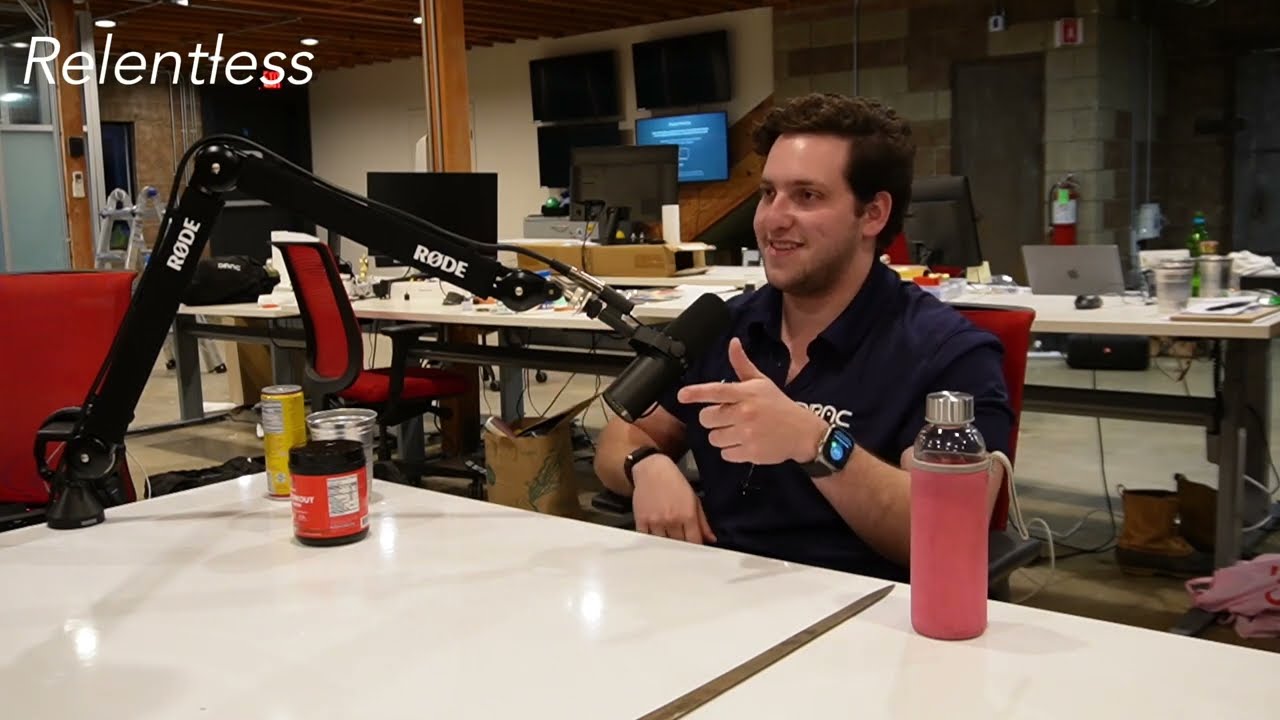
Filip Aronshtein is the founder and CEO of Dirac, a company automating the creation of assembly work instructions for manufacturers. The company’s name honors Paul Dirac, the underappreciated Nobel Prize-winning physicist, reflecting Filip’s belief that engineers love building software for other engineers but rarely build for the technicians and manufacturing workers whose lives it would actually improve. Dirac started as an attempt to build a robotic aerospace factory but pivoted after 90 customer conversations revealed that manufacturers desperately wanted the software under the factory — software that could automatically generate assembly instructions from CAD files — far more than they wanted outsourced robotic assembly.
The Problem: Work Instructions Are Broken
The current process for creating work instructions is agonizingly manual: a manufacturing engineer receives a CAD file, disassembles it part by part, figures out the assembly order, takes hundreds of screenshots, and compiles them into a several-hundred-page PowerPoint or Word document over weeks or months.
This process is universal — every manufacturing engineer at every company does it this way, and they all hate it.
The root cause is a 50-year divorce between design and manufacturing: before the 1970s, engineers and manufacturers were connected by the blueprint. When CAD software emerged, mechanical engineers moved from the shop floor to the back office, and design became completely divorced from physical reality.
Engineers now design systems 5,000 miles from where they’re built, often creating things that aren’t actually manufacturable — like a closed box with something inside it that can’t be assembled.
Design feedback from the shop floor takes 18 months to reach the engineer, by which point the design has changed and the feedback is no longer relevant.
CAD companies have stopped innovating: the four major CAD companies (PTC, Dassault Systèmes, Siemens, Autodesk) are essentially sales and distribution machines that grow through acquisitions rather than building new things. Most of their well-known products (SolidWorks, Onshape) were acquired, not built in-house. They have far more sales staff than engineers, and internal projects frequently never get productized.
The Pivot: From Factory to Software
Filip and his co-founder Peter initially wanted to bring automotive-level automation to aerospace by building a flexible robotic assembly facility. They identified a “middle volume Valley of Death” — aerospace manufacturers producing between 100 and 10,000 units are too many to do by hand but too few to justify automation or attract large contract manufacturers.
Their plan was to stack 10-15 low-to-medium-volume contracts on the same assembly line, artificially inducing economies of scale.
A core piece of software would take a CAD file and automatically determine assembly order and do robotic path planning.
After talking to 90 aerospace manufacturers over six months, they kept hearing the same thing: the factory was interesting, but the software under the hood was what they actually wanted.
A pivotal moment came when a lead manufacturing engineer at Astra posted on Twitter that his team had spent hundreds of man-hours and contract engineers on technical writers to create assembly instructions, and getting something 90% correct would have been game-changing.
Filip emailed 45-50 of the manufacturers they’d spoken with, proposed selling just the software, and got strong interest. He collected letters of understanding (not LOIs, which don’t work the same way in software) and raised a $300K angel check from Dan Romanchik of Air Angels within a week of first meeting him.
The Product and Early Traction
Dirac automates the generation of assembly work instructions from CAD files, aggregating manufacturability data and tribal knowledge about how things fit together in the real world.
The software automatically associates notes, tools, torque specs, and other information with specific components, so the next time a similar part appears, the instructions are pre-populated.
The goal is at least an order of magnitude speedup in drafting work instructions.
First customer: Southwest Antennas, a San Diego-based Tier 1/2 antenna manufacturer making 2,000 different antenna types. A junior employee with limited experience completed a 65-page complex assembly work instruction in four days — work that would have taken the head of engineering four weeks by hand.
Growth has been driven by a $2,000/month LinkedIn ad (a simple GIF of automated work instructions) that generated enormous inbound interest from multinational corporations, validating that this is a widespread, painful problem.
Filip personally spends 2-3 hours a day on 30-45 minute calls with prospective customers, believing deeply in understanding their lives and building genuine relationships.
The Team: “Anti-Software Software Company”
Dirac explicitly hires people with hardware backgrounds who taught themselves software, filtering out pure software engineers because they lack a mental framework for understanding the gap between simulation and reality.
The team is Filip, Peter, and four engineers — all multidisciplinary, all with hardware/manufacturing backgrounds who pivoted to software.
Keenan: former manufacturing engineer at Boeing who taught himself to code and wrote software for their manufacturing engineering team for four years.
Jared: former manufacturing engineer at Hubble Power Systems and senior nuclear engineer at General Dynamics Electric Boat (worked on Virginia-class submarines), entirely self-taught in coding.
Sam: robotics background working on computational geometry problems.
Vodol: ML engineer working on “geometric inheritance” — the difficult problem of understanding that two versions of a CAD model are the same design with parts added or removed, enabling geometric fingerprinting through combinations of surface area, volume, axes of inertia, center of mass, and other properties.
Filip’s philosophy on hiring and culture: hire only AAA players, and give people a comfortable “out” so B players self-select out before they become entrenched. He learned this from someone who scaled organizations to billions of dollars.
Long-Term Vision: Reuniting the Blueprint
The end goal is “Trueprint”: mechanical design software with manufacturability built into the core, reuniting the CAD design side and the work instruction build side back into a single platform — essentially reuniting the blueprint that CAD software fractured 50 years ago.
Dirac is building integrations into existing PLM systems (TeamCenter, 3D Experience) so they can work with large enterprises that can’t rip out their existing infrastructure.
The same core technology has multiple applications: changing six lines of code turns assembly instructions into disassembly instructions for maintenance and repair. They’re working with an automotive manufacturer on repair manuals and another on robotic assembly — the original purpose of the software.
The animations Dirac generates are actually robotic arm path plans, repurposed from the original factory vision.
Filip hasn’t given up on the factory long-term but doesn’t publicly discuss the 25-year plan because early investors told him to drop it and it spooks people.
Personal Philosophy and Influences
Tony Stark was Filip’s childhood role model — he saw a meme comparing Elon Musk to Tony Stark, researched Stark’s biography (MIT, master’s in electrical engineering at 19, born on Long Island), and essentially followed that path. He made his Twitter account at 13 specifically to tweet at Elon.
Isaac Asimov’s Foundation series inspired the company’s founding philosophy: humanity currently builds spaceships by hand, but to send a million ships into the stars, we need mass production. They’re considering naming software releases after Asimov characters.
Cyrus the Great is Filip’s favorite historical figure — he studied Alexander, who studied Caesar, who studied Napoleon, who studied Cyrus. The lesson from the Cyropaedia is that the best way to build something lasting is to build up the people around you, giving them autonomy, agency, and wealth. Filip leads his life by this principle.
Filip’s biggest personal challenge has been learning to communicate more concisely — he naturally goes on tangents and side quests in stories, but most people just want the beginning and end. He sees building a company as a battle against your own preconceived notions and is constantly working on self-improvement.
He left Northrop Grumman because of misaligned incentives (cost-plus contracts), a culture of low effort (10am-4pm schedules), and being denied challenging work despite finishing projects in days that were supposed to take months. They spent more on his TS clearance than his annual salary offer ($91K base with a master’s in robotics).
Filip is relentlessly optimistic and believes in the “just build it” ethos — you don’t need permission to do hard things. He carries 3D-printed prototypes from his first startup idea (a fingerprint-activated pill bottle to combat opioid deaths) in his backpack to this day.