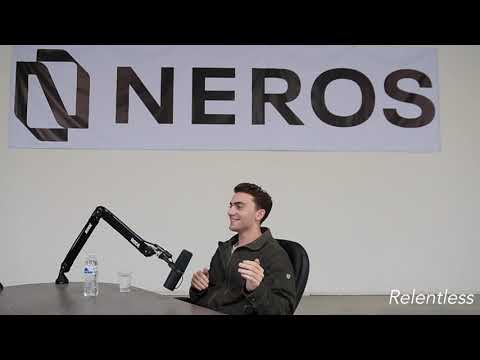
Soren Monroe-Anderson is the co-founder of Neros Technologies, a defense-focused drone startup based in the United States. He grew up in Alaska with a deep, lifelong obsession with designing and building aircraft, boats, and flying machines, which eventually led him to become a world-class competitive FPV drone racer before transitioning into defense technology. The conversation traces his journey from childhood tinkering to founding Neros, revealing how his hands-on engineering instincts, competitive racing discipline, and manufacturing-first mindset shape his approach to building unmanned defense systems at scale.
Early Life and Obsessions
From the age of six or seven, Soren spent his free time sketching designs for bush planes and boats on graph paper, visiting Merrill Field in Anchorage to study real aircraft up close, and reading library books on how planes and boats are designed.
His parents were highly supportive of his interests, taking him to shops to source materials for projects like a hang glider he designed at age eight, even though they vetoed actually building and flying it.
He designed a hovercraft from plywood and a leaf blower in fifth or sixth grade as a science fair project, and later built a hydrogen generator using electrolysis to extend the leaf blower’s runtime and power output.
He also used that hydrogen generator to make bottle rockets by filling water bottles with hydrogen and oxygen gas underwater, then igniting them.
He and his best friend David experimented with model rocket engines, gunpowder, and PVC pipes, launching projectiles with electric igniters.
His father ran a street-level mapping company and was an early adopter of drone imagery, buying Soren a Phantom 1 with a GoPro for aerial photography.
Soren mounted an FPV (first-person view) system—Fat Shark goggles and a camera/video transmitter—onto the Phantom using velcro, which transformed his experience because the Phantom was reliable and had good battery life, unlike the RC planes that required extensive building and troubleshooting.
He crashed the Phantom a few times pushing it like a racing drone, which led him to start building actual racing drones.
Competitive Drone Racing
After moving to New Hampshire at age 12, Soren got more serious around 2016–2017, attending major events like the MultiGP International Open where he met top pilots including his future co-founder Olaf.
In 2016 he realized how much better top pilots were; in 2017 he watched vanover win MultiGP Nationals online (he didn’t qualify), which motivated him intensely.
From 2017 to 2019 he flew every single day, structuring his school schedule to leave early and fly until dark, logging what he estimates as thousands of hours.
He emphasized intentional practice over raw flight hours, drawing a parallel to video games where many people have thousands of hours but few are genuinely good.
He competed in DCL (Drone Champions League) and DRL (Drone Racing League) with Team USA (Quad Force One), traveling to six European countries and South Korea in 2019.
DCL used larger drones with tighter spec constraints and a different flying style where momentum matters more; DRL had stadium events with NBC coverage but Soren disliked the simulator-based races and pre-filmed formats.
At a DCL race, he experienced what he believes was electronic warfare—the first time he’d ever encountered it.
His 2019 Nationals performance collapsed (from 3rd the prior year to ~26th) due to a controller failure mid-event, being forced to use unfamiliar equipment, mid-air collisions, and a drone that fell from the sky on a final lap.
In 2020, after a period of simulator racing during COVID, he committed fully to winning the world championship, spending two months flying every day with his friend David in Vermont, treating it as his peak performance event.
He managed the tension between optimizing component selection (motors, propellers, flight controllers, ESCs) and needing enough time to train on a locked-in setup, setting a deadline to finalize his build weeks before the event.
His 2020 championship builds were the most carefully crafted drones he’d ever made.
Entrepreneurial Path Before Neros
Soren had entrepreneurial instincts from a very young age—at his father’s wedding on the East Coast, he collected interesting quartz crystals from the gravel driveway and sold them for $1 each from a garage booth, making about $40.
He designed and sold a drone racing frame, going through the full process of design, packaging, and distribution through retailers, before deciding to focus on being a pilot rather than a product seller.
He designed a minimalist carbon fiber phone case during Christmas break 2019–2020 while in Costa Rica, investing $1,500 of his drone racing earnings into a steel mold in China.
He went through a full branding process including logo, website, and brand guide, working with a professional branding agency through mutual connections—his first deep exposure to brand building.
He co-founded FPV Supply Co (originally fpv gates.com) with his friend Liam, addressing the pain point of expensive, hard-to-source drone racing gates.
They tested materials from Chinese suppliers and figured out how to ship rolled gates in poly mailers via ground shipping for around $20 domestically, enabling free shipping on larger orders.
The first batch had material quality issues because the supplier switched materials; they replaced every defective unit, turning angry customers into loyal ones.
The business now runs day-to-day under Silus Propsal, a fellow pilot, and continues to serve the FPV community.
After DRL, he spent about a year working on a hard-tech venture fund focused on early-stage scientists and technologists, which was a useful bridge between racing and founding Neros but wasn’t the right fit because he wanted to build hardware himself.
Founding Neros
Soren couldn’t sleep on March 10, 2023, thinking through the idea for Neros—what the first product should be, how a defense drone company should be structured, and how it would be different. He incorporated in late April 2023.
He set a fundraising bar of $1 million as the threshold that would allow Olaf to join full-time and let him pursue the company with everything he had.
Before raising, he’d only talked to two investors; he built the pitch deck after a trip to Alaska, incorporating early end-user feedback.
Initially skeptical of storytelling’s importance, Soren came to believe that new technology is useless without good storytelling and can be ruined by bad narrative (citing nuclear power as an example).
He learned to encode his identity, motivation, vision, and technical credibility into short, digestible pitches for investors, customers, and recruits.
From day one, Neros was obsessed with the end user. Soren and Olaf leveraged nearly a decade of drone building experience by talking directly to end users and acquisition decision-makers.
They flew drones to places where drones were actually being used, having face-to-face conversations that couldn’t be replaced by remote communication.
In defense, the end user doesn’t usually make purchasing decisions, so Neros has to balance empathy for operators with the needs of procurement.
Products shipped to real operational environments can’t have bugs or issues because lives are at risk and cognitive load is already extreme.
When shipping prototypes, they’re completely honest about limitations and let end users decide if they’re in a position to test.
Neros iterates quickly based on real-world feedback, sometimes making small changes and sometimes scrapping features they were personally attached to.
Manufacturing and Scaling
Neros manufactures domestically in Los Angeles, which is standard for defense companies but challenging because the U.S. supply chain relies on questionable practices and Chinese components passed off as domestic.
The biggest challenge is skilled labor: in Shenzhen, technicians who can solder, run SMT lines, and inspect boards carefully are abundant and inherent to the culture; in the U.S., finding and training such people is orders of magnitude harder.
In Shenzhen, if you need a component or machine, you go to the local electronics market; that ecosystem doesn’t exist in the U.S.
Soren admires that many people in China spend their days making physical things and have deep skilled labor expertise, though he acknowledges questionable working conditions.
Unlike most hard-tech startups that struggle to build one working prototype, Neros already has a working product and is focused on scaling production—a fundamentally different problem.
They’ve set aggressive targets for production volume (e.g., 10,000 drones per month) and are designing their manufacturing process step by step: breaking assembly into stations, then automating, then redesigning the product around automation.
Soren looks to SpaceX as a model—taking something ridiculously expensive, simplifying it aggressively, vertically integrating manufacturing, and changing the game—noting that no one has built a “SpaceX of Defense” yet.
Vision and Personal Reflections
Soren is inspired by the Skunk Works model: small elite teams building revolutionary aircraft (U-2, SR-71 Blackbird, F-117) in remarkably short timelines by stacking multiple enabling technologies and maintaining intense focus.
He also draws lessons from World War II, where the U.S. built more tanks than Germany despite having inferior designs, highlighting the importance of industrial base and production volume—something he believes America has neglected.
Unlike many deep-tech founders, Soren isn’t driven by sci-fi; he’s motivated by things America used to have and has lost—the best defense industrial base in the world, widely available supersonic passenger travel—and wants to restore that capability.
His favorite fictional character is Tony Stark/Iron Man, and he’s designed palm thrusters and turbine systems for a personal flying device, inspired by real-world examples like Jetman (who flies on a carbon fiber wing with four RC jet engines).
The hardest thing Soren overcame was his family’s move from Alaska to New Hampshire when he was 12. He was deeply unhappy for about a year, having lost the friend group and sense of home he’d built in Alaska.
He eventually found his footing through drone racing, which gave him purpose and a new community. He and his racing peers spent what he estimates as 10,000 hours together on Discord—flying, working on drones, and playing video games—forming bonds that remain important to him.
He still feels sadness about not growing up fully with his Alaska friends but recognizes the move gave him access to competitive drone racing that shaped his trajectory.