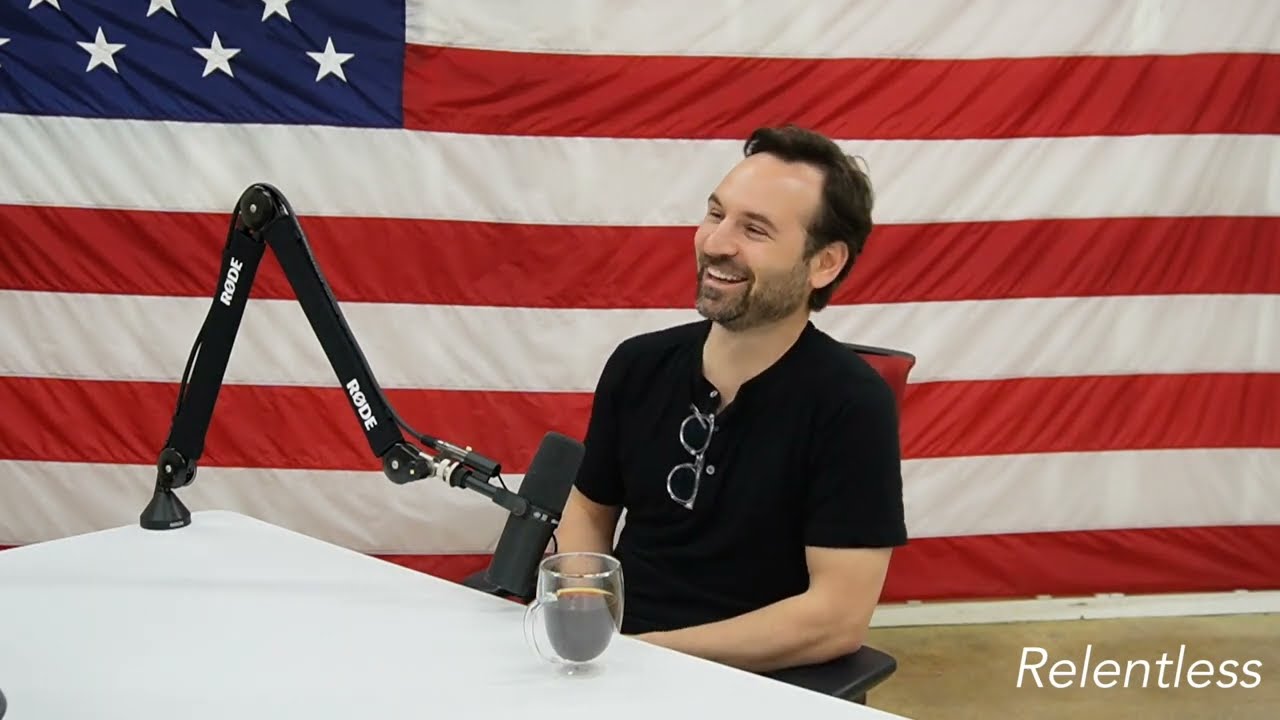
Aaron Slodov is the CEO and co-founder of Atomic Industries, a company building an “AWS for manufacturing” — a platform that makes it as easy to produce physical parts at scale as it is to spin up software infrastructure in the cloud. His path to founding Atomic was shaped by a restless entrepreneurial streak, a physics background, a stint at Google, a previous startup (Remesh), and a frustrating attempt to manufacture plastic figurines that exposed deep inefficiencies in American tooling and manufacturing.
Early Life and Entrepreneurial Instincts
Grew up in Cleveland in a happy, insulated bubble with no exposure to how the rest of the world worked.
Even as a child, he was fascinated by money and systems: he tried to replace dollars with leaves as currency among his siblings, and created a secret encoded language for a small group of friends who foraged and resold found items like bikes and skateboards.
At 17, before the year 2000, he raised $50,000 from family and friends to open an internet café — drafting a real contract with his lawyer father and partnering with a local coffee shop owner. She backed out after being unsettled by a teenager presenting a legal agreement, and the project fell apart when no comparable venue could be found.
He also built a small web development business in the late 1990s, teaching himself HTML and early web tools when platforms like Tripod were among the first to let people build personal homepages.
Menial Jobs and Self-Education
After high school, he deliberately delayed college, feeling immature, and worked a series of jobs — landscaping, pizza delivery, data entry at his father’s law firm, and furniture delivery to wealthy clients in a WASPy Ohio suburb.
The thinking was to expose himself to how different businesses operated at different scales. The landscaping owner fired him, saying “you remind me too much of myself.”
He also taught himself C++ and Java, building small physics engines and basic game components, though nothing that became a real product.
Studying Physics
His decision to study physics was driven less by career logic and more by a spiritual quest. Raised in a half-Jewish, half-Christian household, he explored Buddhism and other traditions before concluding that understanding the physical reality of the universe was the most meaningful pursuit for him.
He was a troubled high school student — not because of any single dramatic issue, but from boredom and acting out. He accumulated detentions, refused to attend them, escalated to Saturday schools, then in-school suspensions, and eventually jumped out a window to escape one. His GPA never exceeded 3.0.
He had to start at community college, take remedial courses, and work his way up before applying to a state school physics program. He was 22 or 23 when he started.
During undergrad he worked two full-time jobs (40–60 hours a week) on top of a full course load, taking 5.5 years to finish his degree. His family offered no support, treating it as something he had to figure out himself.
Google and Early Career
During college he did a summer internship at SETI in California, living on the former Moffett Field Air Force Base next to Google’s headquarters — an experience that planted a seed.
After graduating in 2010, he applied to PhD programs and to a new Google residency program for recent graduates. He got into strong PhD programs but chose Google instead, experiencing subconscious anxiety about choosing a corporate path over pure science.
At Google he first worked briefly on a renewable energy project (a cheap heliostat/solar mirror farm) under the R&D group, which was shut down when Larry Page and Sergey Brin took over from Eric Schmidt and deprioritized non-CS-centric projects.
He then moved to the self-driving car division (the “Chauffeur” project) under Sebastian Thun and Anthony Levandowski. His work involved tearing down Lexus hybrid SUVs, mounting mechanical transducers across the frame, and vibration-profiling the vehicles to determine safe sensor placement.
Remesh: From Social Platform to Market Research
After Google, he spent six months at Meetup in New York to get startup experience before returning to a PhD program.
During his PhD, he co-founded Remesh with a friend from Kent State. The original vision was born during the 2012 Palestine-Israel flare-up: the friend, whose lab included both Palestinian and Israeli students, wanted to build a platform that could disaggregate the voice of people from their governments — a real-time conversational tool that could let a million people talk to a president or to each other.
They literally cold-called the White House switchboard, worked their way to the right people, and were turned down because they were a tiny startup, not Twitter or Google.
They pivoted to market research, going through the TechStars fintech accelerator in Cleveland (despite having nothing to do with fintech — the TechStars team liked them enough to take a chance). They also went through Flashstarts, Cleveland’s first local accelerator, founded by the former owner of Books.com (sold to Amazon).
They hit $1 million in revenue quickly. A key breakthrough came when Aaron sniped the Procter & Gamble CMO at a bizdev event held at the Cincinnati Reds stadium, sat next to him during opening remarks, pitched him in 15 seconds, and turned it into a major anchor customer.
They raised a Series A, but Aaron eventually left due to a conflict over location and role: the board wanted everyone in New York; Aaron, who had been jet-commuting weekly from Cleveland, refused to move and wanted to focus on building an engineering team rather than being an individual contributor. The discontinuity led to a split.
The Figurine Nightmare and the Birth of Atomic Industries
After leaving Remesh, Aaron explored a passion project: a subscription box for D&D and Warhammer-style plastic figurines — monsters and scenery, not just character models. He validated demand with a landing page and pre-orders.
Manufacturing was a disaster. Injection molds are expensive, require minimum orders of 50,000–100,000 units, and involve a long, opaque process of design validation, mold creation, sampling, and iteration — mostly outsourced to factories in China via Alibaba with little control or transparency. The economics didn’t work for a high-mix, quick-turn product.
This experience led him to spend a year researching the tool and die industry in the US, posing as a business school student to interview shop owners and learn the trade’s secrets. He found that technology and manufacturing remain fundamentally disconnected — “oil and water.”
He saw an opportunity to build what AWS did for software infrastructure, but for physical manufacturing: a platform that makes producing any part as easy and on-demand as spinning up a server. He believes a weak industrial base is a national security vulnerability and that the ability to manufacture at will — from toys to F-35 parts to submarines — is what adversaries should actually fear.
He brought on two co-founders during Y Combinator in 2021: one a long-time friend (15+ years) passionate about reindustrialization, the other a shop owner from Michigan he’d met during his research year and who reached out expressing interest in leaving his company.
YC’s 2021 batch was remote and included several hard-tech companies (Stoke Space, Moxie, a satellite imagery company). Aaron noted how different the fundraising landscape was from his Remesh days — valuations and prices felt inflated, and the zero-interest-rate environment was in full effect. He valued YC for its network of accomplished partners and its growing openness to hard-tech startups, including a recent request for startups focused on reshoring US manufacturing.
Lessons on Co-Founders and Personal Resilience
On co-founders: he treats the choice as a marriage. Conflict resolution matters more than success — most startup failures trace back to founder breakups. He would never make a snap co-founder decision; both of his Atomic co-founders were people he’d known or built relationships with over a year or more.
The hardest thing he’s ever overcome was a traumatic event before age 18 that he keeps private. It was transformative — it set off his spiritual exploration and shaped who he became. He doesn’t believe he’ll ever fully get over it, but it’s a core part of his story.