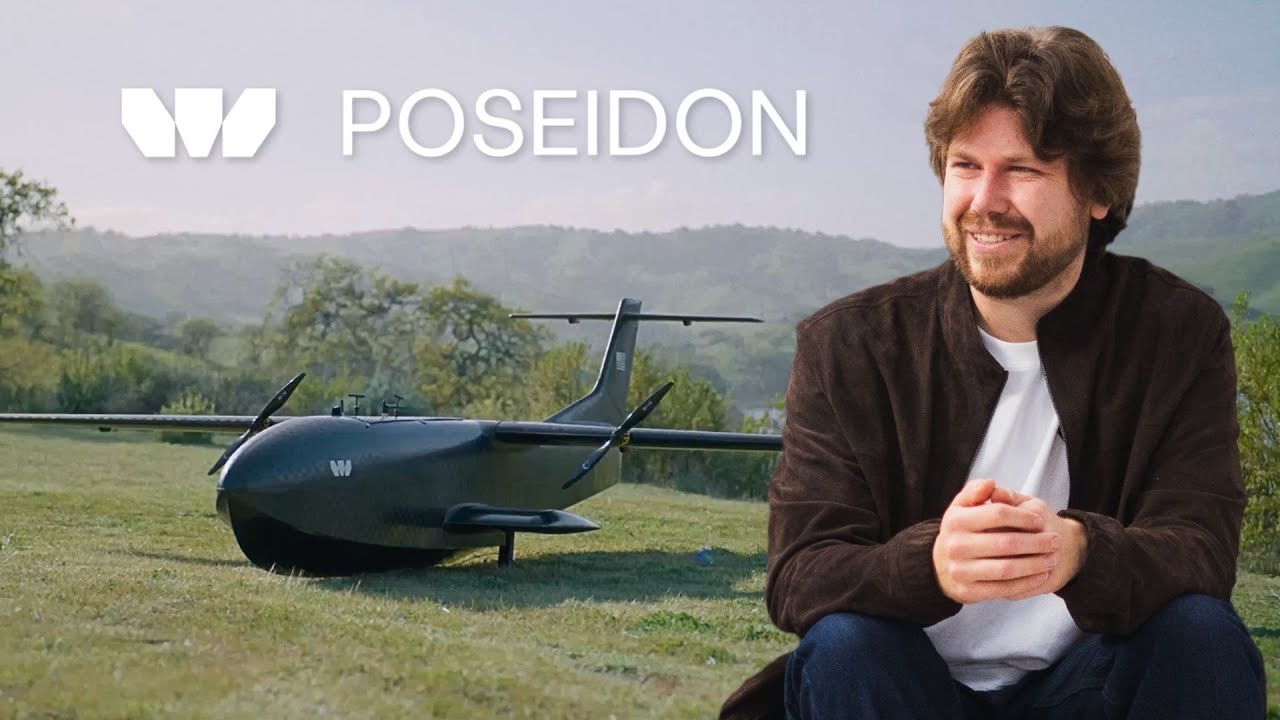
David Zagaynov, co-founder and CEO of Poseidon, is building unmanned cargo planes to drastically reduce the cost of moving goods by air. After working at Amazon, he saw that while ground logistics had been heavily optimized, the aircraft used for air cargo had barely changed in 50 years. Poseidon’s core insight is that removing the pilot eliminates the cockpit, life support, and human-rating requirements, which cuts weight, fuel burn, and maintenance costs. The company is now in a sprint to fly two prototype platforms, Heron (a seaplane) and Egret (a land-based plane), by mid-2026, with a long-term vision of operating its own logistics network, including purpose-built cargo airports.
The problem with air cargo today
Air cargo planes are ancient. The average regional air cargo plane is 35–40 years old, with fleets like the Cessna Caravan certified over 40 years ago and still in widespread use.
Innovation is stifled by certification costs and airline incentives. Certifying a new manned aircraft can cost hundreds of millions to billions of dollars. Airlines that buy these planes want to run them for decades, so manufacturers only make iterative improvements to already-certified frames and engines.
The Cessna Caravan is the workhorse of regional air cargo. It costs roughly $1,100–$1,200 per flight hour to operate, split roughly equally between fuel, maintenance (airframe and engine), and crew.
These planes were not designed for cargo. Most are retrofitted passenger planes. They often “volume out” (run out of space) before reaching their weight limit, because their holds aren’t optimized for package density, which averages around 5–6 lbs per cubic foot for e-commerce shipments.
The industry faces a worsening pilot shortage. Pilots who start at regional cargo carriers leave for better-paying airline jobs once they have enough hours. By 2035, half the eligible pilots will be forced into retirement by age limits, massively exacerbating the shortage. Missed flights due to pilot gaps incur heavy fees.
Regional operators are barely profitable and getting squeezed. FedEx and UPS constantly push for lower costs per ton-mile, and smaller operators have little margin to absorb increases. Many are consolidating or going out of business.
Poseidon’s approach: remove the pilot
Taking out the pilot is the single biggest lever. It removes the cockpit, windows, and life support systems, saving significant weight and space. This allows smaller, cheaper engines and a fundamentally different airframe design.
Certification is easier without humans on board. The FAA’s primary concern with manned aircraft is protecting the lives of people on board and on the ground. Unmanned aircraft face a simpler certification path, especially under the new Part 108 framework (expected to become law early 2026), which creates a clear regulatory path for large cargo drones flying beyond visual line of sight.
Target operating cost: $400–$500 per flight hour, roughly 60% less than a Cessna Caravan. This comes from three factors:
No crew costs (remote pilots can oversee multiple planes, moving toward full autonomy)
Fuel burn cut by more than half through modern composite construction, optimized design, and the absence of human-rating requirements
Maintenance dramatically reduced through fewer parts, simpler engines, and composite airframes that don’t corrode (a major problem for seaplanes)
The planes are designed to be the “F-150 of the sky” — cheap, reliable cargo trucks optimized purely for moving mass from point A to point B, not derived from any existing manned platform.
Two platforms: Heron and Egret
Heron is a seaplane; Egret is land-based. They share the same wing, tail, avionics, and engines. The main difference is the fuselage, adapted to their respective operating environments.
Both are named after the same family of birds that live in different environments — a reflection of how the same core engineering is adapted to water and land operations.
The design philosophy is “a box with wings.” If a box with wings were the cheapest way to move cargo, that’s what they’d build. The fuselages are optimized around the 5–6 lbs per cubic foot density of typical e-commerce packages.
Poseidon started with ground effect vehicles (inspired by Soviet ekranoplans from the 1960s–70s) but expanded beyond that because ground effect only works in certain environments (over water, with low waves). The mission broadened to reducing cost per ton-mile across the entire air cargo spectrum.
Prototyping and learning: the Seagull story
Seagull was Poseidon’s first real aircraft, a quarter-scale prototype seaplane. It went from clean-sheet design to first test flight in about 6 months with roughly 3.5 engineers.
The first prototype crashed during testing at Golden Gate Park lake at 1 a.m. — chosen because it was the only time the RC boat lake was empty. The plane flipped and started sinking. Zagaynov stripped down and swam 100 meters into the lake (which had a foot of duck poop on the bottom) to drag it back.
That failure led to a ground-up redesign: Seagull. Seagull validated payload, range, autonomous controls, and satellite link communication. It still serves as a testbed for avionics and control algorithms being developed for Heron and Egret.
Key lesson: design for manufacturability. Techniques that work for a one-off prototype are a nightmare when scaling to hundreds of planes. This lesson is directly informing how Heron and Egret are being built.
The first test flight used RC controls operated by Rick, a test pilot found on a forum who ran Northern California’s largest RC flying club. The team handed him the controls and trusted him not to crash. He did excellent.
Manufacturing and scaling
Poseidon is highly vertically integrated, doing most manufacturing in-house under one roof. Their process is closer to composite boat manufacturing than traditional aerospace.
Carbon fiber composites are central to the design. They’re light, strong, corrosion-free (critical for seaplanes), and allow mathematically optimal wing and fuselage shapes because parts are laid into molds. This reduces part count by roughly an order of magnitude compared to traditional aircraft (Boeing’s 747 has ~120,000 suppliers).
The current facility is 25,000 square feet in San Francisco, but it’s already too small. The 50-foot-wide, 50-foot-long planes don’t fit through the doors — wings and fuselage must be shipped separately and assembled at test sites. Zagaynov recently convinced neighboring tenants to break their lease early to expand into adjacent space.
The company has moved five times since starting in a Foster City garage, each time running out of space within months. The next step is building a dedicated factory for initial rate production, followed by a larger facility to produce tens of dozens of planes per month.
Market strategy and go-to-market
Poseidon is dual-use, targeting both defense and commercial markets. The defense market provides R&D funding and early traction at lower technology readiness levels (TRL 6–7), while the commercial side provides a growing business line that bridges the “valley of death” between R&D and full-scale deployment.
They’re talking to both large operators (FedEx, UPS) and smaller regional cargo carriers. The smaller operators are particularly receptive because their fleets are aging out, pilot costs are rising, and they’re under constant margin pressure.
Lower operating costs unlock new routes and markets. At $400–$500/hour, Poseidon’s planes can compete with partially filled narrow-body jets (like 767s flying Miami to the Bahamas) and even some truck routes. They can also serve remote areas currently limited to slow boat deliveries.
The planes are designed to land on degraded runways (gravel, unpaved), opening up places like rural Alaska that conventional jets can’t serve.
Long-term, Poseidon wants to build and own its own network of cargo airports. A cargo-optimized airport would be radically different from a passenger airport: shorter runways directly connected to warehouses, no terminals, no TSA, no passenger facilities. Owning just a few airports would make Poseidon one of the top airport owners in the country.
Loading and unloading: the humanoid robot angle
Even without a pilot, someone still needs to load and unload cargo. Zagaynov sees humanoid robots (like the recently launched Neo) as a natural solution. A Neo could ride inside the plane, hop out at a remote landing site at 3 a.m., unload packages onto a dolly, plug itself back in, and be ready for the next flight.
A single remote operator could manage a fleet of Neos across multiple airports, unloading one plane while others are in transit. Most e-commerce packages are under 60 lbs, within the reported lifting capacity of current humanoid robots.
Poseidon has a pre-order for a Neo robot and plans to test it as soon as the hardware is available.
What won’t change
The fundamental need to move things around the world is permanent. From the Silk Road to modern e-commerce, logistics have been existentially important to human civilization. Wars have been won and lost based on supply chain reliability.
E-commerce continues to grow, and with it, the demand for faster, cheaper, more flexible delivery. The U.S. and Europe are both major producers and exporters, and global supply chains are deeply interconnected (e.g., a camera bought in the U.S. may contain a lens from Zeiss in Germany).
In a world of abundance, more stuff gets built, and more stuff needs to move. The goal is to carry more, with more flexibility, at lower cost.
What Zagaynov is most excited about
Getting Heron and Egret in the air. The first flight of Seagull was an emotional moment where the entire team cried. He expects the first flight of the full-scale cargo planes to be “that times 100.”
The team. As Poseidon has grown, the people joining the mission have been exceptional both as engineers and as people, and sharing the culmination of that work in a successful test flight is what drives him.