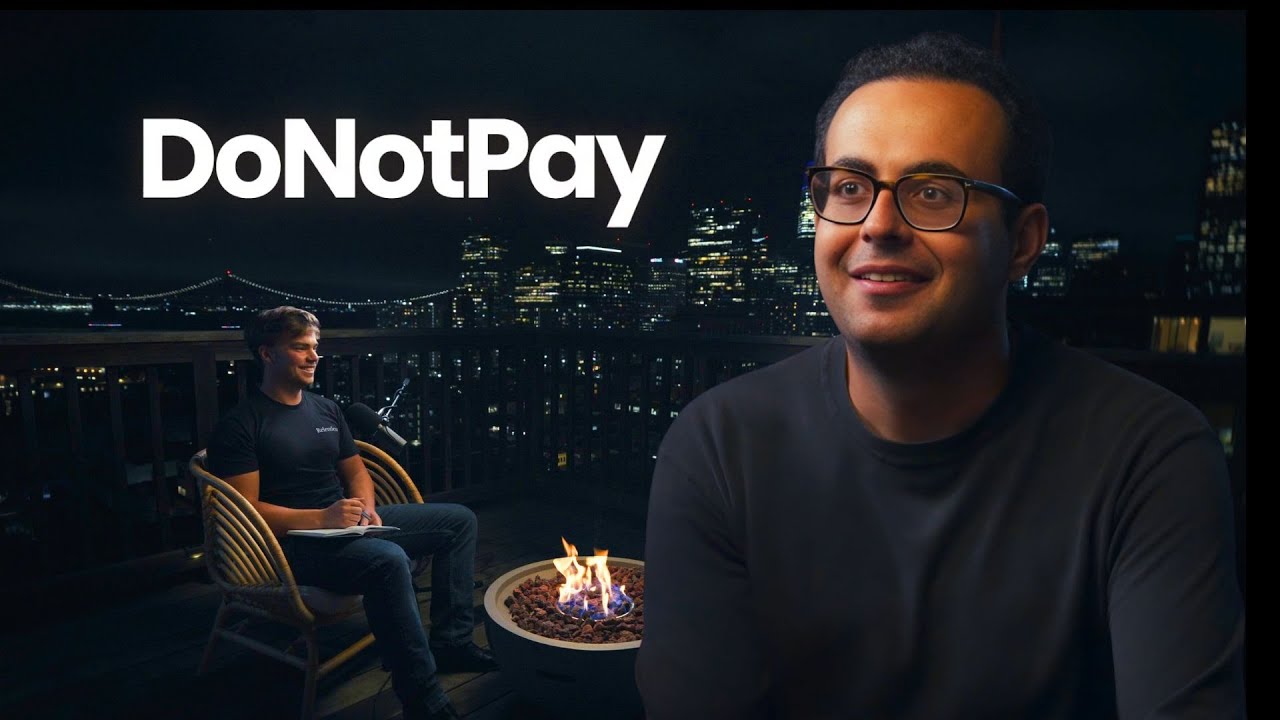
Joshua Browder is the founder and CEO of DoNotPay, a consumer rights automation platform, and Browder Capital, an early-stage venture fund. He grew up as the son of Bill Browder, the human rights activist behind the Magnitsky Act, which froze billions in Russian state assets and made his family a target of Russian intimidation. That upbringing instilled in him a fearlessness and a sense of perspective that shaped his entrepreneurial path. He came to Stanford partly inspired by California weather in YouTube lectures, built DoNotPay from a free parking-ticket-fighting tool into a profitable subscription business, and became an active seed investor in young founders.
Being anti-authority from a young age
Browder traces his anti-authority streak to childhood software development, where he could build things without asking permission.
As a teenager, he sold iPhone themes on Cydia, the jailbroken app store, bypassing Apple’s restrictions.
He then built an unofficial app for the UK sandwich chain Pret A Manger in 2010, without any contract or authorization.
The app rose in the App Store charts and Apple wanted to feature it on the “What’s Hot” section, sending him a consent form to sign as if he were an official representative.
He signed it as a teenager, and Pret’s legal team only realized his age when he showed up in person.
Rather than sue a 14-year-old sandwich enthusiast, Pret invited him for a private kitchen tour with the CEO and made the app the official Pret app, which still exists today.
Growing up with a high-profile activist father
His father, Bill Browder, was Putin’s number one foreign enemy for pushing the Magnitsky Act through the US Congress, which froze massive amounts of Russian state wealth and became the framework for Ukraine-war sanctions.
The family faced both legal harassment (arrest warrants in countries like Spain) and physical intimidation (Russians showing up at their house).
Browder says the experience taught him to be fearless and to keep everyday problems in perspective.
Investing philosophy and what he looks for in founders
Browder entered investing through the Teal Fellowship, where he invested his $100,000 fellowship prize money in Adam Gild’s pre-seed startup, which became a unicorn.
He now runs Browder Capital and looks for founders with an “irrational chip on their shoulder” and a deep personal connection to the problem they’re solving.
He cites his own behavior waiting on hold for four hours to save $20 as the kind of obsessive personal stake he wants to see.
He specifically looks for evidence of exceptionalism in a founder’s childhood, such as selling Minecraft servers, running sneaker bots, or building enterprise SaaS as a teenager.
He believes younger and younger founders will achieve meaningful results because information transparency is at an all-time high, though he cautions against letting AI do all the thinking for you.
He sees himself as both a player and a coach, and argues that still running DoNotPay makes him a better investor because the tactical landscape changes every six months.
Creative ways DoNotPay fights for consumers
DoNotPay has built over 100 consumer rights products. Two of Browder’s favorites:
Suing robocall companies: Under the Telephone Consumer Protection Act, Americans can claim $1,500 per spam call. DoNotPay created a virtual credit card linked to the company, not the consumer. When a robocaller tries to process a payment, the payment network reveals the business’s real name, address, and phone number, which DoNotPay uses to generate the legal letter. One New Jersey man has used this to earn close to $100,000 and buy a new roof.
The free trial card: Inspired by Warren Buffett’s story of suing Harper’s Magazine in small claims court to cancel an unwanted subscription, DoNotPay pioneered a virtual credit card for free trials that isn’t linked to the user’s real card, so subscriptions can’t auto-renew without consent. Robinhood Gold later introduced a similar feature.
The Warren Buffett interview that changed everything
As a Stanford sophomore, Browder was invited to interview Warren Buffett on stage at the Microsoft annual summit in Seattle, where Jeff Bezos, Sam Altman, and Satya Nadella were also present.
He asked Buffett a unique question no one had asked before: about a time Buffett fought for his own consumer rights.
Buffett shared the story of suing Harper’s Magazine in his 20s for continuing to bill him after he canceled, representing himself in small claims court and winning both a refund and punitive damages.
Two major things came from the event:
Reed Hoffman was in the audience and offered Browder an EIR internship at Greylock, which became one of DoNotPay’s first pre-seed investors.
The Teal Fellowship noticed Browder’s tweet about the interview and encouraged him to apply, which gave him the funding to build DoNotPay seriously.
Living in the original Facebook house
Browder and a summer roommate rented a rundown house in Palo Alto for $4,000 each in 2018, only to discover on moving day that it was the actual house where Mark Zuckerberg started Facebook (not the one from the movie).
A shrine of photos with Zuckerberg, Eduardo Saverin, Sean Parker, and Dustin Moskovitz was still inside.
The house became a stop on Silicon Valley tourist bus routes, and Browder used it as a growth hack: he let tour groups inside if they downloaded the DoNotPay app, acquiring his first users this way.
The next year, DoNotPay took over the entire house as a live-in office.
The lowest point and the pitch that turned everything around
Six months after the Facebook house, Browder was struggling to raise an institutional seed round despite hundreds of thousands of users and daily CNN coverage.
Nineteen VCs in a row rejected him, and he was close to giving up and returning to Stanford or taking a job at Google.
A legendary Silicon Valley lawyer and advisor, Damien Weiss, told him the pitch was wrong and gave him three changes to make overnight:
Do a live demo instead of relying on a PDF deck.
Put logos of aspirational companies on the slide (Intuit, Honey) so VCs could understand the vision.
Switch from a Credit Karma-style lead-gen model to a subscription model, since lead-gen was toxic after the Cambridge Analytica scandal.
The next day, with nothing about the company changed, the new pitch got an on-the-spot offer, and word spread so quickly that previously rejecting VCs piled in.
Browder draws a broader lesson: when things aren’t working, minor differences in framing and strategy can completely shift momentum.
Building a profitable, dividend-paying business
DoNotPay has more money in the bank than it has raised and was one of the first VC-backed companies to issue dividends to shareholders.
When Browder considered the dividend, a mentor warned him the market doesn’t value dividends and companies like Google never do them. Two months later, Google issued its first-ever dividend.
He sees DoNotPay as a trendsetter and emphasizes constant adaptation, noting that what worked six months ago may not work today.
Paying it forward and the generosity of Silicon Valley
Browder describes Silicon Valley as a “pay it forward” ecosystem.
He tells a story (without naming the person) of a founder whose first company he backed with a $25,000 personal check. That company didn’t work out, but the founder went on to build an immensely successful second company and gave Browder millions of dollars in equity as a gift, with no legal obligation to do so.
He contrasts this with how people outside the Valley, such as in Alaska, perceive wealth, noting that the culture of generosity and reinvestment is what makes Silicon Valley function.
Superpowers and weaknesses
Browder describes himself as unpolished and straightforward, not a smooth fundraiser.
His strength is tactical, day-to-day execution. He focuses on baby steps and avoids getting lost in abstract mental frameworks, which he thinks many in Silicon Valley over-index on.
Marc Andreessen’s influence
Marc Andreessen was Browder’s first institutional believer in both DoNotPay and Browder Capital.
At their first meeting over breakfast at Andreessen’s Atherton home, Browder was considering making DoNotPay a nonprofit or free public service.
Andreessen convinced him that the organizations with the biggest global impact are businesses, not nonprofits, and that a for-profit structure would let DoNotPay scale its mission. Andreessen Horowitz wrote a $1 million pre-seed check.
Mansa Musa and the lesson about inflation
If Browder could witness one historical event, it would be Mansa Musa’s gold pilgrimages. Musa was the richest person in history (inflation-adjusted), an African king who would give every person in a city a bar of gold.
Despite the massive wealth injection, bread prices would rise 100x because everyone was nominally rich, causing hyperinflation.
Browder sees this as an early lesson that you can’t just distribute money without a structure to allocate resources efficiently, and as a historical argument against communism.
What he would change about the world
Browder would blend the best qualities of every major city into one place: San Francisco’s delusional ambition, Washington DC’s focus on power, New York’s capitalism, LA’s self-care, and London’s multiculturalism and reduced emphasis on racial categorization.
He describes the UK as more of a melting pot where race is less of an official category, noting his own mixed Turkish and Slavic heritage.
Growing up with dyspraxia
Browder has dyspraxia, a condition adjacent to dyslexia that affects spatial perception and motor skills, making even basic tasks like sucking from a straw difficult as a child.
Coding became his outlet because it relied on keyboard shortcuts and gave him confidence through mastery.
He now supports dyslexic and dyspraxic children through investments (like Speechify, a reading assistance tool) and donations to a UK special-needs high school for dyslexic, dyspraxic, and autistic students.
Doing things against his own interest
For the first four years, DoNotPay was a completely free public service with no business model, ads, or payment, including products like homeless assistance applications.
Browder believes this built lasting brand loyalty and that the goodwill came back as karma, even though a business model from day one would have been faster.