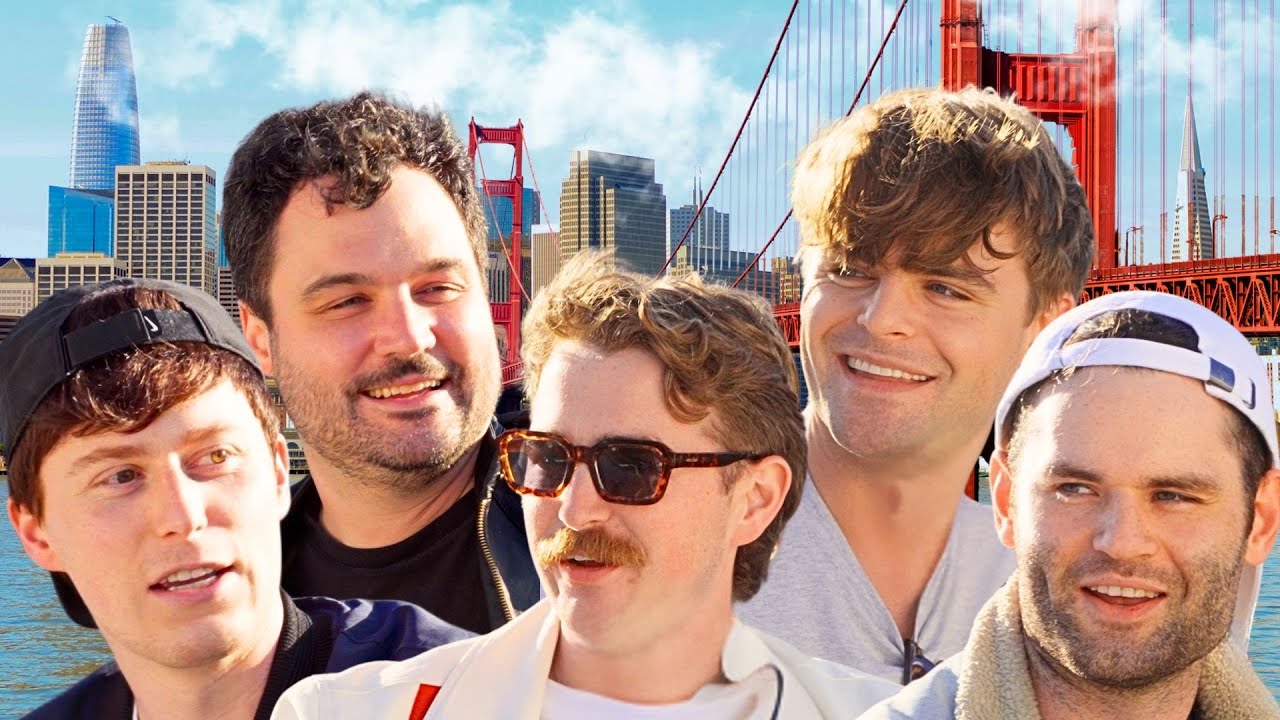
A group of hard-tech founders — Sam D’Amico (Impulse Labs), Jason Carman (Story Company), Will O’Brien (Ulysses), Michael LaFramboise (Aurelia Systems), and Lawrence Allen (Teranova) — gathered on a ferry in San Francisco to discuss why they’re building physical-world companies in a city that has spent the last two decades dominated by enterprise SaaS, and what it will take for Silicon Valley to return to its industrial roots.
Impulse Labs makes the highest-performance electric stove on the market and is building battery-storage technology into every medium-sized appliance to reinvent the grid.
Aurelia Systems builds laser weapon systems designed to shoot down drones at ~10 cents per shot, a 10 millionx cost improvement over kinetic interceptors.
Ulysses builds autonomous underwater vehicles for ocean ecosystem restoration, offshore survey, and defense.
Teranova makes terraforming robots that lift land out of flood zones.
Story Company makes sci-fi films inspired by real science and engineering, aiming to provide “narrative air cover” for hard-tech founders.
The frontier spirit is still here — and it’s shifting back to hardware
San Francisco was born from successive frontier movements: Catholic missions, the Gold Rush, industrialization, the counterculture, and the early computing revolution. The founders argue that frontier spirit never left — it just went inward into software and the internet for 15 years, and is now moving back into the physical world.
The city’s industrial past is literally beneath their feet: the waterfront was built from abandoned Gold Rush ships filled with garbage, and the Bay Area’s former industrial facilities built much of America’s WWII military might.
Several founders chose SF deliberately despite being from elsewhere (Ireland, Detroit, rural California) because the concentration of talent, venture capital willingness to fund hard problems, and frontier culture makes it the best place to build physical-world companies.
The difficulty of hardware companies is a feature, not a bug: it’s easier to recruit top talent for hard problems, easier to raise capital for massive missions, and the resulting companies are more durable than SaaS businesses.
Why they started: personal missions, not market opportunities
Sam (Impulse Labs) wanted to cook pizza fast, realized every appliance has a peak-power-to-average-power mismatch that batteries can solve, and discovered the appliance industry has been neglected for decades while AR/VR became the domain of mega-cap companies.
Lawrence (Teranova) grew up in a Bay Area flood zone, saw the city planning to spend $1 billion on a seawall, and thought first principles said the land should just be lifted up.
Will (Ulysses) grew up on the coast of Ireland, got “nerd sniped” by the problem of dying subsea ecosystems, and realized underwater technology hasn’t meaningfully advanced since the 1980s despite revolutions in self-driving cars and drones.
Michael (Aurelia) watched YouTube footage from the war in Ukraine, saw millions of drones making traditional air defense economically untenable ($100K–$1M per interceptor vs. $10K per drone), and set out to build laser systems that can shoot drones down for ~10 cents.
Jason (Story Company) grew up on movies like Star Wars, noticed that post-internet culture lacks a shared narrative, and wants to make sci-fi films that inspire people about real technology being built for good.
Building a future worth living in — not escaping the real world
The founders are explicitly pushing back against the transhumanist/AGI cult trend in San Francisco that wants to upload consciousness and escape physical form. They’re focused on human flourishing in the material world: stewarding the oceans, controlling the skies, terraforming the land, powering the grid, and telling stories that give people a shared sense of purpose.
Will frames it in terms of Genesis: humanity is given dominion over the seas, air, and land, but also commanded to steward them. The ocean feeds 3 billion people daily and employs a billion, yet we know more about the surface of Mars than our own oceans.
Jason worries about the 300 million Americans who aren’t in San Francisco getting excited about the future. He sees storytelling as essential to giving people a sense of identity and hope, and wants to provide “narrative air cover” so that when someone hears “10,000 robots in the ocean” or “terraforming land,” they don’t immediately think “evil megalomaniac.”
Sam pushes back on the AI bubble narrative: even if AGI doesn’t pan out, the infrastructure buildout (storage, optical switches, data center equipment) benefits hardware companies. He’s shipped AI-written code for his stove and sees AI as a tool for building physical things, not a replacement for them.
The AI cult problem — and a cultural rebalancing
Sam describes the AI cult phenomenon in SF: group houses of 20- and 30-somethings screening for elite AI researchers, forming competing sects around different visions of AGI, some of which have gone “way off the deep end and turned into murderous cults.” It’s “gang wars for nerds” within a one-mile radius in Lower Haight.
Will frames the cultural shift using high school archetypes: for decades Silicon Valley was dominated by “nerds” (mind), then “art kids” (spirit/counterculture), and is now seeing a return of “jocks” (body) — founders getting into MMA, TRT, combat sports, and church. He sees this as a healthy rebalancing.
The founders point to Brian Armstrong’s Coinbase memo (“this is a place where you do your work”) as a seminal moment pushing back against ideological capture of tech companies, and see the rise of hard-tech founders as inseparable from this cultural correction.
The real bottleneck: America forgot how to build things
The founders identify a decades-long pattern of de-industrialization driven by:
Ralph Nader-era litigation and environmental law that built institutions for blocking physical-world projects
The end of the Cold War, which removed the urgency behind defense industrial capacity
Financialization under figures like Jack Welch, turning physical industries into spreadsheets
Offshoring to China, which is now the best in the world at the electric technology stack
The result: software engineers are massively overpaid relative to the value they add, while the people who actually build things have been disenfranchised, laid off, and underpaid. Meanwhile, AI researchers command $200M+ compensation packages for “pre-training secrets” that haven’t yet shown up in models.
The integer problem: Elon Musk can build in the US because he’s big enough to buy one of every machine needed and have demand that makes each machine pay for itself. Startups can’t afford integer numbers of machines, so they go to China. The solution is fractional equipment rental and shared fabrication spaces.
China comparison: Shenzhen builds skyscrapers on every other block and is a city of abundance where you can build anything. Silicon Valley is strip malls that haven’t changed since the computing era began. The US is wealthier than China but can’t build things as fast.
Fixing San Francisco: housing, culture, and political engagement
Housing: San Francisco was downzoned in the 1970s and is still paying for it. Artificially induced scarcity has made a two-bedroom apartment $4,500–$6,500/month and rising. A new rezoning bill (SP979) that would allow six-story buildings instead of two-story is close to passing, but faces opposition from figures like Aaron Peskin, who started his political career trying to block a dorm at UC Santa Cruz.
Culture: The founders lament that SF’s counterculture and arts scene has been displaced by tech transplants who don’t reinvest in nightlife or local culture. They joke that “500,000 art hoes would fix San Francisco” — meaning the city needs more diverse demographics and creative people, not just software engineers. Jason’s company is making an SF romcom to make living in the city look desirable again.
Political engagement: Unlike the previous generation of founders who signed the Giving Pledge and outsourced their agency to London-based effective altruism nonprofits, this generation is going to DC, hiring lobbyists, and learning to operate the political system. Multiple founders share the same lobbyists and have been to DC repeatedly in recent weeks. Initiatives like Grow SF, Y Combinator’s political engagement, and California Forever (a proposed new city in Solano County with space for shipbuilding and hardware startups) signal a shift toward political literacy among hard-tech founders.
Cautionary tale of nonprofit incentives: San Francisco’s homeless nonprofit ecosystem illustrates how well-intentioned programs create perverse incentives — nonprofits handing out needles and foil attract homeless people from across the country, and only homeless nonprofits can run affordable housing, creating a conflict of interest that displaces working-class residents.
What they’d do with the money
When asked what they’d do with liquidity in 10–15 years, the founders overwhelmingly favor building things over traditional philanthropy:
Michael would plant manufacturing facilities in places like Detroit, employing thousands of people and creating massive secondary economic effects (tax revenue, wage increases, downstream jobs).
Sam argues that giving money to hardware companies has more leverage than giving to NGOs — you can build huge things that employ people and produce goods at profit margins, creating self-sustaining economic engines.
The group agrees that the second and third-order effects of building real businesses in neglected communities (like what SpaceX did in Brownsville, Texas) dwarf the impact of traditional charity or art museums.