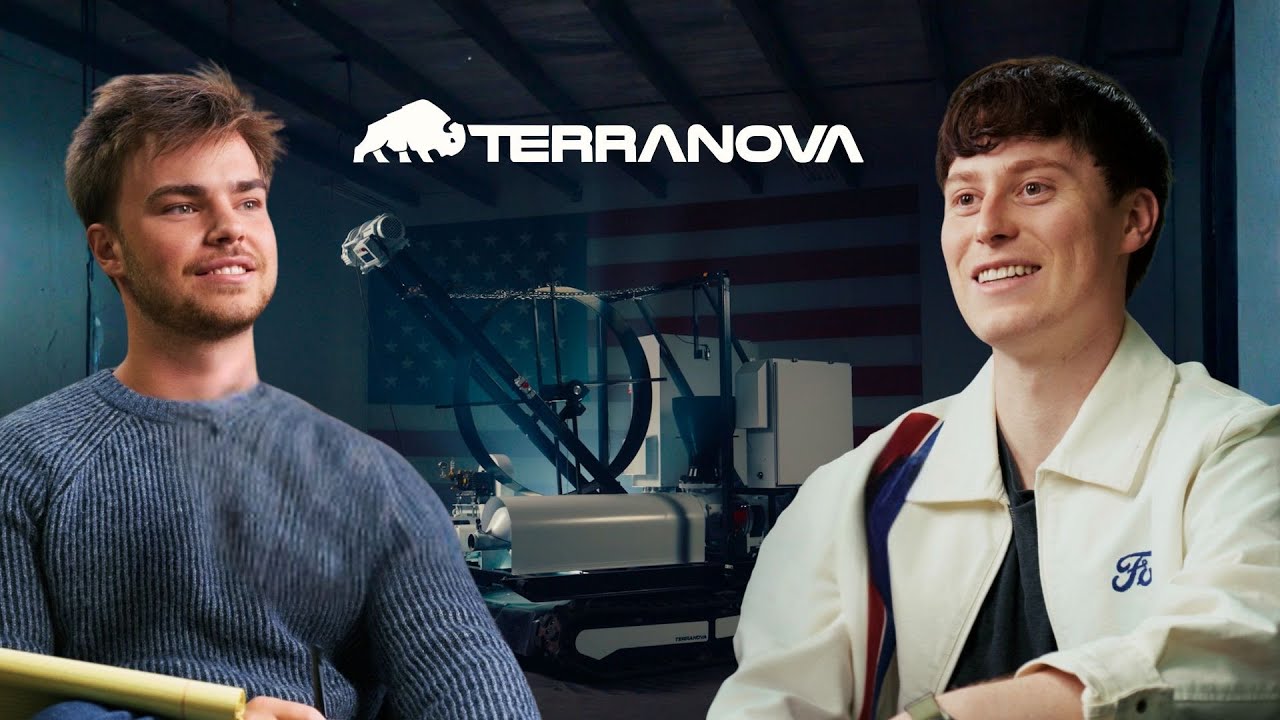
Terranova is a startup that lifts land out of flood zones by injecting wood chip slurries underground, a process that could protect entire cities from flooding and subsidence at a fraction of the cost of seawalls or traditional fill. Laurence Allen, co-founder and CEO, spent years developing the technology in stealth before launching publicly, and the company is now building its first production robots and lining up infrastructure projects across California and internationally.
How land raising works
Terranova injects a slurry of water, wood chips, and a thickening agent into the ground at depths of 15–300 feet, progressively lifting the land surface above.
The system uses modular units: an “ARC” shipping container that processes slurry and supplies energy, and mobile “Prometheus” rovers that deliver the injection at pressure.
One ARC can support three rovers, and together they can lift one acre by one foot per day.
The rovers can operate up to 220+ feet from the ARC, which is critical on soft or wet terrain where trucks get stuck.
The process is dramatically cheaper and faster than alternatives:
Seawalls cost $500–900 million for small municipalities and take years to build.
Traditional fill requires demolishing structures, importing dirt, and 1–2 years of compaction.
Terranova targets ~$50,000 per acre-foot versus ~$250,000+ for cement-based grouting (material alone).
No permanent hardware is left behind—well bores are simply abandoned after injection, simplifying permitting.
The technology achieves ~2mm precision in elevation control, enabling it to lift highways, runways, and even occupied buildings without cracking or disruption.
The sinking city problem
Subsidence—land sinking due to groundwater extraction, petroleum pumping, or compaction of fill—is a massive and underappreciated global problem.
California’s Central Valley has subsided ~20 feet from groundwater extraction.
Jakarta is sinking so fast the Indonesian government plans to relocate the capital.
Mexico City has sunk 80–100 feet; some areas of San Rafael sink 2 inches per year.
Tyrrhenia sinks ~25 cm per year.
Terranova positions itself as “the anti-subsidence”—a scalable way to reverse or prevent sinking without stopping the underlying extraction.
Long Beach, CA solved its petroleum-related subsidence by injecting seawater underground to offset extraction.
Florida alone produces enough waste wood annually to lift the entire city of Miami by the amount it needs in one year.
Why wood chips
Wood chips are the ideal injection material because they are volumetrically abundant, essentially free, and flow well underground.
California municipalities pay ~$1,000 per semi-truck load to dispose of wood chips, often burning them in subsidized biomass plants.
Sources include agricultural waste, urban tree trimming, sawmill waste, and forest fire fuel management.
Wood is neutrally buoyant in slurry form, flowing far more easily than cement grout, which requires injection wells every ~10 feet versus Terranova’s ~1,000 feet.
Once underground in anaerobic conditions, wood chips do not decompose and behave like MDF or particle board—potentially performing better than natural dirt in earthquakes.
The historical precedent exists but was never scaled:
In the 1970s, Venice lifted an entire island with buildings using cement “mudjacking”—it worked but was never repeated because of cost.
Alaska built its highway system on wood chip surface fill; the Dumbarton Bridge in the Bay Area sits on 15 feet of wood chip fill.
Terranova’s innovation was replacing expensive cement with free wood chips and replacing research teams with autonomous robots and AI planning software.
How Terranova started and developed the technology
Allen’s co-founder began filing patents in 2020; the company incorporated in late 2021 while Allen was interning at SpaceX.
Allen turned down a return offer at SpaceX to join full-time, a decision driven partly by his original team having dispersed.
The company stayed in stealth for years, bootstrapping and developing technology cost-effectively before raising venture capital.
The first prototype was a hacked concrete pump (“Old Faithful”) that could push wood chips underground but constantly clogged due to tiny ball valves.
Validation happened at a walnut orchard project site in Sacramento, in a flood-prone area behind levees where the road sits above the farmland.
The team iterated from a combined mothership-rover unit to the current separated ARC-and-Prometheus architecture, solving clogging with a proprietary additive and autonomous slurry control.
Working with partners vs. vertical integration
Terranova deliberately chose not to vertically integrate well drilling, instead licensing the technology to local contractors.
Well drilling is a mature industry; Terranova’s non-permanent wells avoid the permitting requirements of permanent water wells.
Contractors like Gotham (which does FEMA projects) bring speed, local permitting knowledge, and existing customer relationships.
Allen’s philosophy: “We don’t want to be the reason cities are waiting. If they need to steal our technology to save Jakarta, I’d implore them to do so.”
The company uses AI tools trained on ~900,000 geocores to model California’s underground geology, allowing cost estimation and project vetting without on-site work.
Customers can explore flood risk and model injections at plan.terranova.inc.
Scaling and manufacturing
Terranova is building 10 Gen 2 Prometheus units in the next 12 months, along with 3 ARC units, enabling concurrent projects and higher-acreage work.
The 24-month plan focuses on getting the technology into contractors’ hands across multiple states and countries.
Allen is meeting the Prime Minister of Cambodia in January; Indonesian ministers are already pitching Jakarta on the technology.
Manufacturing is done in-house in Berkeley, CA, in a 16,500 sq ft facility at $1/sq ft.
The team shifted sourcing away from China to maintain control of their supply chain.
The robots are mechanically straightforward—large pumps on tracks with batteries and custom sensors—making domestic fabrication feasible.
Allen lives in the office, a practice he adopted from his time living across the street from SpaceX, to maximize productivity and team connection.
Lessons from SpaceX
Allen worked on Dragon thermal protection systems and briefly on Raptor engine production during a crisis surge.
He absorbed lessons in high-stakes reliability, rapid iteration, and the empowerment of young engineers given real ownership of hardware.
The “surge” culture—like being called in at midnight on Thanksgiving when Elon discovered a Raptor production problem—shaped his approach to urgency and intensity.
At Terranova, Allen hires “spiky young makers” who tinker obsessively, prioritizing demonstrated maker portfolios over brand-name employers.
He specifically seeks people like Ben Noak (a legendary maker YouTuber he met as a kid) and judges candidates by a 10-second scroll of their project portfolios.
He’s found that ex-SpaceX, Tesla, and Zipline engineers are good not because of those employers but because of the maker backgrounds they had before joining them.
Challenges and personal cost
The hardest part of the journey has been the toll on personal relationships—a 2.5-year relationship ended largely because Allen never left the office, and he struggled to enjoy social situations without feeling he should be working.
He frames startup success as directly correlated with “blood, sweat, and even tears,” and feels a responsibility to his team, investors, and the global need for the technology.
Early technical challenges included getting equipment to work reliably and repeatably, solving the clogging problem, and developing jetting technology to lower initial injection pressure.
On the business side, Allen is careful to set honest expectations with customers about Terranova’s stage as a venture-backed company, using make-whole clauses in contractor bonds to manage risk while acknowledging the company’s early status.
Biotech detour and broader vision
Allen originally pursued bioengineering, driven by a babysitter who died of a rare protein misfolding disorder. He did CRISPR research in high school and entered Berkeley as a bioengineer.
He concluded that rare disease cures are chronically underfunded because the patient populations are too small to justify commercial drug development.
He switched to mechanical engineering to build Terranova, but remains excited about the future of human augmentation, designer babies, and technologies like CRISPR and Neuralink.
He sees a coming revolution in human biological modification that will follow the current robotics revolution.