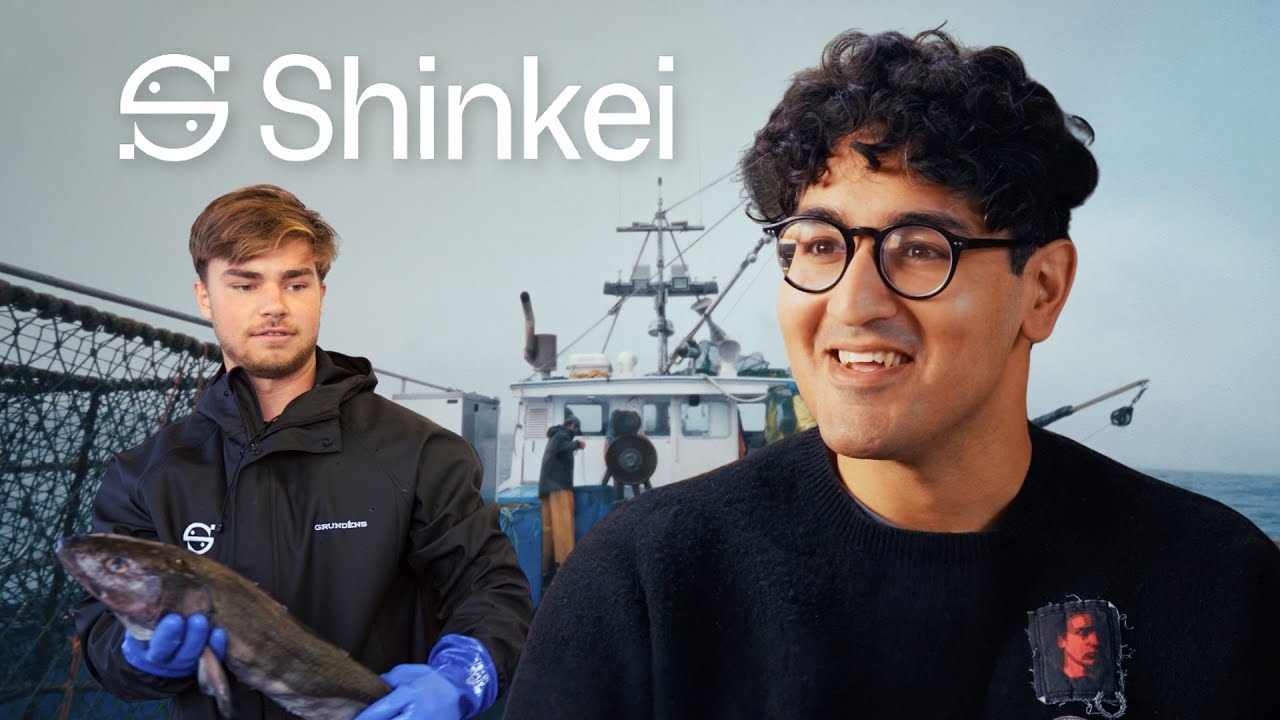
Saif Khawaja is the co-founder and CEO of Shinkei Systems, a company building robotic systems that radically improve how fish are processed at sea. Their flagship product, Poseidon, is a compact robot deployed on fishing boats that humanely euthanizes fish by spiking them in the brain and then cutting the gills — a process inspired by kosher slaughter. This stops the production of stress hormones and lactic acid, resulting in fish that lasts up to three times longer, tastes significantly better, and retains more weight. Shinkei is also building a consumer brand called “Ceremony Grade” that brings traceability, quality grading, and artisanal handling standards to a commodity market that has historically had almost none.
The problem with how fish are traditionally processed
Most fish sold in the US are left to suffocate on deck, flopping around for anywhere from 5 minutes to over an hour depending on species and handling. This releases stress hormones and lactic acid, which decay meat quality and shorten shelf life.
The process is gruesome and inhumane — Saif compares it to putting a cow’s head underwater.
Fish are sometimes crushed under other fish, and conditions vary wildly.
The value of better handling accrues downstream, not to the fisherman. Retailers care about shelf life and weight retention; chefs care about flavor. But fishermen don’t capture that value, so there’s little incentive to handle fish better.
The US fish supply chain is deeply opaque. When you buy fish at a retailer, you typically only get a packout date, not a landing date or projected shelf life — unlike milk with an expiry date. There’s no grading system for quality the way there is for beef (USDA Prime, grass-fed) or poultry (pasture-raised).
Roughly 61% of all fish landed in North America don’t make it to a plate, with much of that waste happening late in the supply chain.
Over 90% of American fish are imported, and about half of domestic catch is shipped to countries like Ecuador, Peru, Guatemala, or China for processing — where labor costs are a fraction of US wages — then frozen, thawed, and refrozen before returning, destroying meat quality.
How Poseidon works
Poseidon is a 2.5 by 3-foot robot that goes on the deck of a boat. Fishermen feed fish in headfirst, one by one. The robot spikes the fish in the brain (euthanizing it instantly), then cuts the gills to open the major artery.
The heart, still active after brain death, pumps out the blood, resulting in a less acidic carcass with fewer stress hormones and less nutrition suspended in blood — which starves bacteria and extends shelf life.
The fish lasts up to 3x longer, tastes better, and retains more weight (yield per pound).
The technical challenge is surgical accuracy at industrial speeds. Shinkei needs to hit a 2mm target (about half a pinky fingernail) while processing fish fast enough for commercial throughput.
Early iterations of Poseidon
The very first prototype was a 3D printer with a nail stuck on the end, using off-the-shelf OpenCV computer vision in Saif’s dorm room. He would generate G-code to move the printer to a specific spot and puncture a plastic fish.
The first commercially deployed version used a high-pressure water jet instead of a nail — Saif’s reasoning being that there’s plenty of water in the ocean. But saltwater corrosion made it extremely difficult to find water jets that could handle the environment at the required PSI.
This approach was throughput-limited by cycle time and couldn’t reach the industrial speeds needed.
The current system achieves the required precision and speed, and Shinkei can now produce a new version of Poseidon every two weeks with one person, or six robots per month with three technicians.
Shinkei’s business model
Shinkei gives robots to fishermen for free under a zero-cost lease, in exchange for exclusivity on any product that goes through the machine.
They pre-order the fish, pay a small floating premium above commodity price, take ownership of the fish, and assume the risk of selling it.
Fishermen see a 25–100% improvement in net income. The robots pay for themselves in four weeks.
This transforms a stochastic income system (hunt and hope) into a cash-flow-predictable one.
Shinkei is vertically integrated — they control the technology, the harvesting standard, and the brand — because the differentiation and margins come from the full stack, not any single layer.
Ceremony Grade: creating a new standard for fish
Shinkei sells fish under the “Ceremony Grade” label, a new standard and philosophy for the highest-quality fish. It encompasses how the fish are caught, handled, packaged, temperature-monitored, and traced — not just geography.
Saif draws a loose analogy to the Michelin Guide; Shinkei’s fish is served at nearly every Michelin-starred restaurant in the US that serves fish, and they have access to over 50 stars through their distribution network.
Top restaurants in Europe are reaching out by name, and Shinkei’s fish is being auctioned off in Tokyo.
Their main species is black cod, a traditional commodity fish they’ve transformed into something prized by the best chefs in the world.
The long-term vision is to bring Ceremony Grade fish to nationwide retailers, where consumers could pay around 10% more (eventually reaching price parity) for fish that lasts longer and tastes better — the same way you’d choose grass-fed beef or pasture-raised chicken.
Celebrating fishermen
Shinkei’s philosophy centers on celebrating fishermen, who are among the most underappreciated and dangerous workers in the US. Commercial fishing is consistently in the top three most dangerous jobs by fatality rate.
Saif spent a month and a half on a small boat in New England early on, including getting caught in a tropical storm with 25-knot winds, 8–10 foot swells, and 6–7° pitch and yaw. It was a formative experience.
He sees fishing not as agriculture but as natural resource extraction — more like hunting or mining, with no fixed real estate or guaranteed production.
Fishermen are partners, not customers. Shinkei has turned down fishermen they didn’t trust to follow handling protocols, even with a long backlog.
How the company started
Saif was born in Canada, raised in Saudi Arabia and Dubai, and came to the US alone at 18 for college. He was pursuing a PhD when he read an essay by a vegan activist titled “If Fish Could Scream,” which argued that because fish lack vocal cords, they receive far less empathy than terrestrial animals.
He initially wanted to explore how fish express pain — putting sensors on skin to convert electrical signals into sound, essentially “giving fish a voice.” In researching that, he discovered the euthanasia and bleeding techniques that became Shinkei’s core technology.
He took the company full-time at 22 in mid-2022.
The early days were extremely difficult. Hardware wasn’t hot, it was a down market, and few venture investors understood or cared about fish harvesting. Saif went through about a year and nine months of financial uncertainty, running out of money to eat at times, before the C round wired in January 2024.
He averaged 2.5 hours of sleep per night in the week and a half leading up to the first deployment, bringing Chick-fil-A and cigarettes to keep the team going.
The first deployment was at a fish farm in upstate New York (Simon Farm) in January 2023 — a brief detour into aquaculture that Saif acknowledges was the wrong call. He always knew he wanted to work with wild fisheries.
Following intuition over advice
Saif’s core philosophy is following his intuition even when it contradicts expert advice. He was told wild fisheries were too niche, maritime environments too harsh, and the whole idea unreasonable. He was told to sell the technology as robotics-as-a-service to fish farms instead of selling fish. He ignored all of it.
He attributes this to a tough childhood as an immigrant in the Middle East, culture shock coming to the US without family support, and years of being told he lacked a conventional career path — which built up a high pain threshold and independent mindset.
The biggest example was finding his co-founder, Reed. Everyone told him to find any technical person and call them a co-founder. He met 40–50 people from top companies and never found the right fit. When he met Reed (who was at Starship at the time), it was an immediate, almost romantic connection — “co-founder at first sight.” Reed was initially skeptical, but Saif persisted, and they refounded the company together.
Reed scrapped much of the previous technology, helped develop the Ceremony Grade model, and brought analytical rigor and leadership that complements Saif’s abstract thinking and sales ability.
Saif sees himself as the abstract thinker and missionary (sales, vision, recruiting), while Reed is the analytical planner who distills big ideas into concrete execution. They trust each other deeply and operate in complementary swim lanes.
Scaling up
Shinkei is now active in every major US fishing region — Alaska, Washington, California, Texas, Louisiana, and New England — and exporting to six countries.
They’re gearing up to launch in several nationwide retailers in the coming months, with the goal of making Ceremony Grade fish available at scale.
Their scaling criterion is trust, not just demand. They want to be on every boat that will respect their handling protocols. So far, no fisherman has said no to the economics, but Shinkei has turned down a small number they didn’t trust to honor the partnership.