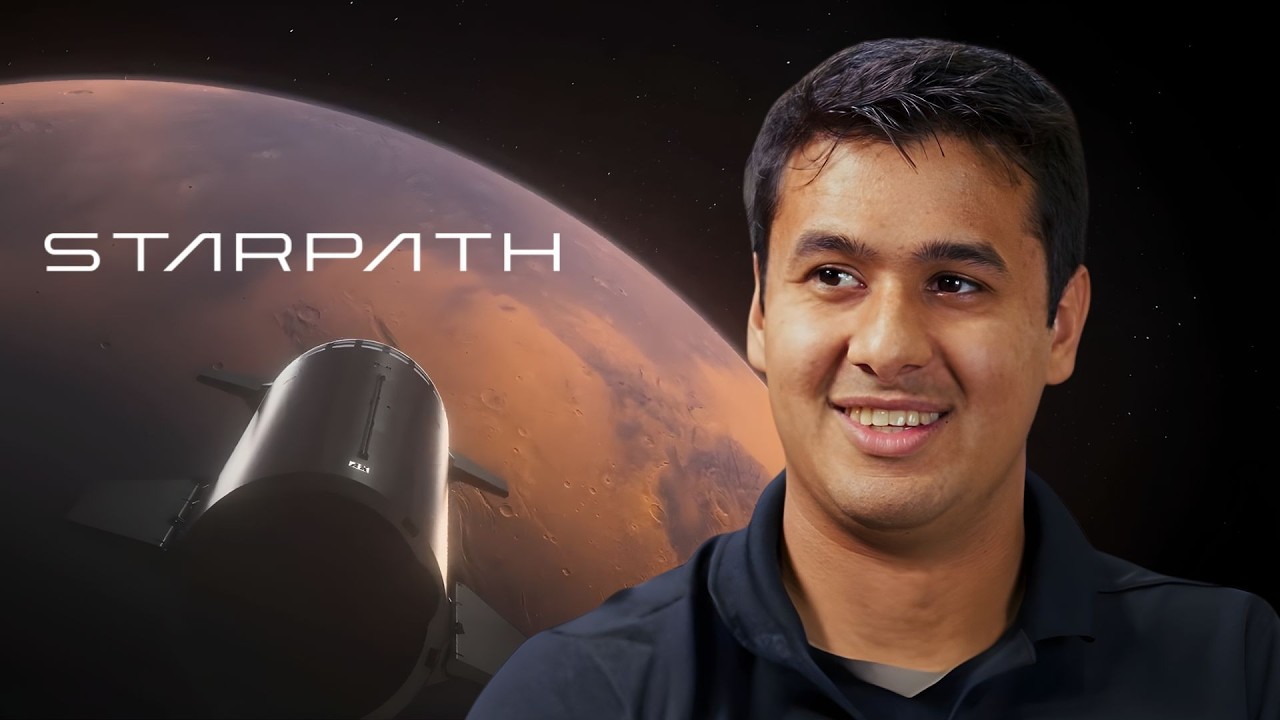
Saurav Shroff is co-founder and CEO of Starpath, a company building the machines needed to make life multi-planetary, starting with Mars. The core insight driving the company is that a rocket propellant production plant on Mars is the second most important piece of infrastructure for a Martian city (after the rocket itself), because it is physically impossible to fly from Earth to Mars and back without refueling on Mars. Starpath’s mission is to build the equipment—rovers, chemical processing plants, and solar panels—that makes propellant production possible at a cost low enough to make a round-trip to Mars affordable for a middle-class American.
Why a propellant production plant is the core engine of a Mars city
A fully and rapidly reusable rocket (like SpaceX’s Starship) is the first machine needed—without it, transport costs are prohibitively expensive.
The second, less obvious machine is a rocket propellant production plant on Mars. Without it, any Mars trip is a one-way journey, which nobody will take.
90–95% of all power produced by a Mars city will go toward making rocket propellant, regardless of city size or stay duration. This is because a rocket engine is roughly the most energetic device humans have ever built (short of nuclear fusion), and the propellant plant is essentially running that process in reverse—undoing the most energetic reaction humans do.
The chemistry is simple (high school level): extract water from Martian dirt, split it into hydrogen and oxygen via electrolysis, then react the hydrogen with CO₂ from the Martian atmosphere to produce methane. The methane and oxygen become rocket propellant. The hydrogen-CO₂ reaction actually releases a small amount of energy that feeds back into the process.
Starpath builds three machines to implement this: (1) a power generator (solar early, nuclear later), (2) a chemical processing plant that ingests mined dirt and performs the reactions, and (3) a mobile mining rover that digs up dirt as feedstock.
Starpath’s rover: 100x cheaper than NASA’s
NASA rovers have historically cost hundreds of millions of dollars each (not including launch costs), because they are optimized for doing many disjoint science experiments, not for producing resources cheaply.
Starpath’s rovers cost in the low hundreds of thousands of dollars—over 100x cheaper—driven by vertical integration of expensive components and a design optimized for mass production.
Starpath has built 10 rovers to date. The first was made from commodity aluminum beams bought at Home Depot in 3 weeks for under $10,000. Each successive rover fixed problems from the previous one. Rovers 1–5 each took under 8 weeks and cost under $15,000.
Rover 10 is the first to pass thermal vacuum testing (TVAC)—the “graduation exam” for space rovers—making it the lowest-cost rover ever to do so. Rover 11, finishing early next year, is even better and easier to produce.
Testing evolved from a literal sandbox in the office (to test basic driving and mining shapes) to mining calibrated frozen subangular dirt inside a thermal vacuum chamber that simulates lunar/Martian conditions.
Solar panels: from necessity to a standalone business
Starpath initially set out to build deployable solar structures for Mars and the Moon, then tried to buy solar cells from existing vendors. Quotes came back at $100–$400 per watt—10 to 20x more than the $10–$20 per watt they needed for the total system to be viable.
The existing satellite supply chain was designed for extremely low volumes (a few satellites per decade) and had no incentive to reduce costs. The economy is shifting toward scale, but the supply chain hasn’t kept up.
Starpath vertically integrated solar cell production for its own needs, then realized it had an extremely valuable product. It now sells solar panels to satellite companies for about a tenth the price of existing vendors, while also using them for its own missions.
Why Mars, not the Moon
Starpath’s rovers and plants are designed to work on both the Moon and Mars, and the company plans to deploy on the Moon first for revenue and testing.
But Mars is fundamentally more interesting long-term because it has organic compounds (carbon, hydrogen, nitrogen, oxygen). From these, you can make virtually anything humans need: rocket propellant, electricity, drinking water, breathable oxygen, food, medicine, computer chips, even Tylenol and bread.
The Moon lacks these elements in accessible quantities. There is no plausible future with liquid oceans, an atmosphere, or Tylenol production on the Moon. Mars, in 100 years, could look significantly more Earth-like.
SpaceX’s own plans confirm this: they are building a fleet of 1,000+ Starships, which only makes sense for Mars (the round trip takes ~4 years). Two Starships could service all of low Earth orbit; five could handle all lunar cargo.
The scale problem: energy, propellant, and fleet size
A self-sustaining Mars city requires roughly 1 million tons of cargo on the surface. Each Starship carries ~100 tons, so a fleet of 1,000 Starships making 10 trips each gets you there.
Each person on Mars needs ~100 kilowatts of power—roughly 200 times the per-person consumption on Earth—because most energy goes to making the rocket propellant for their eventual return trip. A rocket is the size of a swimming pool in terms of propellant volume.
To power even a moderately sized Mars city, Starpath needs about 40 gigawatts of solar capacity—roughly 1,000 times more than all spacecraft solar panels produced on Earth today combined (~40–50 megawatts per year).
Starpath’s solar production line can already produce millions of watts per year and is scaling to hundreds of megawatts per year. Beyond ~1 gigawatt, nuclear reactors become more cost-effective (higher power per mass shipped), and Starpath expects nuclear to take over for long-term growth.
Iteration philosophy and scaling culture
Starpath’s core philosophy is fast, cheap iteration: build the simplest possible version, test it, document what’s wrong, fix it, repeat. This is not a novel idea, but Starpath applies it with unusual discipline.
The company grew from a garage in San Francisco with just the founders to a team of about 16 people. They are growing as fast as they can find mission-aligned talent.
To maintain fast iteration as they scale, Starpath keeps individual responsibility clearly scoped: each engineer owns a specific component end-to-end, with in-house tools and budget to prototype and test quickly—so a 100-person org can iterate as fast as a 5-person one.
The biggest technical hurdle is not any single engineering problem but the cost and speed of manufacturing in the US. If fabrication were nearly free, iteration rates would double or triple. Starpath designs for mass production from the start.
The “idiot index” and how Starpath cuts costs
The idiot index is the ratio of a finished good’s price to the cost of its commoditized raw inputs. In aerospace, it is routinely 100:1 or higher (e.g., a $40,000 motor that could be made for $400).
In nuclear power, the idiot index is ~140:1, driven largely by regulation—ironically, regulation from people who care about the environment, despite nuclear being one of the cleanest energy sources.
Starpath’s approach: identify the single most expensive component (usually 90% of cost), then either vertically integrate its production, substitute a cheaper alternative, or redesign around it. This alone typically yields a 10x improvement.
For rovers, Starpath achieved 100x cost reduction partly by questioning whether extreme reliability (fault tolerance, redundancy) was economically necessary—accepting that 10–30% of robotic missions might fail is far cheaper than engineering for 99% reliability.
Risks and the business case for Mars
Starpath prices technical risk at near zero: even if it takes 2–3 tries to get the technology right, the business still works.
The biggest risk is demand: even if Starpath builds everything perfectly—cheap propellant, beautiful habitats, delicious food—will enough people want to pay $100,000–$400,000 for a round trip to Mars?
The initial pitch is adventure: the greatest humans have ever undertaken, comparable to becoming a Navy Seal. This will work for the first hundreds or thousands of people.
The harder challenge is maintaining demand once the novelty wears off—making Mars compelling as a place to live and work, not just visit. Starpath’s approach is to start with the fundamentals (energy, propellant, water, oxygen) and layer on quality-of-life improvements over time.
Saurav personally would accept a 20% chance of death to go to Mars, though he acknowledges the actual safety target should be airplane-level (near zero). For robotic missions, Starpath is comfortable with a 10–33% failure rate because the hardware is cheap enough to absorb.
Mission alignment and hiring
Starpath is extremely selective, having stayed at ~16 people. The biggest reason for not hiring someone is lack of mission alignment.
They want people who look at what Starpath is building and think “this is the next big thing,” and who are undeterred by claims online that what Starpath has already done is “impossible.”
Saurav’s personal regret-minimization framework: if he had 10 years left to live, he would spend the first 2 years getting equipment on the Moon for testing, then mass-produce the proven machines (100,000+ units—a small number by automotive standards) and store them in warehouses, ready for the rocket. He would then go to Mars himself and do manual labor—repairing mining robot teeth, for instance—because the satisfaction of building something real with your hands is irreplaceable.