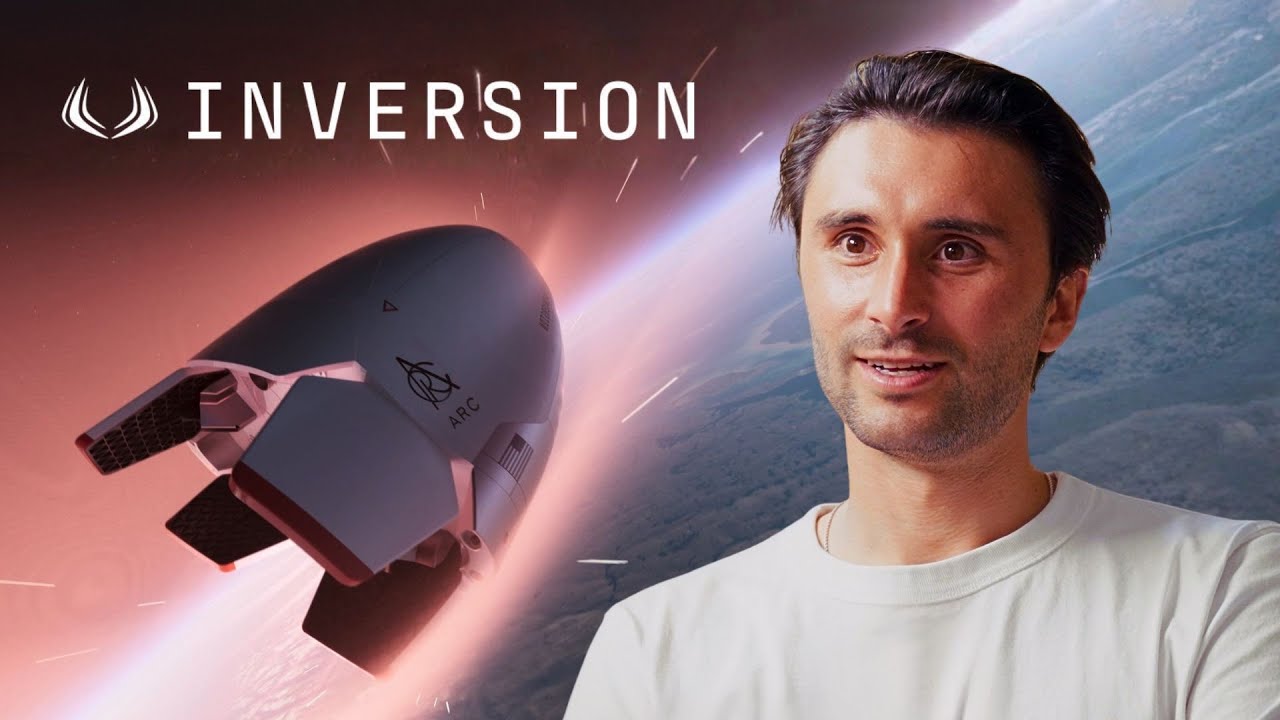
Inversion is building re-entry vehicles that deliver cargo from orbit to anywhere on Earth in under an hour, targeting primarily military customers who need rapid access to remote or contested areas. Co-founder and CEO Justin Fiaschetti argues this capability will fundamentally reshape global logistics the way aircraft did a century ago, moving beyond digital uses of space (internet, imaging, GPS) to physical delivery of goods.
The core idea and why it matters
Space is already a platform for digital access to the globe, but no one has used it for physical cargo delivery at scale.
The insight came while Fiaschetti was working in the launch industry: if satellites can beam data anywhere, why can’t spacecraft deliver physical payloads?
The company was founded in January 2021, went through YC Summer 2021, and raised a seed round that fall.
The value proposition is not about the cost of the goods delivered but the impact of having them exactly when and where they’re needed.
Mission-enabling cargo: medical supplies, communications equipment, sensors, ISR assets.
The analogy is stealth aircraft: the F-17 Nighthawk reduced a 32-aircraft operation to one plane because it could penetrate defenses alone. Similarly, space-based delivery could eliminate massive terrestrial logistics chains.
Ray: the first demo mission
Ray was a ~2-foot-wide spacecraft built entirely in-house by a team of just 25 people, launched in January 2025 on a SpaceX Transporter mission.
Originally planned for August 2024 but delayed, which allowed more ground testing.
The goal was learning: both company processes and specific subsystems (software, GNC, attitude control) that would transfer to the main product.
An engine ignition failure prevented the planned deorbit and landing, but the mission still achieved 90–95% of its learning objectives.
A single small component on an ignition board failed, preventing the torch igniter from firing.
The team still demonstrated orbit raising/lowering maneuvers, attitude control, and proper burn direction.
Aerodynamic performance and parachute deployment couldn’t be tested in flight, but both can be validated through other means (drop testing, simulation, heritage materials).
How they test and iterate
Heavy investment in simulation infrastructure allows daily design iteration.
Nightly full-mission simulations run with varying inputs (GPS failure, etc.); results are reviewed each morning and inform the next day’s work.
This has reduced the need for wind tunnel testing, which is expensive and time-consuming. Simulations are accurate to within ~10% of wind tunnel results.
Parachute testing uses creative methods:
Low dynamic pressure: drop from a hot air balloon (zero vertical velocity, worst-case scenario).
High dynamic pressure: deploy from an aircraft in a dive to replicate flight-speed shock loading.
ARC’s aerodynamics are completely novel (lifting body design), unlike Ray’s, so Ray’s aerodynamic data didn’t directly transfer. But software, GNC, and propulsion systems did.
ARC: the main product
ARC is a 4-foot-wide, 8-foot-tall lifting body re-entry vehicle designed for DoD cargo delivery.
Can store payloads in orbit for up to 5 years and deliver them anywhere on Earth in under an hour.
Lands softly under parachute.
Lifting body design provides over 1,000 km of cross-range in either direction, meaning fewer vehicles are needed to cover a geographic area.
Single main parachute (no backup), a deliberate design choice enabled by not having humans on board, which reduces cost and complexity.
Why now: launch costs and reusability
The business became viable because of rapid rocket reusability, particularly SpaceX’s Falcon 9.
The key unlock is not just lower cost per launch but the production efficiency and launch cadence that reusability enables.
A single booster flying 31 times means you don’t need to manufacture 31 boosters.
Competition is increasing (Neutron, New Glenn, Starship), which should drive costs down further.
Fiaschetti draws an analogy to semiconductors: as launch costs drop, the market for space-based services expands nonlinearly.
Better product: the supply base doesn’t offer components optimized for their specific needs. Using off-the-shelf parts forces thousands of small compromises.
Speed and cost control: lead times from suppliers can be 18 months (valves) to 3 years (parachutes). Building in-house eliminates this.
Supply chain reliability: a single delayed supplier can delay the entire vehicle by 6 months. In-house production removes this risk.
Production optimization: once in production, every component can be redesigned for cheaper, simpler manufacturing. Components can be combined or eliminated.
They don’t vertically integrate where the external supply chain is already fast and competitive (e.g., battery cells).
Customer development and behavior change
The team talks to customers constantly, tuning the product based on feedback.
Early concern was cost; Inversion’s analysis shows orbital storage and delivery is already cheaper than maintaining hundreds of terrestrial warehouses with aircraft, runways, treaties, and logistics staff.
This doesn’t make sense for high-volume, low-value goods (uniforms) but does for urgent, unpredictable needs.
The bigger question is how behaviors change once the capability is reliable.
Fiaschetti compares it to the iPhone: it was pitched as a phone/internet/music device but became a content consumption platform. The main use case shifted.
Similarly, most future Inversion missions may not involve humans at all, delivering autonomous systems or supplies to support them.
The first aircraft required pilots because there were no computers. Inversion starts without that constraint, which is a fundamental advantage.
Replacing terrestrial infrastructure
The DoD spends tens to hundreds of billions annually on operations and maintenance for global logistics (bases, distribution, personnel).
Fiaschetti believes overseas bases will become purely political rather than operational within 30 years.
Long-term, Inversion envisions single-digit thousands to low tens of thousands of vehicles in orbit.
Initially, each vehicle hosts its own cargo (like Starlink satellites: iterate versions, scale gradually).
Eventually, cargo would be centralized in orbital warehouses with multiple delivery vehicles, but that requires scale and demand that doesn’t exist yet.
Educating the market
Inversion frames its service in terms customers already understand: airdrops.
Operators call in a delivery the same way they would for an aircraft airdrop; the only difference is the vehicle comes from space.
The pitch: start by being better/faster/cheaper in current operations, then expand to new capabilities customers can’t do today.
The goal is to reach the point where customers fundamentally rethink how they operate, just as aircraft enabled dropping people behind enemy lines for the first time.
Competitive landscape
China has active space planes and could scale them for cargo delivery.
Fiaschetti is confident this capability will be a decisive military advantage across all branches and domains.
The only argument against it is cost, but costs are dropping along a predictable technology curve.
By the early 2030s, he considers it impossible to argue that the cost doesn’t justify the value.
Team and culture
The team stayed small (~25 people for Ray) and is structured for full ownership.
Each engineer owns their system end-to-end: design, build, test, and supply chain decisions.
Engineers are expected to understand how their decisions affect other systems (e.g., an avionics engineer should explain how parachute accuracy requirements drove their sensor choice).
This contrasts with traditional defense primes that use detailed requirements documents, which take a decade to develop.
Hiring focuses on future-founder types: creative, driven by purpose, capable of independent decision-making.
Fiaschetti uses an interview exercise where candidates pick two random objects and generate three product ideas from them, testing creative thinking under pressure.
Leadership philosophy: set the direction, then unblock people.
Fiaschetti’s job is to give the “why” and remove roadblocks (bureaucracy, missing equipment, slow processes).
The culture emphasizes questioning assumptions: “Why are we doing this?” often reveals outdated constraints that can be eliminated.
What Fiaschetti loves about being a CEO
The cycle of talking to customers, getting feedback, iterating on the product, and having “aha” moments where a solution clicks.
A key moment came when hypersonics testing customers revealed ARC was more valuable than expected: its maneuverability during re-entry lets them test sensors and components, not just materials. This expanded the market beyond initial assumptions.
The hardest thing
The hardest decision was the first one: committing to do it at all.
Once the decision is made, every subsequent problem fits into a framework of “I’m solving this because I’m doing the thing.”
The catalyst was a feeling of inevitability: the idea was so obviously valuable that Fiaschetti and co-founder Austin spent the first month searching for competitors, convinced someone must already be doing it.
The “why now”: launch costs have dropped, component costs have dropped, capital is available, and global access is more strategically important than ever.
The vision: sitting on a porch decades from now, watching a re-entry vehicle streak across the sky so routinely that grandchildren don’t even notice it.