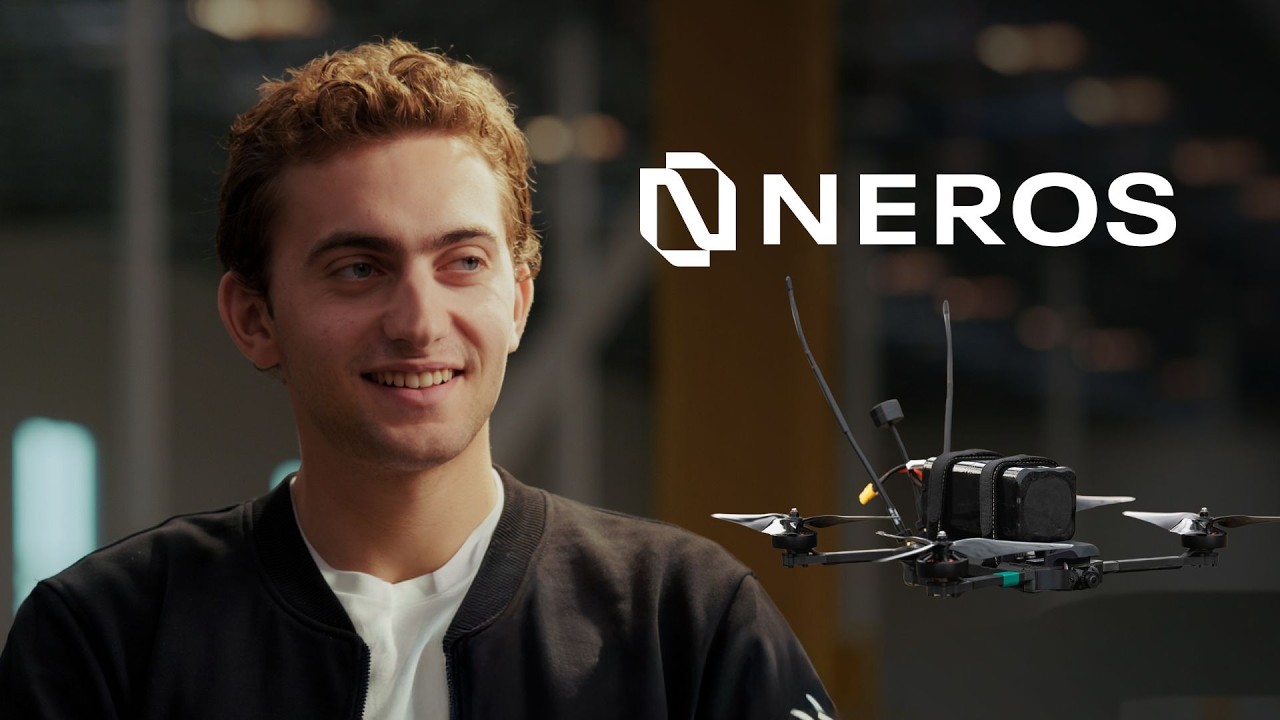
Soren Monroe-Anderson, co-founder and CEO of Neros, discusses scaling America’s largest FPV drone manufacturer from a garage operation to a 250,000-square-foot factory designed to produce up to 1 million drones per year—a response to the massive gap between US drone production (under a few hundred thousand per year) and China’s ~70 million. The conversation covers the evolution of drone warfare since the Russia-Ukraine war, the technical and supply chain challenges of building a fully allied supply chain, the company’s testing culture and “flyoff” sprints, and Soren’s personal reflections on leadership, health, and the moral case for defense work.
Scaling from garage to million-drone factory
Neros started in a basement/garage building a couple hundred drones, moved into a smaller warehouse in March 2024, and only began shipping more than a few hundred drones per month in early 2025.
The team grew from 16 people to ~125 over 2025, roughly 10x year-over-year.
The new 250,000-square-foot facility is designed not just for assembly and test but for component manufacturing and vertical integration, spec’d to support the long-term goal of 1 million drones per year.
The company is investing its own capital ahead of government contracts, betting that building capacity now is essential for credible deterrence.
The old facility’s limitations on non-Chinese supplier components pushed Neros toward vertical integration—motors, magnets (neodymium), PCBs, and eventually chips.
How the Russia-Ukraine war reshaped drone warfare and US priorities
When the full-scale invasion began in 2022, Neros didn’t exist yet, but the founders had already envisioned applying drone racing technology to defense.
Ukraine proved the concept of small FPV quadcopters as meaningful military capability, which the US Pentagon initially dismissed.
By 2023–2024, Neros was focused on building better products for Ukrainian units while US interest remained limited.
The US mindset has since flipped 180°: small drones are now a top priority from senior Pentagon and national security leaders.
The US Army has signaled intent to acquire 1 million drones over 1–2 years, but no manufacturer currently exists at that scale—Neros is building capacity ahead of that demand.
Learning from SpaceX and China
Neros looks to SpaceX’s Starlink user terminal factory as the best blueprint for modern high-rate consumer electronics manufacturing in America—electronics-heavy, RF-intensive systems assembled at millions per year, now cheaper than Chinese production.
America effectively taught China how to manufacture at scale; China then optimized and scaled beyond anyone else.
The core challenge in the US: electronics are more expensive, longer lead times, and lower quality than in China.
SpaceX is now likely the largest PCB manufacturer in America because traditional board houses are limited.
The real “magic” is not any single process but the iteration loop between product performance and manufacturability—owning both the factory and the product enables rapid improvement.
Building a military-spec, jamming-resistant drone
Neros has spent heavily on anti-jamming radio systems, iterating through multiple generations.
The drones are extremely flight-efficient in every size category, achieved through analytical testing and owning all component design.
Ukrainian units have called Neros drones the first “military-spec” FPV they’ve used.
A notable test in Alaska: Neros flew 7 km beyond their ground station toward military jammers, hovered in front of five jammers operating simultaneously for 10 minutes—only one of two control links was degraded.
As a prank, they strapped a jar of Smucker’s Strawberry Jam to the drone as the payload; soldiers eventually saw it up close, coining the phrase “the jammer has been defeated by the jam.”
The result was sobering for soldiers: expensive counter-drone equipment (hundreds of thousands to millions of dollars) totally failed against a low-cost FPV system.
Prototypes vs. production: the 6-month frustration
There is a huge gap between a working prototype and a production-ready product—qualification, production validation builds, and shipping typically take ~6 months.
Soren describes the frustration of having awesome prototypes in daily internal use but being unable to ship them.
The company deliberately limits customer exposure to new products until they’re production-ready to avoid overpromising.
Creating a fully allied (China-free) supply chain
Neros has cleared the biggest hurdle: getting all “critical components” China-free, and has gone further (motors, neodymium for magnets).
Full “made in America” (every microchip, every mineral) is effectively impossible in the near term.
The more important goal: building drones with an allied supply chain competitive with China and Russia, with regional biases depending on the customer.
Neros won’t go full Tesla (building lithium plants)—some layers of the supply chain require team efforts across America and allied countries.
Production hell: supply chain, not assembly
The worst production problems have been supply chain failures: ordering 98% of parts for thousands of drones, then discovering a $5 part with a 6-week lead time was missing, halting the entire line.
Neros deliberately ramps assembly capacity smoothly rather than in huge jumps, staffing up gradually and driving down tact times consistently.
The company builds capacity ahead of contracts to avoid the classic defense startup failure mode: signing up for delivery timelines they can’t meet, then failing to deliver.
Soren criticizes defense companies that overstate their current capacity—true capacity is the whole system working together, not just square footage or equipment.
Timelines, urgency, and “flyoff mode”
Neros has made timeline mistakes, learning the hard way (e.g., shipping ground stations in early 2025 before they were ready).
The company maintains urgency through mission-driven culture and discrete high-stakes events (flyoffs, contract milestones, test events).
They use intentional “flyoff mode” sprints: buying dinner for the team, keeping the office energized for short bursts—but sparingly, because sprints can’t be sustained indefinitely.
Key sprints: summer 2024 (winning the IDCC contract for Ukraine), August 2025 (PABAS Army program flyoff), and currently preparing for “Drone Dominance”.
Soren’s personal involvement has shifted from doing everything (soldering drones at 4 a.m. in 2024) to delegating to the team as the company matures.
Leadership hiring as the #1 constraint
The single biggest blocker to execution over the past 1–2 years has been recruiting—not lack of demand, but lack of people.
Neros has never been demand-constrained; they’ve gone slower than they wanted because they couldn’t hire fast enough.
Post-Series B and post-key government contracts, attracting senior talent has become significantly easier.
The company has built a system for finding non-obvious talent: people from unknown companies or schools with exceptional skills, not just “logo” resumes.
Soren’s time is now split between leadership hiring, long-term vision/product roadmap, and management—he actively works to clear calendar blocks for deep work.
Shifting from building drones to building a company
Soren no longer builds or flies drones for fun—what started as a passion (powerlifting, triathlons, rock climbing, drone racing) has been almost entirely replaced by company-building.
He acknowledges this is natural and expected, but notes the irony: “I started a drone company and I don’t build drones anymore.”
The mission and purpose are what justify the shift—he wouldn’t have started Neros if it were just about building drones.
Health and sustainability
In mid-2025, Soren suffered from a kidney issue that caused recurring severe pain, frequent illness, and drained roughly a third of his energy.
He delayed treatment for months because of company focus—a decision he now recognizes was detrimental to the company, not just himself.
After surgery in May 2025, his energy, mental state, and health improved dramatically.
He now treats medical issues immediately and tries to maintain routines (sleep, gym), though he admits he still cycles between neglect and recovery rather than maintaining steady-state health.
Ukraine operations and battlefield feedback
Neros has formalized its Ukraine presence with an office in Kyiv and shipped over 6,000 drones to Ukraine in 2025.
They measure success primarily by battlefield results and real-world effectiveness, not contract size.
Feedback loops have matured: early on they tried to do everything users requested; now they listen to problems, not proposed solutions, and prioritize ruthlessly.
Example: Ukrainian units initially rejected Neros’ more flexible propellers, assuming stiffer props were needed for heavy payloads. Neros bet them to test back-to-back—the flexible props won, breaking a deeply held assumption.
Another example: Neros uses significantly larger motors on their 8-inch drones than the standard, which initially seemed wasteful to Ukrainians but proved superior under heavy payloads through extensive testing.
Testing culture evolution
Neros tests every day in the desert near their headquarters, running 3–5 test series simultaneously.
They’ve evolved from subjective drone racer feedback (“it’s locked in, flies on rails”) to analytical, data-driven feedback that engineers can actually use.
Testing spans three categories: development (component-level thrust/efficiency curves, flight testing), qualification (ensuring reliability and spec compliance), and manufacturing (component-level and end-of-line testing).
Fiber optic (Archer Fiber) as a step-change capability
Fiber optic control has been one of the most significant FPV developments in the last two years, enabling operation in heavily jammed environments, beyond radio line of sight, or in tunnels.
Drawbacks: finicky, expensive, reduces payload, requires larger drones—so it won’t be the majority of missions.
Neros validated Archer Fiber with a partner (since no non-Chinese alternative exists) and is moving it into production.
Lifting the entire US drone industrial base
Neros wants to eventually supply components to other US drone manufacturers, not just build its own drones.
Shared componentry between FPV and other drone types means high-rate manufacturing of motors, PCBs, etc. can unblock multiple companies.
2026 is the target for starting component manufacturing; supplying others may follow after filling internal demand.
Soren emphasizes collaboration over domination: licensing technology, partnering with other US component companies, and treating this as an allied joint effort.
Building region-specific supply chains globally
Neros plans to partner with organizations in other regions (especially Indo-Pacific) to transfer technology and build region-specific supply chains.
The US factory serves as the backbone for the American supply chain and countries within logistical reach.
Multiple factories in America and abroad are planned over the longer term.
No single country can achieve full domestic drone production alone in the next 3 years—this must be an allied collaborative effort.
What America needs to remain competitive
The core problem: America optimized for short-term stock price by offshoring manufacturing, teaching China how to build everything, and now lacks the industrial base to support its military or critical infrastructure.
This extends beyond drones to energy production (industrial gas turbines, nuclear reactors, solar), investment castings, and other essential manufacturing.
Soren believes building companies like Tesla, SpaceX, and Neros across all critical industries is essential.
A strong industrial base feeds consumer, enterprise, and defense simultaneously.
Are we going fast enough?
Soren’s biggest worry: the time window is limited—if the US doesn’t build a drone industrial base in the next few years, its military is significantly weakened, especially in a scenario like a Chinese invasion of Taiwan.
He rejects the “it’s too late” framing: America has come back from positions of weakness before, and it’s largely a mindset and people problem.
He believes broad public awareness of the problem is essential before it reaches world-war-level urgency.
The moral case for defense work
Building lethal systems was a deeply intentional decision that Soren and co-founder Olaf discussed extensively.
Soren believes defense is fundamentally important and that America must control the most powerful defense systems.
He’s concerned that defense has become politicized and stigmatized, with a “mind virus” that frames working on defense systems as immoral.
He distinguishes between criticizing government actions (healthy and necessary) and opposing defense work itself (dangerous).
The most toxic viewpoint: people in America who aren’t pro-America—they’re a loud minority but drive a lot of the anti-defense sentiment.
Soren’s vision for America: a place that values innovation, freedom, and democracy—imperfect but the greatest driver of human progress.
Future of warfare: autonomy with human control
Neros is unusual among defense startups for not leading with an AI pitch—they come from a drone racing background and focused on FPV first.
They are pro-autonomy and building it internally and with partners, but they insist on maintaining manual precision and human decision-making.
FPV drones give a human operator unmatched precision in controlling an object through 3D space at large distances—inch-level precision at 20–30 km.
Current AI models are not better than human pilots in most battlefield circumstances, especially with camouflaged, dynamic, and small targets (the main Russian tactic now is soldiers on foot or motorcycles).
End-to-end autonomous missions (object recognition → autonomous strike) fail frequently in real battlefield conditions.
The future: each warfighter able to do more, with lower barriers to entry—FPV systems must become as easy to use as DJI drones, removing the current requirement for highly skilled pilots.