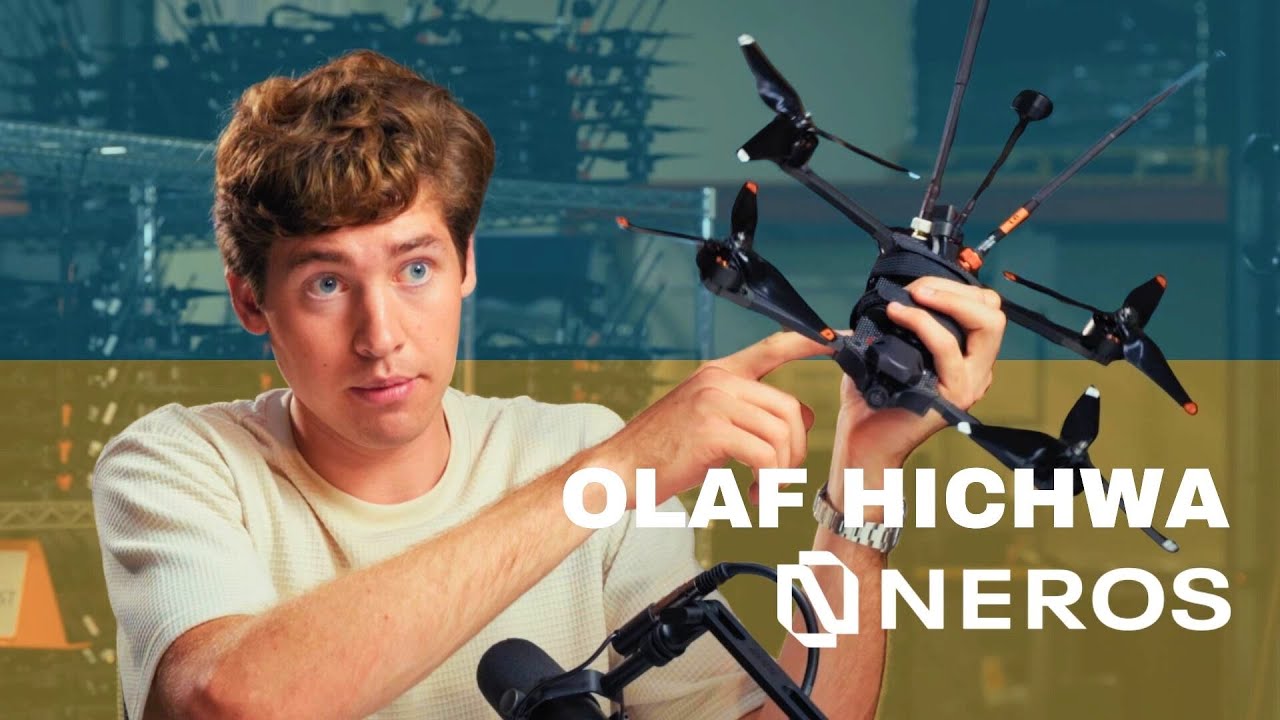
Neros is an American drone company founded by Olaf Hitchwa and Saurin, two former competitive FPV (first-person view) drone racers who pivoted from hobbyists to defense manufacturers after witnessing the war in Ukraine firsthand. Their mission is to build a fully American-made FPV drone supply chain from the ground up—removing every trace of Chinese components, down to the semiconductor level—while scaling production to one million drones per year, a goal they see as critical to U.S. national security given China’s dominance in global drone manufacturing.
Origins: From basement hobbyists to defense founders
Olaf and Saurin met as teenagers at a drone racing competition in Indiana, bonding over obsessive attention to detail in drone design and a shared drive to win races.
They spent years building and iterating on hundreds of drone configurations, constantly swapping motors, flight controllers, and frames to optimize performance.
In 2023, they founded Neros in Saurin’s basement in Norwich, Vermont, initially building 30 racing drones using entirely off-the-shelf Chinese parts—every screw, motor, carbon fiber frame, radio, and chip came from China.
They didn’t consider country of origin at first; their only goal was performance.
First trip to Ukraine: A wake-up call
In September 2023, Olaf, Saurin, and Saurin’s dad flew to Ukraine with 30 drones in their suitcases, delivering them to frontline units.
The trip was surreal: they underwent emergency medicine training, met Ukrainian fighters, and saw grassroots drone-building efforts—wives assembling drones in skyscrapers, soldiers buying $400 Chinese drones out of pocket.
They witnessed how FPV drones were already responsible for a staggering share of casualties in the war, and how Ukraine’s survival depended on mass-producing weapons faster than Russia.
Crucially, they realized that China was supplying both sides, profiting from battlefield feedback to improve its own drones while building a massive industrial base funded by Ukrainian and Russian spending.
The China problem
China produces 20–40 million drones per year; the U.S. produces only 40,000–70,000 (including all types).
DJI alone likely produces one drone per second during working hours.
97% of components in drones used by both Ukraine and Russia are made in China—even when final assembly happens locally.
China received real-time battlefield data from both sides, allowing it to rapidly iterate on anti-jam radios, fiber-optic links, and long-range strike platforms—all without government R&D funding.
Olaf calls this “evil” and “terrifying,” noting that China’s drone dominance represents a strategic loss for the U.S.
Building a China-free drone
Neros’ drone is likely the most China-free drone in the world:
All core electronics (PCBAs) are designed in the U.S.
Bare boards are fabricated in the U.S. (lamination, lithography, SMT).
Chips are China-free; Olaf can name the only three Chinese chips in the entire system.
They’ve pursued vertical integration: custom flight computer, motor driver, anti-jam radio, and video link—all designed in-house.
This level of de-risking is extremely rare; most defense companies either don’t know their supply chains or only limit Chinese parts.
Neros is transparent with the DoD about remaining dependencies and actively works to eliminate them.
Scaling production: From 30 to 1 million drones per year
Neros currently produces 2,000 drones per month, the largest drone manufacturing line in the U.S. by a factor of two.
Their goal is 1 million drones per year—still a “drop in the bucket” compared to China, which recently placed a single purchase order for 1 million drones with one company.
Lead times for semiconductor orders are 6+ months.
They must forecast demand far in advance while keeping designs flexible.
They’ve decoupled PCB orders (stable) from component sourcing (volatile) to allow faster iteration.
More than half of current production goes to Ukraine via European coalitions—before significant U.S. government orders.
End-user obsession and bottom-up procurement
Olaf and Saurin are deeply empathetic to end users—frontline soldiers—because they’re close in age, background, and mindset.
They prioritize direct feedback from warfighters over top-down Pentagon procurement processes.
In Ukraine, soldiers can choose approved drones via Amazon-style storefronts and earn cash incentives for successful kills—a model Olaf advocates for the U.S. DoD.
This bottom-up approach led to organic adoption: Pete Hegseth and JD Vance were photographed with Neros drones after Marine Corps units pushed hard to get them.
Real-world feedback and rapid iteration
Early versions of Neros drones were rejected by Ukrainian testers as “not fit for battlefield use” due to weak radios, poor cameras, and excessive weight.
Feedback is blunt and immediate: soldiers call directly when systems fail mid-mission.
Neros uses this feedback to iterate quickly, though long lead times make rapid changes difficult.
They’ve learned to balance flexibility with supply chain stability—e.g., ordering boards early while keeping firmware and RF components updatable.
Manufacturing philosophy: Consumer tech, not legacy defense
Neros rejects traditional defense procurement practices that rely on expensive, outdated mil-spec components (e.g., a $200 connector used on Abrams tanks).
Instead, they adapt consumer-grade parts for military use:
Use $3 microcontrollers as the main flight computer.
Repurpose RF chips from parking meters into wideband anti-jam radios.
They follow SpaceX’s “algorithm”: put engineers next to the production line, minimize connectors, reduce board count, and design for manufacturability.
They aim to build a vertically integrated U.S. PCB fabrication capability, similar to SpaceX’s Starlink production in Bastrop, Texas.
Lessons from SpaceX and global ambitions
Neros sees itself as the next chapter in American hard-tech manufacturing after SpaceX.
They admire SpaceX’s ability to produce Starlink terminals at China-level prices without Chinese supply chains.
Long-term, Neros wants to establish local production entities in allied countries (e.g., Ukraine, Taiwan), not outsource to contract manufacturers like Apple does with Foxconn.
These entities would be fully integrated into Neros, building local industrial capacity while maintaining U.S. oversight.
Personal cost and motivation
Olaf describes living a “split life” as a teenager—academically focused but emotionally disconnected, with friendships limited to online Discord communities.
Building Neros fulfilled a lifelong need to create tangible things and work alongside passionate people.
The pressure is immense: every day of delay could mean a warfighter dies.
During a critical 4-month sprint to deliver a new ground station, the team worked 16-hour days, fell asleep at their desks, and pushed through illness—culminating in a flawless live demo in Latvia where their drone outperformed all competitors.
Olaf reflects that happiness comes not from stability but from climbing out of the pit—one step at a time.
The hardest thing Olaf has overcome
Living a disconnected, online-only adolescence and struggling to form real-world relationships.
Finding fulfillment through Neros by finally being surrounded by people who share his obsession with building things.
Accepting that the mission will never truly end: even after reaching 1 million drones, the goalposts will keep moving.