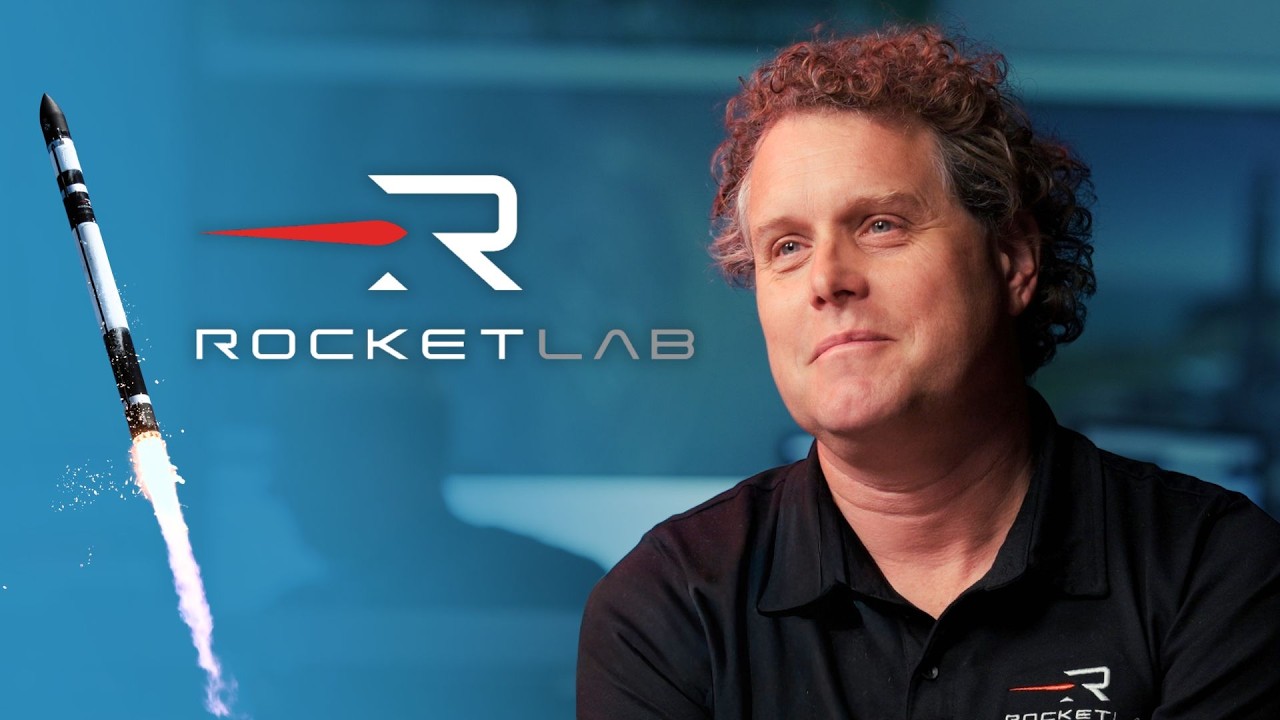
Peter Beck is the founder and CEO of Rocket Lab, a space company he started in 2006 in New Zealand with essentially no money, and which has grown into a publicly traded company launching rockets at a cadence that scaled faster than Falcon 9. The conversation covers how he built the company on a shoestring, the culture of relentless problem-solving that defines Rocket Lab, the transition from R&D to production at scale, the development of the Neutron reusable rocket, and his philosophy on building beautiful, enduring hardware.
Building Rocket Lab from nothing
Beck started Rocket Lab with $100, not $100 million like Elon Musk had for SpaceX, which forced a culture of extreme resourcefulness from day one.
The Rutherford engine on Electron is named after Ernest Rutherford’s famous saying: “We have no money, so we have to think.”
Early on, Beck would go to junkyards to salvage fittings and hardware because new ones were unaffordable. He’d unscrew Swagelock fittings off old machines and reuse them, since the $320 fittings were cheap but the $50 ferules were not.
This early hardship cemented a lasting culture of capital discipline and stewardship that Beck says is absent at many well-funded competitors, most of which have failed despite having far more resources.
Virgin Orbit had $1.2 billion to do what Rocket Lab did with $80 million, and still failed commercially and technically.
The Rocket Lab hustle
The defining cultural trait at Rocket Lab is what Beck calls the “Rocket Lab hustle”: a relentless, dogged determination to execute on impossibly difficult problems, regardless of the hour or the odds.
When a supplier completely failed on thin-wall titanium pressure vessels (only two companies in the US could make them), Rocket Lab developed its own 3D printing and welding processes to produce the tanks in time for launch, and now there are three suppliers.
When a small 500 lb rocket engine exploded the Friday afternoon before important visitors were arriving from the US on Monday, the entire team worked through the weekend rebuilding the engine and test cell from scratch, and also made performance improvements that resulted in the rebuilt engine performing 13% better than the original.
Beck says nobody survives at Rocket Lab if they want to work 8 to 5. The facility has lights on at all hours, and there are beds and pillows in the customer room for anyone who needs them.
The culture is that when something goes wrong, everyone runs toward the problem to help, not away from it to avoid blame.
Scaling Electron faster than Falcon 9
Electron scaled from first flight to 50 flights faster than Falcon 9 did, and Beck expects the same from 50 to 100.
This was possible because Electron was designed from day one to be producible, not just to work. Many rockets are designed by engineers who optimize for performance without considering manufacturability.
The biggest bottleneck to increasing launch cadence is not the factory (capable of one per week, or over 50 per year) but customer readiness and the growing market for dedicated small launch.
Two-thirds of Rocket Lab is actually the space systems side, which builds components and complete spacecraft. Launch is only one-third of the company.
The Capstone mission: an impossible project
The Capstone mission to the moon was a $10 million NASA contract that went three times over budget, but Rocket Lab delivered the spacecraft to the moon with flawless accuracy.
It was the most ridiculously difficult engineering project the company had ever undertaken. They were measuring grams on the rocket and once had a three-hour debate about whether they could afford the mass of NASA stickers on the side.
The mission included the highest-performing engine Rocket Lab had ever built, plus a separate tank of additives injected to make it run super hot.
Despite being the most punishing mission, Capstone is consistently cited by employees as their best moment at Rocket Lab.
Beck says the company won’t take on something they have no clue how to achieve, but they do believe they can do everything they commit to, and they always deliver.
Designing beautiful things
Beck is deeply committed to building beautiful hardware, a philosophy rooted in his upbringing where his family expected everything that came out of the garage to be beautiful.
He believes that if you build something beautifully, you’ve taken pride in it, looked deeper than your own work, and the result almost always functions well. Building something that is beautiful but doesn’t work is rare; building something that works but is ugly is common.
He says it takes no longer to build something beautiful than to build something poorly, because poorly built things require constant rework.
The company used to have a saying on the wall: “Make everything you do a work of art.” This applies to code, software, facilities, and hardware alike.
Transitioning from R&D to production
Beck came from a production design engineering background, so he understood the difference between making something work and making something producible at scale.
The transition from R&D to full volume production was incredibly painful, as it is for every startup, but was made easier because Electron was designed for producibility from the start.
Production hell with rockets involved getting all the manufacturing DNA built into the organization while simultaneously trying to scale output.
Neutron: the next-generation reusable rocket
Neutron is Rocket Lab’s larger, reusable rocket, designed to be far more producible than Electron.
Unlike Electron, where every gram counts and tubes had to be bent by hand on the rocket, Neutron’s fluid and electrical systems are built entirely off the rocket and then installed as complete modules.
Neutron uses carbon fiber composite structures made with automated fiber placement (AFP) machines from the automotive industry, making structures absurdly light and cheap to produce at scale.
Carbon fiber has four times the strength-to-weight ratio of stainless steel, which allows the rocket engines to be less stressed and more reliable.
SpaceX switched from carbon fiber to steel for Starship, but Beck believes carbon fiber’s superior strength-to-weight ratio is worth the added manufacturing complexity, which they’ve solved through automation.
Neutron will scale faster than Electron because the team is so much further ahead in design, manufacturing, and infrastructure.
The first launch will be a splashdown test, followed by an attempt to land on a barge.
Why Beck went public
Beck always planned to take Rocket Lab public because he wanted to build an endurable institution that would outlast him and have impact over generations, not just be a blip in history.
Being a public company enforces discipline, rigor, and pressure to become profitable and sustainable, which private companies with easy capital access often lack.
Going public was also a great capital unlocker: Rocket Lab went public with one product and now has hundreds, including serving as a prime contractor for the US government on national security programs.
Every venture capitalist who invested in the company has had their entire fund returned.
Beck’s management philosophy
Beck sees his job as fixing problems and making the decisions nobody else wants to make. He doesn’t add value to things that are running well.
He was physically present for the first hot fire of the Neutron engine (Archimedes) not to contribute technically, but so that if a risky “go/no-go” call had to be made, he would be the one pressing the button, not the engineers.
He runs “green light schedules” with no built-in fat, because engineers will use all the time you give them. If you add buffer, the buffer becomes the schedule.
He is a relentless optimist, which he considers absolutely critical in an industry where “the rocket gods are trying to crush you every chance they get.”
He measures his best days by problems solved, not by retrospection. He’s not a retrospective person.
Hiring and talent
The bar to get into Rocket Lab is extraordinarily high, and Beck makes no apologies for it. People from respected other space companies have not made the grade.
The biggest bottleneck to growth is feeding enough top talent to the machine while maintaining that bar.
Beck believes in a Jeff Bezos-like philosophy of raising the hiring bar over time so that each new cohort is better than the last.
Everyone at Rocket Lab knows their tenure is finite, including Beck himself. He wants the company to be able to continue and thrive when he is eventually replaced.
The democratization of space
Beck says the last decade has truly seen the democratization of space: it no longer takes a nation to build a satellite or a rocket. A few college kids in a dorm can build a satellite.
Rocket Lab itself launches more than most governments (except China), has sent a spacecraft to the moon, and has two spacecraft on their way to Mars.
Governments are good at things that are incredibly difficult, require a nation’s worth of talent, and can’t make money. The moment those conditions change, commercial entities naturally take over.
America and Silicon Valley
Beck’s first trip to Silicon Valley to raise venture capital was transformative. He gave himself three weeks to come home with a check or be run out of town.
He pitched to only three VCs, chose Vinod Khosla because Khosla had felt the pain of launch through his investment in Skybox, and came home with funding after showing up with a successful sounding rocket flight and a complete one-tenth scale set of blueprints rolled out across the partner’s desk.
He bought an American flag at Whole Foods after the successful meeting. He believes America is unique in that if you have a dream and energy, you can do it, and even if you fail, people will back you again.
He contrasts this with Europe’s more subdued, risk-averse culture.
What comes next
Beck is methodical and wants to finish Neutron before talking about what infrastructure Rocket Lab will build in orbit.
The space systems division has built the capability to build anything for orbit: Mars missions, lunar missions, national security spacecraft. The only missing piece is Neutron.
He believes the biggest space companies of the future will all have their own rockets and will provide critical infrastructure and backbone in orbit, and the line between “space company” and other types of company will become very blurry.
When asked whether he prefers being underestimated or having everything working, he said he likes everything humming and working.