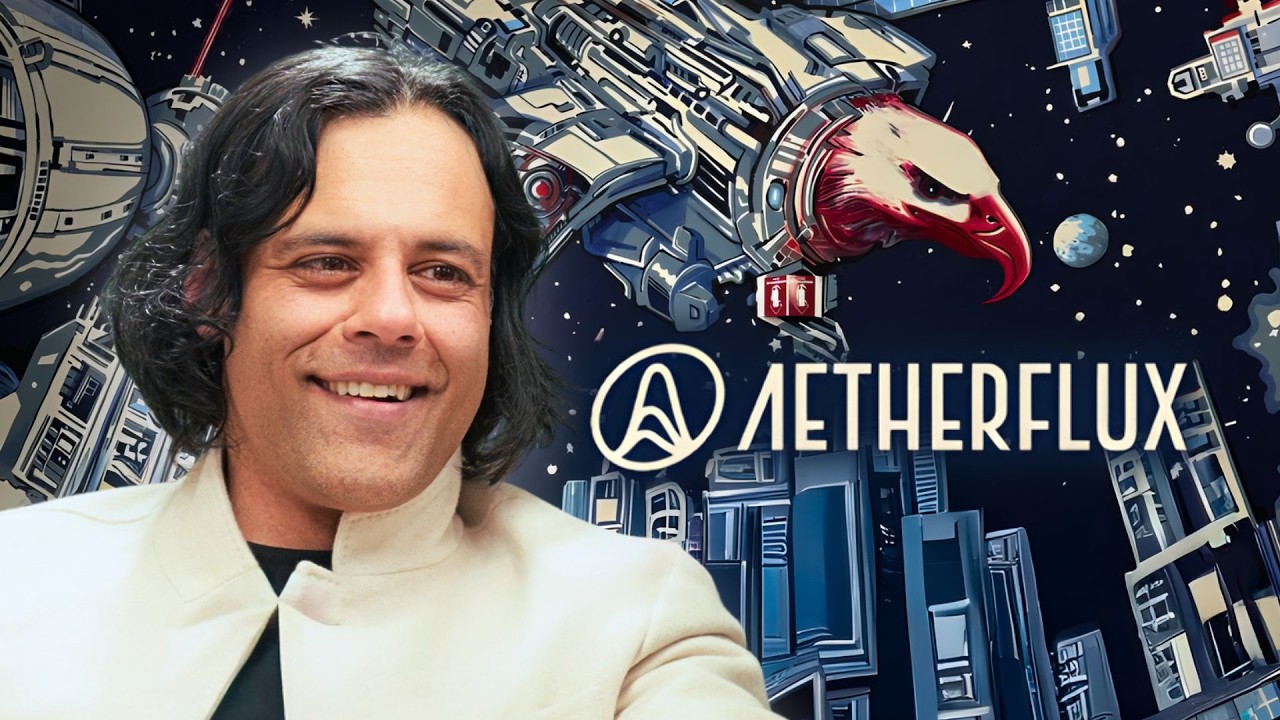
Baiju Bhatt, co-founder of Robinhood and founder of Aetherflux, discusses his journey from fintech to space hardware, the philosophy behind building Aetherflux, and lessons learned across two very different startups.
Aetherflux is a space-based energy company developing laser power beaming from orbit, with a longer-term vision of orbital data centers that place compute directly next to space-based solar power generation.
The conversation covers company culture, design philosophy, intuition-building, failure, and how Baiju thinks about creativity, decision-making, and staying in the game over a long career.
Culture at Robinhood vs Aetherflux
At Robinhood, the core disciplines were front-end, backend, and DevOps engineers, compliance and regulatory staff, legal, and a small but strong design and product research team focused on customer interviews as the north star for evaluating ideas.
At Aetherflux, engineering is far more specialized and fragmented: embedded software, optomechanical, thermal, mechanical, electrical, computer science, laser, and optics engineers all work together, making cross-disciplinary communication and integration more complex.
Baiju believes the universal cultural truth is that when people are genuinely having fun, they go above and beyond and become more creative, because fear and stress shrink creativity while comfort and happiness let the mind explore more directions.
Fun environments also lower the barrier for people to share half-formed ideas, which is where breakthrough concepts often originate.
Drawing out those ideas from quieter team members takes deliberate effort and repeated encouragement, especially when people are new and still figuring out the norms.
Design philosophy: form and function
Baiju idolized Steve Jobs and deeply internalized the principle that design is not just how something looks but how it functions, and that form should natively represent function rather than being decorative window dressing.
He cites the example of a laptop’s power state: Apple’s allergy to always-on indicator lights in favor of making “on” the default state, with an explicit signal only for “off,” reflects the idea that the object’s form should embody its function.
For satellite hardware, this means the satellite’s physical form should be dictated by its job: for laser power beaming, the dominant elements are power generation and heat dissipation, so the design challenge is merging those functions (e.g., solar panels that also serve as radiators, or laser diodes that leverage existing surface area for heat rejection).
As Aetherflux moves from designing payloads for third-party satellite buses to designing entire satellites and constellations, the function will increasingly dictate the form.
Baiju describes the feeling of good design as when something looks so inevitable that you cannot imagine it looking any other way, a standard he pursued at Robinhood and is now applying to hardware.
Building a Shelby Daytona over COVID
During COVID, Baiju built a Shelby Daytona race car from scratch over roughly six to nine months, motivated by a need for a creative outlet unrelated to software.
He believes creativity comes from connecting unrelated ideas, so having a hobby outside one’s primary work is essential for staying creative in the main thing.
The project started as a box of parts and became a drivable rolling chassis, though he left the paint and upholstery to professionals, recognizing the value of tactile expertise (“finger-feel”) in craftsmanship.
The impetus was partly financial timing (he was broke in his earlier years) and partly the psychological need during COVID’s blur of 12-hour workdays to project his creative energy into something physical and tangible.
Orbital data centers
Baiju’s original thesis for Aetherflux was that low Earth orbit is a platform for global commerce, and energy is a foundational industry ready to be built there because photovoltaics are cheap and AI is driving an energy crunch.
The initial go-to-market path follows the historical space pattern: start with government/DoD applications (contested or remote environments without grid access), mature the technology, then scale to commercial/industrial uses.
The key insight that unlocked orbital data centers came from questioning the power beaming chain: photons to solar panels to electricity to laser back to light to ground-based solar panels to electricity to data center. Each conversion step wastes energy.
The thought experiment: what if you just put the compute chips right next to the solar panels in space, eliminating all the conversion steps?
While the literal architecture of GPUs mounted on the back of solar panels isn’t the final design due to other constraints, the principle of co-locating power generation and compute is the core idea.
The strategic advantage is speed to deployment: bringing a new data center online on Earth takes 5–8 years, but an orbital data center could theoretically go from chips to orbit in weeks to months, using a factory model where chips come in one side and integrated satellites go out the other, then get launched and networked together with lasers.
Baiju agrees with Elon Musk’s view that there will eventually be an overabundance of chips, making the constraint not chip supply but deployment speed.
Using many small satellites networked with lasers rather than one massive megastructure avoids single-point failure risks and is more economically feasible in the near term.
Building intuition and getting failures out of the way quickly
Baiju’s core philosophy for entering unfamiliar domains is to “get your failures out of the way quickly”: don’t be precious with ideas, ship something, complete the loop from idea to market feedback, and learn from what doesn’t work.
He describes this as walking three steps down a path, checking if it feels right, and if not, walking back and trying another direction, like navigating a maze by actually hitting dead ends rather than trying to think your way through from the start.
The Robinhood example: before the brokerage app, Baiju and his co-founder built “Analyst,” a stock market companion app with news, social features, and stock ratings. It was released in 2013 and usage asymptoted to zero.
The lesson was that people think of mobile apps as functional buttons, not everything-apps. This led to the earliest version of Robinhood being radically reductive: account value, a sparkline, and a list of stocks, with everything else tucked behind a hamburger menu.
For Aetherflux, the iteration loops are much longer (government contracts can take years), so building a culture of shipping and learning is harder but still essential.
The approach has been to scope down to the smallest viable demonstration (a small satellite beaming about 1 kilowatt of power, the threshold where it counts as power beaming rather than just laser communications) and aim to get that into orbit within roughly two years.
The hardware behind Baiju in the studio is scheduled to launch that summer, about two years and three months after he left Robinhood full-time.
Seeding Aetherflux and scrappiness
Baiju seeded Aetherflux with $10 million of his own money to accelerate the timeline, including booking a rideshare launch and purchasing a satellite bus.
He put down the deposit on the satellite with his Robinhood Gold Card, one of the last projects he worked on at Robinhood before leaving.
Having done a startup before gave him muscle memory for how to spend money wisely, whom to hire early, and how to avoid spinning wheels, but it didn’t eliminate the fundamental difficulty of starting from scratch.
Early hires included a laser safety officer and, more recently, Joe Yaffey as chief legal officer and chief operating officer, reflecting a “regulatory-forward” approach to beaming power from space.
The willingness to be scrappy again was something Baiju had to consciously relearn after years of operating Robinhood at scale, where risk aversion and process maturity were appropriate.
The second company is just as hard as the first
Baiju expected the second startup to be somewhat easier given his experience and resources, but found it is just as hard in different ways.
The problems are oddly similar: a key hire leaves and you’re back to square one, a team has misfits and you’re understaffed, recruiting isn’t working and you have to figure it out.
The difference is emotional: the first time, these problems felt existential; the second time, they feel like annoying paper cuts that he knows he will solve.
He references Sam Altman’s observation that by the sixth or seventh existential crisis, you’ve built the mental model that you’ll survive this one too, and the approach is to control what you can control, put one foot in front of the other, and trust that if you’re not breaking the laws of man or physics, there is a path through.
Prioritization, family, and staying in the game
With three boys and a fourth child on the way, Baiju now prioritizes family time non-negotiably: he goes home for dinner and time with his kids before bed, even if it means rescheduling late meetings.
Ten years ago, he was in the office until 9 p.m. most days, working out at lunch and staying sweaty for afternoon meetings; now the structure is different but the intensity remains.
He practices “slow-form thinking”: when working late on a problem, he often chooses to sleep on it rather than word-vomiting a decision at night, and frequently finds that his thinking has shifted or improved by morning.
He believes creativity cannot be forced on a schedule; the universe gives creative ideas at its own pace, and you need to be open to receiving them. Loading your brain with context and then going for a run is a reliable way to let ideas percolate and line up.
Baiju’s hardest personal challenge was being severely overweight as a kid (around 210 lbs in 10th grade), being teased for it, and losing nearly a third of his body weight down to the high 130s through sheer determination.