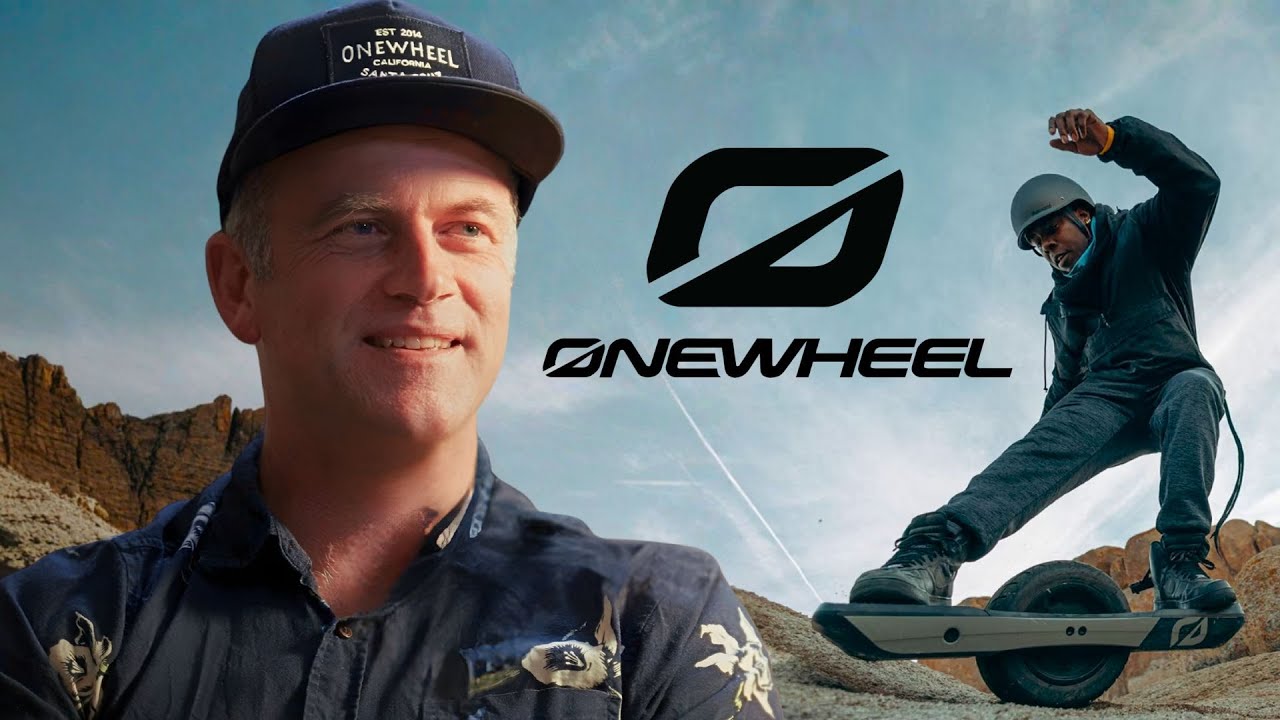
Kyle Doerksen is the founder and CEO of Future Motion, the company behind Onewheel — a self-balancing electric skateboard with a single large wheel, a motor inside it, and an active control system that lets riders lean to accelerate, brake, and turn. He spent 17 years developing the product from a crude garage prototype into a category-defining vehicle, building a company that has sold over 400,000 units while staying capital-efficient, manufacturing domestically, and resisting the venture-backed hardware playbook.
The origin story
Kyle grew up snowboarding in Canada, and the feeling of riding powder — a board free to move in three dimensions — became the core inspiration for what Onewheel should feel like.
He studied mechanical engineering and computer science, then worked as a product design consultant in the Bay Area designing everything from kids’ toys to implantable medical devices.
In 2008, as a personal tinkering project, he built a first prototype using an Arduino, a chain-drive motor, and lead acid batteries — the technology of the era. It worked, but the experience fell far short of his vision.
He shelved it and later helped spin out an electric bicycle company called Faraday Bikes, which gave him firsthand knowledge of the supply chain, lithium batteries, and hub motors — and confirmed that small electric vehicles were going somewhere, but that e-bikes would be a crowded, competitive market.
Around 2013, he pulled the prototype back off the shelf. By then, key technology costs had plummeted: a six-degree-of-freedom IMU sensor that cost $90 in 2008 was down to $3–4 thanks to the Nintendo Wii and iPhone driving massive volume. Hub motors and lithium batteries had matured. The technology was finally within reach.
Launching on Kickstarter
He launched Onewheel on Kickstarter in January 2014 with no formal user research or market validation — just a passion project he believed in. It funded successfully within days.
He raised a small seed round immediately after, hired the first employees, and partnered with a domestic contract manufacturer. They went from crude prototypes with wires hanging out to shipping finished units to customers in roughly 9 months.
The Kickstarter generated around 400–500 orders, and pre-orders added roughly another 500, giving them a clear initial production target of about 1,000 units.
Finding the right suppliers
Sourcing was a major challenge because Onewheel required custom components at low volume. Big suppliers wouldn’t take a startup seriously — no track record, no volume.
For the first-generation motor, they partnered with a small company that had developed an e-bike motor that hadn’t worked out commercially. They were willing to engage at low volume (a couple hundred units) and built Future Motion a custom transverse flux motor — an exotic technology that probably no other consumer product has ever used.
They used A123 battery cells, a MIT spinout making high-power lithium iron phosphate batteries. Future Motion was one of the only non-military/medical customers for these cells at the time.
The lesson from Segway loomed large: Segway had invested tens of millions building factories and supply chains before realizing consumer demand wasn’t there. Kyle was determined not to repeat that mistake.
Why he didn’t go through YC
He interviewed for YC once and didn’t get in. The core objection was about market size — how big could a one-wheeled skateboard market be?
Kyle’s view: the TAM was literally zero because the product didn’t exist yet. It was market creation, not market entry. He believed that once people saw it and experienced it, demand would follow — and it did, through a viral effect of riders being seen in public.
Resisting the venture-backed hardware playbook
During his Series A fundraising around 2014–2015, the VC community was enamored with hardware-as-a-service models (the “razor and blade” approach) and had just seen high-profile hardware flameouts like Juicero, which raised $100–200 million selling a machine that squeezed juice packs by hand.
Kyle deliberately took a capital-constrained approach, raising only what was needed and focusing on unit profitability from the start.
He studied how EV startups like Rivian and Lucid were selling vehicles at negative gross margins — losing money on every unit — and decided that was not a model he wanted to follow. He insisted on at least breaking even on the first batch.
Domestic manufacturing as a strategic decision
In 2014, the default for hardware startups was to manufacture in China. Kyle chose to build in the US, initially with a domestic contract manufacturer, for several reasons:
Cash flow: with a domestic CM, they’d get an order, build it, ship it, and pay the invoice 30 days later — versus tying up hundreds of thousands of dollars in container loads from overseas that take months to arrive and then more time to sell.
Intellectual property: nobody in the world knew how to build Onewheels. If they outsourced, they’d be teaching someone else their trade secrets.
Quality control: a self-balancing vehicle either works or it doesn’t. Discovering a defect after a container arrives is catastrophic.
Logistics: the product is physically large. Having finished goods in the US meant direct truck delivery to customers instead of ocean freight.
Around 2018–2019, when they launched the Pint (their first sub-$1,000 model), people expected them to move manufacturing to Asia. They spent time in China getting quotes from contract manufacturers and ultimately decided to vertically integrate and bring manufacturing in-house instead. The full lifecycle costs — including rework, scrap, and shipping — made domestic production competitive, and in-house control gave them flexibility to iterate.
They now operate out of six or seven buildings across Santa Cruz and San Jose, California, and have designed their own manufacturing equipment, including smart conveyors and automated testing systems.
Designing the product experience
Intuitive by default: Onewheel works great out of the box. Riders lean forward to go, lean back to brake, lean heel-side or toe-side to turn. Most people feel comfortable within a minute or two.
Customizable for enthusiasts: the app offers pre-built “digital shaping” settings, and a deeper customization mode with sliders for tilt angle, responsiveness, acceleration, and braking. This serves both casual riders (“just make it work”) and tinkerers (“let me adjust everything”).
Over-the-air firmware updates: from the beginning, they built in the ability to improve the product after purchase. The launch version was deliberately constrained on top speed; a few months later, a firmware update unlocked more performance. This has been a recurring pattern across generations.
Designed to take abuse: people have ridden over 200 million miles on Onewheels. The average board has around 1,000 miles on it. Kyle deliberately chose to build a vehicle, not a toy — CNC machined aluminum frame rails, repairable components, replaceable bumpers — because he wanted Onewheel to be a sport that endures, not a gadget that ends up in a drawer.
Building Onewheel into a sport
Kyle saw board sports (surf, snowboard, skate) as the model: professional riders define the leading edge of what’s possible, attracting attention, but most participants are just there to have fun and progress at their own pace.
Onewheel racing started informally at the GoPro Mountain Games in Vail, Colorado, where they set up a small cone course. It grew so large the event organizers asked them to get their own event.
Race for the Rail became the premier Onewheel racing event, with community-organized qualifying events across the country and internationally. The trophy is a custom-made rail (the side of the Onewheel) — past versions include Thor’s hammer, swords, and nunchucks.
A team of pro riders works for the company, pushing the limits of what’s possible and feeding product feedback into the roadmap.
Repairability and customer experience
Early on, repairability was a weakness — customers complained they couldn’t fix things themselves. Over the last few years, Future Motion has invested heavily in making components user-replaceable and building the infrastructure (ordering systems, plug-and-play parts, repair guides) to support it.
They now sell replacement battery modules that customers can install themselves or send boards to their San Jose facility for service.
Kyle is philosophically opposed to planned obsolescence and subscription models. He’s seen the customer blowback against car companies that lock hardware features behind subscriptions, and he’s deliberately chosen to give customers full access to everything the hardware can do, with free firmware updates.
Onewheels don’t have GPS. Ride tracking happens only through the rider’s smartphone if they choose to record.
The battery safety controversy
Some customers began DIY-ing battery cell replacements — opening packs and soldering in new cells. This is genuinely dangerous with high-energy lithium batteries that must be perfectly matched to the battery management system.
There have been house fires caused by modded battery packs. Future Motion’s position: they don’t support it, they void the warranty, and they’ve made it difficult. They now sell official battery module replacements as the safe alternative.
Every battery pack is fully tested multiple times under various conditions before shipping.
Incorporating customer feedback
Kyle relies more on broad owner surveys than on the loudest voices on social media. The vocal minority (roughly 3%) can skew perception, so systematic feedback collection drives product roadmapping.
Some items, like selling replacement batteries, took years to implement because the infrastructure had to be built first. Now they offer them for all models.
Scaling through COVID
COVID was the most challenging scaling period: demand surged exponentially while supply chains collapsed. Semiconductors were particularly hard to source — wafer fabs had cancelled orders, and the shortage lasted roughly two years.
They redesigned hardware around available chips, creating multiple PCB variants so they could use whatever microcontroller was available that week, with firmware supporting all variants.
Kyle personally reached out to senior executives on LinkedIn to secure critical components like battery management chips.
They over-ordered everything as a hedge, which led to excess inventory post-COVID — a problem that has also hit the bike industry hard. Because they do final assembly in-house, they’ve been able to adapt by using excess components in next-generation products rather than being stuck with finished goods they have to discount.
Manufacturing evolution
They’ve redesigned their manufacturing line multiple times, building custom equipment (smart conveyors, automated test systems) that doesn’t exist anywhere else.
Testing is highly automated, but much of the assembly is still manual. They’re actively exploring robotics to automate more.
Moving from contract manufacturing to in-house was ultimately driven by misaligned incentives: contract manufacturers profit from your inefficiency, not your efficiency.
Leadership evolution
Kyle’s core interest has always been product — building great experiences and making them better. He’s gone from soldering every wire and writing every line of code to working at a higher strategic level, but he still organizes his time around product focus.
He sees the hardest challenge as the zero-to-one phase: going from nothing to something real, with uncertainty on every side — funding, manufacturing, marketing, product definition — and no resources or playbook to fall back on.
Future direction
Kyle is realistic that Onewheel isn’t for everyone, and that’s intentional. But market penetration is still low compared to snowboarding, skateboarding, or cycling, leaving significant room for international expansion and new price points.
They’re exploring what else they can do with their core expertise: brushless motor design, power electronics, battery management systems, and domestic manufacturing at scale — including potential manufacturing partnerships with other companies that want to build hardware in the US.