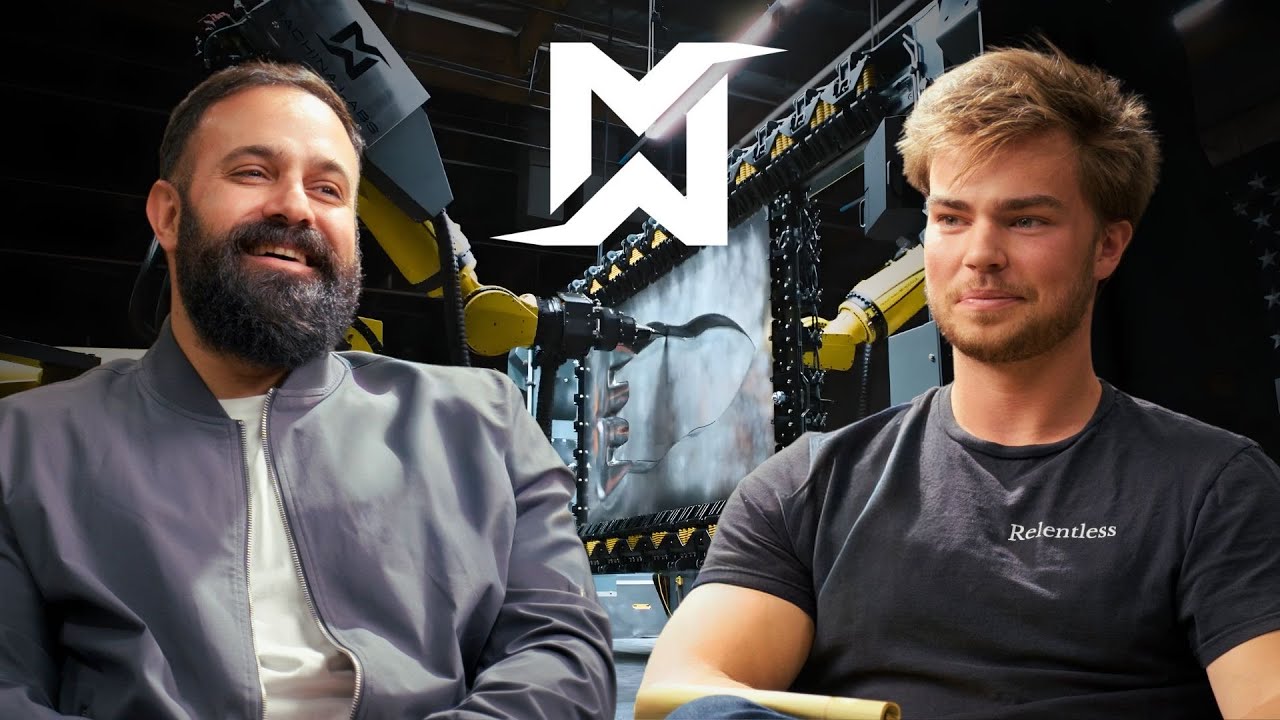
Ed Mayer is the co-founder and CEO of Machina Labs, a company building robotic systems that form sheet metal without traditional dies, enabling rapid, low-cost manufacturing of complex metal parts. The company’s core thesis is turning ideas into physical reality as fast and automated as possible, with the long-term vision of enabling anyone to design and order custom metal products through a digital portal. Machina’s early customers are in defense and aerospace, where design variety is high and lead times for traditional tooling are painfully long, and the company is now expanding into automotive through a partnership with Toyota to enable individually expressive vehicle designs.
How Machina’s metal forming process works
Traditional sheet metal forming requires massive stamping presses and matching dies, which can cost upwards of $120 million for a single car model and take years to produce. Machina replaces dies with two highly rigid, precise robots that pinch a flat sheet from two sides and incrementally expand and shape it, similar to how a potter forms a clay bowl. The process is guided by software that generates rough instructions offline, while sensors feed data to the robot every 4 milliseconds for real-time adjustments during forming. After forming, the robot scans the finished part and compares it to the original design, making corrections as needed. The system also performs trimming, bending, hemming, and heat treatment, with the goal of matching any operation a human craftsman can do.
Early development and the path from 25 trials to 4–5
In the earliest days, Machina had almost no real-world data on how to form sheet metal incrementally with robots, so the team relied on human-in-the-loop trial and error. Their first major part, a rocket engine shroud for SpaceX, took 25 attempts to get right. Failures included tearing from excessive force, buckling from internal stresses, poor surface quality, and parts ending up inches off from the CAD model due to unpredictable sheet movement. The team slowly added more tools and sensor feedback, and now averages around four to five trials per part. The long-term goal is “zero-shot” forming, where AI models learned in simulation allow the robot to form a part accurately on the first attempt.
Origins and founding story
Ed came from an aerospace and software background, spending time at SpaceX and later at Relativity Space focused on 3D printing. At SpaceX he observed that every new product required building an entirely custom factory, which he saw as the fundamental bottleneck in hardware. He was excited by 3D printing’s agility but recognized it could only address certain types of parts. He founded Machina in 2019 to build a universal manufacturing platform that could handle diverse processes and products. He gives credit to academic researchers like Professor Gian Chow at Northwestern who had been exploring robotic incremental forming since the 1990s, but says the missing pieces were cost-effective robotics and AI-driven process parameter optimization, which only recently became viable.
Building the first prototype on $300,000
Machina raised a $2.3 million seed round and needed to get a working system fast. New robotics vendors had 6–12 month lead times, so Ed went to Detroit and bought used robots from a warehouse that scrapped equipment from automotive OEMs, paying roughly one-tenth the price of new robots (~$20K each vs. ~$200K new). He also negotiated with his landlord, a defense industry family, to pay the first year’s rent in equity and have them co-invest in equipment in exchange for bringing visitors to see the robots. Within three to four months the team had assembled a functioning system and formed parts for their first customer, the Air Force and NASA.
Early culture and hiring philosophy
Ed deliberately hired people with a strong bias for action over deep expertise, including former interns from Relativity and SpaceX. He found that experts in robotics often dismissed the approach as impossible due to concerns about robot deflection and accuracy under high force. The early team was “naive enough” to try things without immediately concluding they wouldn’t work. Ed also values generalists who can learn adjacent fields quickly, a lesson from SpaceX where he saw people routinely operate far outside their formal expertise to get early iterations moving. He has had to part ways with some highly knowledgeable hires who fell into analysis paralysis.
Celebrating customers and choosing applications
Machina selects applications where the team has genuine passion and deep domain knowledge, allowing them to act as thought partners rather than mere suppliers. Examples include a metal sculpture of Tesla chief designer Franz von Holzhausen as “Fran Solo” (Han Solo in metal), a custom car Ed built by hand, and an SR-71 model made purely out of enthusiasm that later generated customer interest. The company announced a collaboration with Toyota to let customers design uniquely expressive vehicles, such as a Tacoma with personalized door panels or tailgate art. Ed believes that authentic excitement for the application is what makes the story compelling to customers and helps reset expectations about what’s possible.
Scaling strategy and business model evolution
In 2023 Machina worked with 30 different brands on small contracts but realized it was spreading itself too thin. The company narrowed to fewer than 10 deep partnerships, focusing on defense/aerospace primes and automotive. A key strategic decision was choosing to sell finished assemblies rather than just machines or raw parts, because the US industrial base of tier-one metal structure suppliers lacks the capital and margin to invest in advanced technology. This makes Machina both a technology company and an operations company. To win over large customers, Machina needs roughly 10 internal champions spanning engineering, business, investment, and executive leadership, since the change is so fundamental. Most major customers, including Toyota, Lockheed Martin, and Yamaha, are also investors in Machina.
Facility scaling and capital structure
Machina operated out of its first facility from 2020 to 2023, eventually deploying 11 manufacturing systems. It moved into a second facility in 2024 and expects to reach full capacity by 2027, with a third facility planned. Each facility takes roughly three years to reach full capacity. Ed notes that hardware companies require far more complex capital structures than software companies, combining equity for R&D, debt for equipment and purchase orders, government grants, customer financing, and foreign government partnerships. He didn’t fully appreciate this complexity at the outset but has come to enjoy the fundraising and financing process as a way to get feedback and build relationships.
Designing the system for deployment
Machina’s second-generation system was designed to fit inside a shipping container for easy transport and deployment, addressing the risk that even a fast-forming system would be bottlenecked by slow factory construction. The team explored flatbed truck and modular IKEA-style designs but settled on the container as the most practical form factor. Ed sees the container as a “unit of mobility,” consistent with his belief that any lasting technology must be able to move with humanity as it expands to other planets.
Personal philosophy and the hardest parts of the journey
Ed keeps the company’s top three risks as a constant background on his phone to maintain focus and filter out distractions. He believes the hardest parts of building a startup are internal: accepting when you’re wrong, mentally rehearsing worst-case scenarios (like running out of runway and having to lay off large portions of the team), and pushing through resistance without anyone else knowing what you’re going through. He has learned to “assume the worst, live through it mentally, and then anything that actually happens feels better.” Despite the difficulty, he says he genuinely enjoys every part of the work now, from engineering to fundraising, and believes that if Machina can enable freedom of expression in the physical world, it will become a trillion-dollar company.