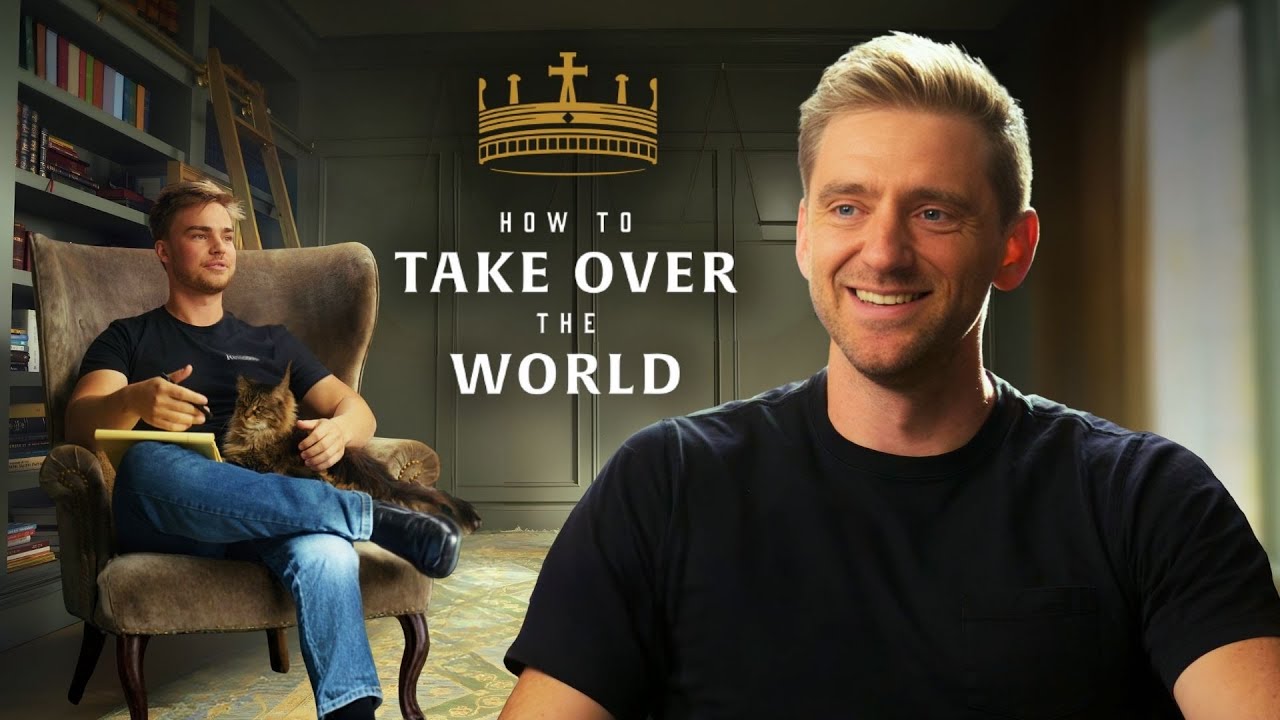
Ben Wilson, creator of the podcast How to Take Over the World, discusses what makes history’s greatest founders, conquerors, and builders tick—and why so few people today operate at that level. He argues that the defining trait of all great achievers is a kind of addictive, singular obsession that crowds out introspection, self-doubt, and optionality. He explores how modern society has lost the warrior ethos, why peacetime CEOs don’t truly exist, how reputation is built through selective irrationality, and what it takes to create something that lasts centuries rather than quarters.
The missing Napoleons of today
Ben argues that today’s equivalents of Napoleon and Wellington are in private equity—descendants of both now work at London private equity firms.
He sees this as a sign that society’s most aggressive, competitive energies are being channeled into financialization rather than creation or conquest.
The counterargument—that this is better than warfare—is met with the observation that 500 years of Italian conflict produced Michelangelo and Da Vinci, while 500 years of Swiss peace produced the cuckoo clock.
He invokes Heraclitus’s idea that war is the “top game” that subordinates all other competitions, and compares the reintroduction of warriors to reintroducing wolves into Yellowstone: predators that kill but create flourishing ecosystems.
Elon’s view is cited: regulation accumulates like strings until only war or equivalent disruption can cut through it.
Wartime vs. peacetime CEOs
Ben claims there are no truly great peacetime CEOs—only wartime CEOs who are good at preparing for winter.
Warren Buffett, Rockefeller, and Carnegie all built massive war chests and thrived during downturns because they were always preparing for crisis.
The best peacetime CEOs are actually wartime CEOs in disguise, always readying for the next battle.
MrBeast as a modern archetype
Ben sees MrBeast as a direct parallel to Walt Disney: both are showmen obsessed with reinvesting all revenue into bigger and better content, pathologically unable to take profit.
He predicts MrBeast’s trajectory by studying Disney’s life, arguing that great founders fall into recognizable “buckets” or types.
MrBeast’s willingness to risk everything—including his mother’s hidden $10,000 savings—exemplifies the total commitment that defines great builders.
Creating chaos as a strategy
Great founders intentionally create chaos to keep moving forward and prevent opponents from organizing.
Michael Dell reportedly created enemies where none existed just to align his people.
Napoleon famously said “first I engage, then I figure out what to do”—he won on fundamentals, so chaos favored him.
Rockefeller operated the same way: if you can deliver oil cheaper than anyone else, constant disruption prevents competitors from catching up.
OpenAI under Sam Altman follows this logic: if you’re winning on fundamentals, chaos benefits you.
The role of enemies and reputation
Ben emphasizes that great founders only fight worthy enemies—never those beneath them.
Rockefeller genuinely mourned the death of a capable opponent who had forced him to think harder.
He cites Nietzsche: “Never debase yourself by having an enemy that’s below you.” True peers can be either friends or enemies.
In-N-Out has no real enemy because McDonald’s isn’t worthy of the designation—it competes with Chick-fil-A or Raising Cane’s, but these are opponents, not enemies.
Peter Thiel’s PayPal engaged in a death battle with Elon Musk’s X.com precisely because it was a worthy enemy—they merged rather than destroy each other.
Companies that become overly fixated on enemies are usually in decline.
Who will be remembered 500 years from now?
Ben argues that Caesar’s name has been synonymous with power for 2,000 years (Kaiser, Tsar, Zar), and uses this as a benchmark.
He believes only Elon Musk and Donald Trump are even “holding a lottery ticket” for that kind of lasting recognition.
Sam Altman might qualify if LLMs don’t plateau, but Ben is skeptical.
Elon’s best shot is making life multiplanetary—founding a new way of life or empire is the kind of achievement that endures for millennia.
He notes that attention spans are shortening: MrBeast content is seen by hundreds of millions but forgotten in weeks, unlike things that were widely seen 80 years ago and remembered for decades.
The Lindy Effect and lasting contributions
The Lindy Effect: the longer something has existed, the longer it’s likely to continue existing (Broadway plays, the Bible), while new things are less likely to endure.
Ben sees a bifurcation: ephemeral viral content is a new category, but truly lasting things are harder than ever to create.
Aesthetic contributions are among the only lasting ones—Steve Jobs’s real contribution wasn’t the personal computer (which would have emerged anyway) but the beautiful form it took.
Great architecture, especially cathedrals, may be the highest form of art because it creates overwhelming emotional experiences that lock civilizations into place for millennia.
Bach’s music will likely be listened to for thousands of years—Carl Sagan joked that including it on the Voyager satellite would be “showing off.”
Short-term sacrifice for long-term legacy
Julius Caesar’s ultimate sacrifice was his life: he granted clemency to his enemies to preserve Rome’s aristocracy and governing capacity, enabling Rome to become the eternal civilization it became.
The Rothschilds provide a business parallel: after Waterloo, Nathan Rothschild received news of Napoleon’s defeat before anyone in London and could have made a fortune trading on it. Instead, he went to Parliament and shared the information, forgoing short-term profit to build trust and legitimacy as outsiders in British society—a decision that paid off enormously over the following 50 years.
Vanderbilt built a reputation for relentless vengeance: if you wronged him, he would eventually destroy you, even if it took years.
Carnegie built reputation through trust and cooperation; Rockefeller combined Vanderbilt’s ruthlessness with Carnegie’s Christian exterior.
Reputation, selective irrationality, and founder control
Great brands are built on “selective irrationality”—making decisions that are irrational in the short term but build long-term trust.
Costco’s Jim Sinegal threatened to kill anyone who raised the hot dog price from $1.50, even though it was economically irrational.
Apple engineers cared about the beauty of circuit boards no one would ever see—this irrational care is what built the brand.
Jeff Bezos aligned investor and customer interests over long time horizons by price-matching competitors even when Amazon could have charged more.
Once a founder leaves, this dynamic is almost impossible to recover—Tim Cook has added ~$700 million in market cap per day since 2011, but Apple is no longer perceived as inventing new products.
Southwest Airlines’ reputation for always offering the lowest possible price was destroyed within minutes of private equity involvement and the elimination of open seating.
Rockefeller’s time-delayed wealth
Both Carnegie and Rockefeller retired relatively young and didn’t become the richest people in the world until decades later—the value was already created, it just took time to manifest.
When told Standard Oil would be broken up, Rockefeller smiled because he knew he had already won: today’s major oil companies (Chevron, Exxon, BP, Aramco, Shell) are all descendants of Standard Oil, and had he simply held the stock, he would be a trillionaire.
Great stories as rocket fuel
Ben’s core thesis: the single most powerful motivator in human achievement is the emotion of seeing greatness in others and feeling capable of it yourself.
Aristotle called this “zeal”—the feeling a man has when he sees great virtues in others that he is capable of possessing but does not yet.
Thomas Edison, at 22, read a biography of Michael Faraday and was so inspired he stayed up all night and vowed to hustle.
Caesar was moved to tears by a statue of Alexander the Great; Steve Jobs was inspired by Edwin Land.
Plutarch’s Lives, the Iliad, Gilgamesh, and the Bible have been inspiring people for thousands of years—this is the content that drives human achievement.
Ben’s podcast aims to provide this same rocket fuel in a new format.
Studying the greats eliminates uncertainty
The single most destructive thing to motivation is uncertainty.
Ernest Shackleton’s key leadership trait: immediately create a new plan when the old one fails, keeping his crew calm and motivated through repeated disasters.
When you study someone great and decide to emulate them, the plan is already there—all that’s left is execution.
Caesar knew he wanted to be Alexander; Steve Jobs knew he wanted to be Edwin Land; Rockefeller knew he wanted to be Amos Lawrence. Once the model is chosen, uncertainty disappears.
Living with uncertainty and eating doubt
Great founders thrive on uncertainty that would paralyze most people.
Leaders must internalize doubt, fear, and uncertainty without showing it—“eat it” rather than express it.
Winston Churchill: “Victory is going from failure to failure with no loss of enthusiasm.”
Steve Jobs’s job as founder was to be the “reiterator of the vision”—when problems arise and everyone panics, the founder must keep saying “remember the vision.”
Caesar took on an estimated $500 million in personal debt (in today’s terms), becoming the most indebted man in Rome, then went to Gaul and became the wealthiest—executing the Roman playbook at unprecedented scale.
Venture capital is essentially this same strategy normalized: take on massive debt, delay payoff, and either go bust or win enormously.
The power of repetition and belief
Great leaders repeat the same mantras endlessly—Bezos on customer experience, Brian Chesky on Airbnb’s mission story (likely over 2,000 times).
This isn’t for the people who already believe; it’s because the audience is always changing—“you’re preaching to a moving parade, not a standing army.”
Humans are “forgetting machines”—emotion is what makes things stick.
The U.S. has oscillated between too much central control (Articles of Confederation chaos) and too much anti-tyranny (weak government), and may now need someone who can cut through accumulated red tape.
Ben’s view: the optimal system is non-dictatorial government with dictatorial companies—small-scale dictatorships that can actually get things done.
Operating in gray areas and the decline of toughness
Historical figures like Vanderbilt operated far outside legal and moral norms—he killed someone who confiscated his ships after exhausting all other options.
Travis Kalanick’s “Operation Grayball” at Uber—creating a fake app to deceive government regulators—is a modern example of skirting the law to survive.
Ben believes fewer people today are willing to go to these lengths, partly because people are “less tough” and more precious about life, but also because such actions are hidden at the time and only revealed later.
He suspects more founders are operating in gray areas than we know about.
The lack of vision in modern society
Ben’s central concern: the greatest resource humanity lacks is not energy or carbon—it’s vision.
Modern overstimulation has eliminated boredom, which is where great visions often form.
We are “bored of overstimulation”—flooded with cheap satisfaction of every human desire, leaving no room for the yearning that drives decades-long projects.
The paradox: movies in the 1980s were far more sexual than today’s, despite (because of) the flood of pornography—overstimulation deadens rather than arouses.
Elon Musk is unique in setting a goal (Mars colonization) that will take decades or centuries to achieve—this kind of long-horizon vision is what humanity needs to recover.
Elon’s biggest bluff
Elon Musk’s career has been defined by moments of extreme risk and near-bankruptcy.
In 2008, Tesla was 3 days from bankruptcy. In a board meeting, Elon pretended he would fund the entire $4 million round himself when investors were hesitant—this bluff changed the room’s dynamics and got others to invest.
Phil Knight: “Belief is irresistible.” Genuine, sincere belief in a vision is the most powerful force in business.
Pixar nearly failed multiple times—Steve Jobs poured in almost all his money with no light at the end of the tunnel. The founding team’s secret: “We all got depressed, but not at the same time.”
Great teams need believers who take turns carrying the vision when others falter.
Eliminating optionality and going all in
The defining trait of the greatest founders: no option B.
MrBeast decided he would be a YouTuber for life, even if he died at 90 having never made money—“live or die, I’m doing it.”
Walt Disney, Elon Musk, and Bill Gates (who coded for days without sleep in Microsoft’s early years) all operated with this binary commitment.
Most people need co-founders or early believers to sustain momentum—even Jesus had his 12 apostles and still cried out “My God, my God, why hast thou forsaken me?”
Sam Altman: “Momentum is the lifeblood of startups.”
Designing a life you actually enjoy
Ben’s favorite historical role: being Rockefeller’s right-hand man, not Rockefeller himself—just to witness greatness up close.
He notes that for many founders, the business eventually becomes a burden: early Disney was paradise (young artists figuring out animation in rising Los Angeles), but later brought labor disputes and profitability pressures.
The Wright Brothers represent the ideal: two people on a beach in North Carolina, sleeping in a shed, waking up each morning to figure out how to fly—pure exhilaration before expectations and burdens set in.
Ben’s own strategy: systematically eliminate everything he doesn’t love (editing, carrying bags) and focus only on interviewing founders—the thing he loves—so he can sustain it for decades.
Being willing to look wrong for a very long time
The people most likely to be remembered 500 years from now are those pursuing missions so off the path that no one else believes in them for years.
Isaiah Taylor of Valor Atomics pitched 85+ investors before getting funding for his plan to build thousands of nuclear reactors.
Jensen Huang bet Nvidia on AI in 2009-2011 when there was no AI market—spent 15 years building an interconnected tapestry (GPUs, crypto mining infrastructure, Mellanox acquisition) that only made sense if the AI vision panned out.
Outside of business, Ben thinks a Napoleonic figure could refound America, and filmmakers may be the only artists with a shot at lasting recognition—but most modern leaders (Xi, Putin, Bukele, Lee Kuan Yew) are operating on too small a stage or lack the imaginative spark.
The internal monologue of great achievers
Ben’s closing insight: great people have almost no internal monologue or self-analysis.
They are fundamentally addicts—their pursuit crowds out everything else, the way a meth addict thinks of nothing but the drug.
Edison felt this way about inventing, Jobs about designing, Napoleon about conquering, Picasso about painting.
Many have traumatic childhoods but won’t discuss them—not because they can’t, but because they’re like sharks who smell blood: they’re already moving toward the next target.
The key is to find the pursuit that magnetically pulls you in so that focus comes naturally—not forcing focus, but being drawn to it.