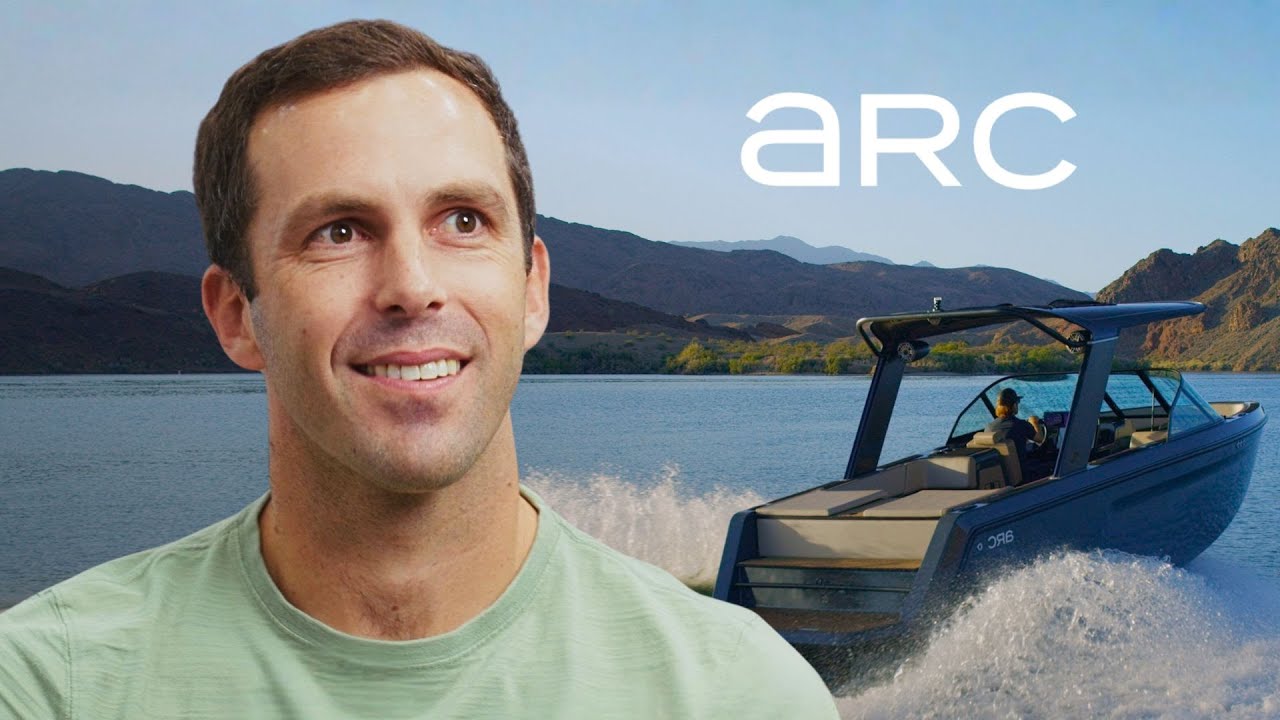
Mitch Lee is co-founder and CEO of Arc Boats, an LA-based electric boat startup that has spent four and a half years building high-performance electric boats by borrowing proven automotive EV technology and repackaging it for the marine industry, which he describes as decades behind automotive — more comparable to gas lawnmowers than gas cars.
The core thesis is that electric propulsion is fundamentally superior for water: it is simpler, quieter, more reliable, cheaper to operate, produces no fumes, and scales linearly with power, unlike diesel engines whose cost scales exponentially.
Arc is not taking market risk (the product is unambiguously better) or technology risk (automotive has solved batteries, motors, and power electronics) — only execution risk, which is still enormous.
The company started in 2021 specifically because automotive supply chains had matured enough that key components like 800V DCDC converters existed off the shelf; even three or four years earlier, Arc would have had to build such components in-house at multi-million dollar cost.
How Arc built and shipped its first boat in two years
The team started with just five or six people, many from aerospace backgrounds, and broke the problem into sequential steps:
Step one: build a battery pack, the foundation of everything.
Step two: build a lightweight, strong boat around the battery pack — resulting in “V0.1,” essentially an aluminum rowboat with a battery dropped in, used for early validation within months of founding.
Step three: add electric propulsion (battery packs and electric motors).
Step four: layer in software to control everything.
Step five: make it aesthetically polished enough that someone would spend hundreds of thousands of dollars on it — which was harder than expected, since the team excelled at structures and high-voltage systems but had no experience with upholstery and fit-and-finish.
The philosophy was fast feedback cycles: break every problem into its component parts, solve one small problem at a time, and iterate as many times as possible as fast as possible.
Product evolution: Ark1 to Arc Sport to commercial vessels
Ark1 was the first shippable product — a limited-edition luxury cruiser designed to be deliberately simple, like the Tesla Roadster. Production was intentionally capped because the team knew they would make mistakes and wanted to learn on a small scale.
Example of learning: the Ark1 windshield ended up costing ~$30,000 due to unexpected complexity in its curvature; by the Arc Sport, the same type of windshield cost $1,200 because the team had learned how to design it properly.
Arc Sport is the second-generation product — a premium wakeboat that takes the Ark1 learnings and layers in more complexity. It is positioned as the best wakeboat in the industry, competing on merits (lower maintenance, cheaper operation, better reliability, superior software) rather than novelty.
Unlike Tesla’s strategy of starting premium and moving down market, Arc is going laterally across premium segments (wakeboats, then center consoles) and up the power curve (from 500 HP wakeboat systems to 1,000+ HP commercial vessels), because in marine, premium segments are actually the highest-volume categories.
Why electric makes even more sense for boats than cars
Gas boats are terrible compared to gas cars: they are loud (no sound dampening, exposed engines), produce dangerous fumes (carbon monoxide poisoning warning stickers are standard), are unreliable (corrosive marine environment), require winterization, and have huge maintenance burdens.
The industry saying is: “The best days of a boat owner’s life are the day they buy it and the day they sell it.”
Electric boats are quiet enough to hold a conversation at 35–40 mph, produce no fumes, have far fewer moving parts, and are dramatically more reliable.
Operating costs are far lower: many boats are point-to-point (leave and return to the same dock), so they can plug in overnight at marinas that already have shore power, eliminating trips to fuel docks where gas costs $8–9/gallon.
Fuel consumption on large boats is extreme — measured in gallons per hour rather than miles per gallon, with some boats consuming thousands of gallons per outing, making them closer to planes than cars in energy intensity.
Scaling production: from zero to three boats a week
Arc started 2025 at roughly zero boats per week, ramped to about one per month early in the year, passed one per week, and is targeting three boats per week by year-end — while simultaneously expanding margins on each boat.
Marine production is fundamentally different from automotive: a car takes ~15–20 hours of labor (heavily robotic), while a boat takes hundreds of hours of labor. Arc chose to make existing labor more efficient rather than simply adding headcount, because efficiency gains both speed production and improve margins.
The approach mirrors assembling IKEA furniture at increasing scale:
Repeat the same assembly enough times to build intuition.
Write clear, logical work instructions so steps aren’t done wrong or backward.
Specialize: assign people to specific stations (composites, final integration, etc.) rather than having everyone do everything.
Build custom tools for annoying or slow steps.
Lock designs so the process can stabilize and be optimized — changing the design constantly is like assembling slightly different IKEA furniture every time.
Production hell is “a thousand small things” — with thousands of parts per boat, a single missing or mistimed component can stall the entire line. The orchestration of having every part arrive at the right place at the right time without being massively overstocked is an incredibly hard systems problem.
Arc currently operates with a heavy demand backlog, so the production signal is simply “build as many as fast as you can.” Eventually the system will need to shift to demand-pull forecasting, accounting for seasonality and supply risks.
Supply chain philosophy: avoid vertical integration unless there is a clear reason
Arc deliberately avoids vertical integrating for its own sake, preferring to tap existing automotive supply chains to move faster and maintain supplier competition.
Vertical integration is pursued only when: (a) the capability doesn’t exist off the shelf, (b) a component is such a large cost driver that bringing it in-house captures meaningful margin, or (c) it is necessary to deliver the core value proposition.
Software and firmware are vertically integrated because they are tightly coupled to Arc’s core value.
Upholstery is explicitly not vertically integrated.
Wire harnessing was brought in-house because it is process-intensive, drives production rate, and requires fast turnaround for revisions — but as designs stabilize, Arc plans to dual-source harnesses externally while keeping R&D and early builds in-house.
Software and iteration as a compounding advantage
Arc’s software integration is deep — far beyond map updates — touching throttle behavior, cooling system efficiency, performance optimization, and new features like integrated camera recording with instant export to a phone.
The iteration cycle from customer feedback to deployed software update takes two to three weeks:
Software engineers test locally, then on a hardware-in-the-loop test bench (“boat on a bench”) that has a real helm, throttle, steering wheel, and touchscreens.
Validated software goes to a test fleet on the water, then to the demo fleet to accumulate hours, then to customer boats.
This creates a Tesla-like experience where the boat gets better over time — something no other marine manufacturer offers.
Hardware iteration follows the same philosophy: collect feedback from customers and manufacturing, marry the two streams, and compound improvements continuously.
Commercial and large-vessel opportunity: hybrid-electric is the key
For large vessels like cargo ships and tugboats, pure battery-electric is impractical due to energy density limitations over long distances, but hybrid-electric is a powerful model:
Electric propulsion scales linearly with power (doubling battery capacity is roughly a 2x cost increase), while diesel engines scale exponentially (a 5,000 HP diesel engine costs millions versus a relatively affordable 500 HP unit).
Many commercial vessels operate at loitering speeds most of the time, where diesel engines are extremely inefficient — electric motors are efficient across their entire power range.
Hoteling loads (dishwashers, lights, electronics) can be powered by batteries instead of running large diesel generators.
A hybrid setup with smaller diesel generators running only at peak efficiency is more efficient even if you never plug in.
The electric side future-proofs the vessel: diesel generators can later be swapped for hydrogen, small modular reactors, or other fuel sources.
This is already validated at the top end: many large cruise ships use electric propulsion powered by onboard diesel generators.
Arc’s path to commercial is scaling up from automotive-grade technology (800V systems on the Arc Sport, 1,000V on commercial products) rather than scaling down from insanely expensive cruise-ship systems, using the consumer business as a revenue foothold and technology proving ground.
Co-founder and company culture
Mitch’s co-founder Ryan came from SpaceX and brought a systems-thinking, first-principles approach along with many early team members from SpaceX.
The company culture emphasizes fast learning cycles, breaking problems into fundamentals rather than accepting industry conventions, and compounding value through rapid iteration.
Mitch says the company would not have been possible without Ryan’s confidence, conviction, and recruiting ability.