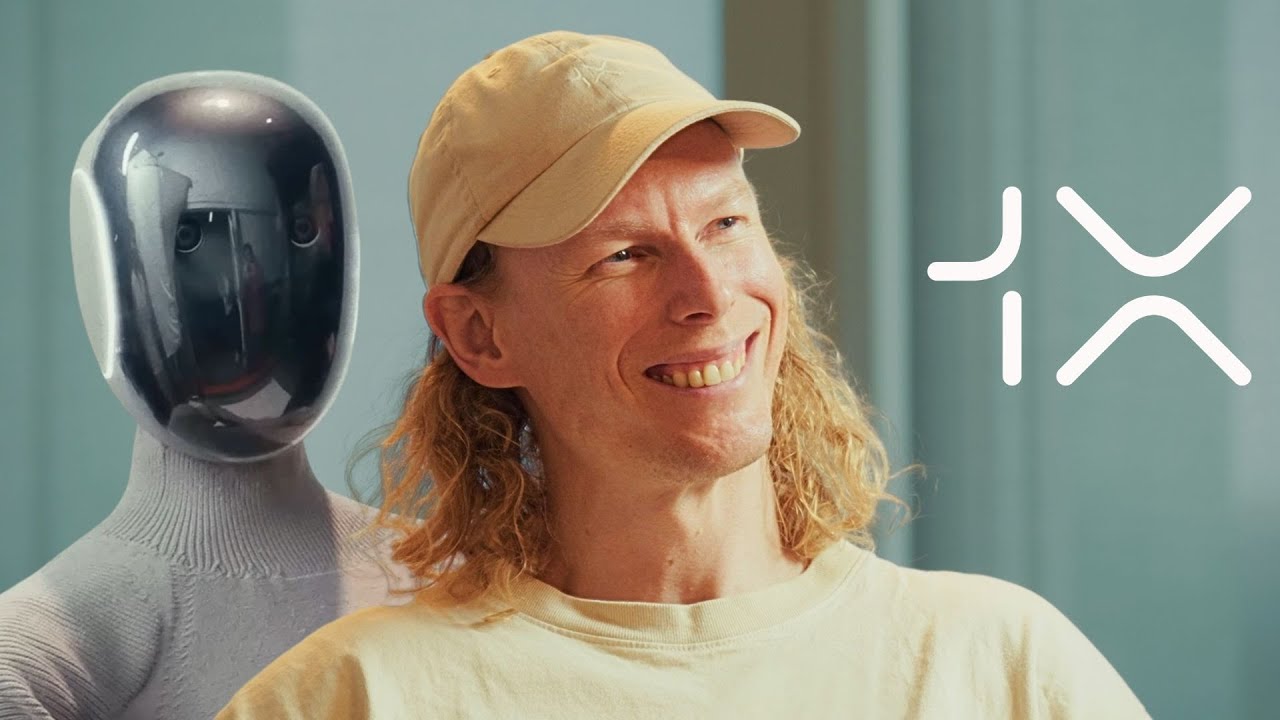
Bernt Børnich is the founder and CEO of 1X, a company building humanoid robots designed to live alongside people in their homes. After a decade of foundational work starting around 2014, 1X has developed Neo, a lightweight, safe, affordable humanoid robot built from first principles. The company is now entering early home deployment and has publicly targeted producing 1 million humanoid robots by 2028. This interview covers the design philosophy, real-world testing surprises, emotional attachment dynamics, scaling challenges, and what comes next.
Designing a humanoid that’s pleasant to live with
Bernt grew up in Scandinavia and was influenced by its design tradition, but his core motivation has always been a childhood passion for humanoid robots, fueled by sci-fi.
He deliberately rejects the “dark, hard sci-fi” aesthetic, aiming instead for something relatable, soft, and pleasant — a robot that redefines how people communicate with artificial entities.
Day-to-day, he acts as product visionary, pushing for consistency across the entire product and refusing to compromise on core principles:
The robot must be safe (living among people)
It must be actually capable, not a toy
It must be affordable enough for broad reach
He lives with Neo in his own home daily, using that direct experience to catch problems early and ensure the product reflects the organization’s health.
Living with Neo — unexpected moments of magic
The magic often comes from small, mundane interactions rather than dramatic capabilities:
Neo autonomously answering the door and greeting a guest while Bernt reads on the couch felt “absolutely magical.”
The first time Neo sat down next to him on the couch during a conversation, the entire dynamic shifted — the interaction felt fundamentally different from standing, a perceptual change Bernt had never noticed before, even with people.
Embodiment and body language are obvious advantages, but the shift in social context (sitting vs. standing) was a genuine surprise that changed how he thinks about human interaction.
How people form attachments with robots
People anthropomorphize robots naturally, and this is important rather than something to fight.
An early example: during healthcare trials with their previous humanoid Eve at an elderly care center, a resident refused to let the company swap out their robot for a newer one — “You can’t take my robot. I want this one.” — treating it as an irreplaceable individual.
Neo is not a pet and not a human — it’s something in between, more like a companion that knows your history, remembers your life, and is always on your side. Bernt compares it to Hobbes from Calvin and Hobbes: a toy tiger that feels alive.
Social context drives cognitive intelligence: even simple tasks like whether a coffee cup needs refilling or should be left alone depend on deep social understanding. Capturing these nuances is key to building better AI.
The quantum serial number — identity through upgrades
1X faces a real version of the Ship of Theseus problem: if you replace every part of a robot, is it still the same robot?
Their initial solution: the head (name + serial number) defined identity. But this broke down when they’d replace a faulty head and the robot would still refer to itself as the same entity, causing internal chaos.
They’ve now introduced the concept of a “quantum serial number” — a virtual, persistent identity that stays the same no matter how much of the robot is physically replaced.
What’s gone wrong during real-world testing
“Everything.” The real world is extraordinarily hard.
Early home testing involved running Neo at night to reset the house while Bernt slept — he’d wake up to strange noises and broken glass.
The robot was like “getting another kid” — constantly getting into trouble.
Despite the chaos, this real-world data is invaluable, and the robots are now genuinely useful and enjoyable for early adopters (self-described nerds), though probably still 1–2 years away from being something you’d buy for your grandma.
When the robot actually became useful
Very early, because the bar is low if expectations are managed: tidying, vacuuming, loading the dishwasher, fetching drinks for friends during board games.
The hard part wasn’t the useful tasks — it was basic reliability, user-friendliness, and Wi-Fi.
Wi-Fi is almost harder than robotics: the robot runs safety-critical functions locally, but access to larger models in the cloud significantly boosts intelligence, and teleoperation for tasks it can’t yet do autonomously requires connectivity.
Inefficiency in society and the future of work
Bernt sees the world through efficiency: robots should turn “have to” into “want to,” freeing people to focus on what they’re passionate about.
Society is full of wasted time — driving, broken infrastructure, unproductive work — that could be reclaimed.
He’s not worried about robots taking all the work: there’s always more to do, and people will find or invent meaningful activities.
Work provides purpose and belonging, which won’t disappear in an abundant future. People won’t be satisfied with leisure alone — they’ll need something that drives them, just not tied to survival.
He predicts a future that values craft and artisanship even more: people will proudly show off plumbing done by a human craftsman, signed and celebrated, even if a robot could do it better.
How Bernt got interested in robots
At age 11, watching an excavator at work, he decided he was going to build humanoids. It wasn’t a deep intellectual realization — it just clicked.
He’d always loved building electromechanical things, taking apart kitchen appliances to rebuild them.
He sees humanoid robots as the pinnacle of engineering — every science combined: material science, electromechanics, sensors, compute, AI, product design, psychology — all in one product.
Starting 1X and building from first principles
Founded around 2014, 1X has been working on this for a decade — not a recent startup chasing hype.
Bernt knew humanoid robotics couldn’t be bootstrapped and couldn’t reuse existing supply chain. Everything had to be built from first principles:
Motors, gears, sensors, actuators, electronics, software, manufacturing processes — none of it existed for this application.
This first-principles approach is why Neo is lightweight, low-energy, compliant, safe, more capable, and more affordable than competitors who are essentially bolting together classical robotics components.
The company has come close to the edge financially (less than 48 hours of runway at points) but survived and is now in a unique position with deep foundational research.
Bernt’s current top concerns are operational: production quality, reliability, customer experience, security, privacy, and safety — getting the basics right.
Scaling challenges and the road to 1 million robots
The biggest scaling challenge is reliability — all subsystems must work simultaneously without failure, and this only gets harder at scale.
They stood up their Hayward factory and produced a first robot within 4 weeks of getting the building, and onboarded 40+ people in a single day through a public hiring event.
The operational complexity of maintaining reliability while rapidly scaling manufacturing and onboarding is enormous.
There’s also a race to improve AI capabilities fast enough to keep early adopters happy — the “pet rock that gradually gains functionality” can’t still be just a rock by 2027.
Managing expectations with early adopters
Early adopters (roughly 3% of the population) are massive in number but also the most demanding — they’re knowledgeable and will hold you to exactly what you promised.
The discipline: under-promise and over-deliver. If the robot can pick up a mug and open a door, promise exactly that — nothing more.
Bernt internally believes they can do far more than they publicly commit to, maintaining a buffer so that worst case the customer is happy and best case they’re blown away.
What’s next: getting Neos into homes
Bernt is most excited about shipping Neo to normal customers — moving beyond internal testing and early adopters to regular households.
He believes if employees wouldn’t buy the product themselves, something is wrong — echoing Brian Chesky’s philosophy at Airbnb.
But he insists employees should pay for the product (perhaps at a discount) — you’re not truly experiencing the customer journey unless you’ve spent your own money and can say you’re still happy.