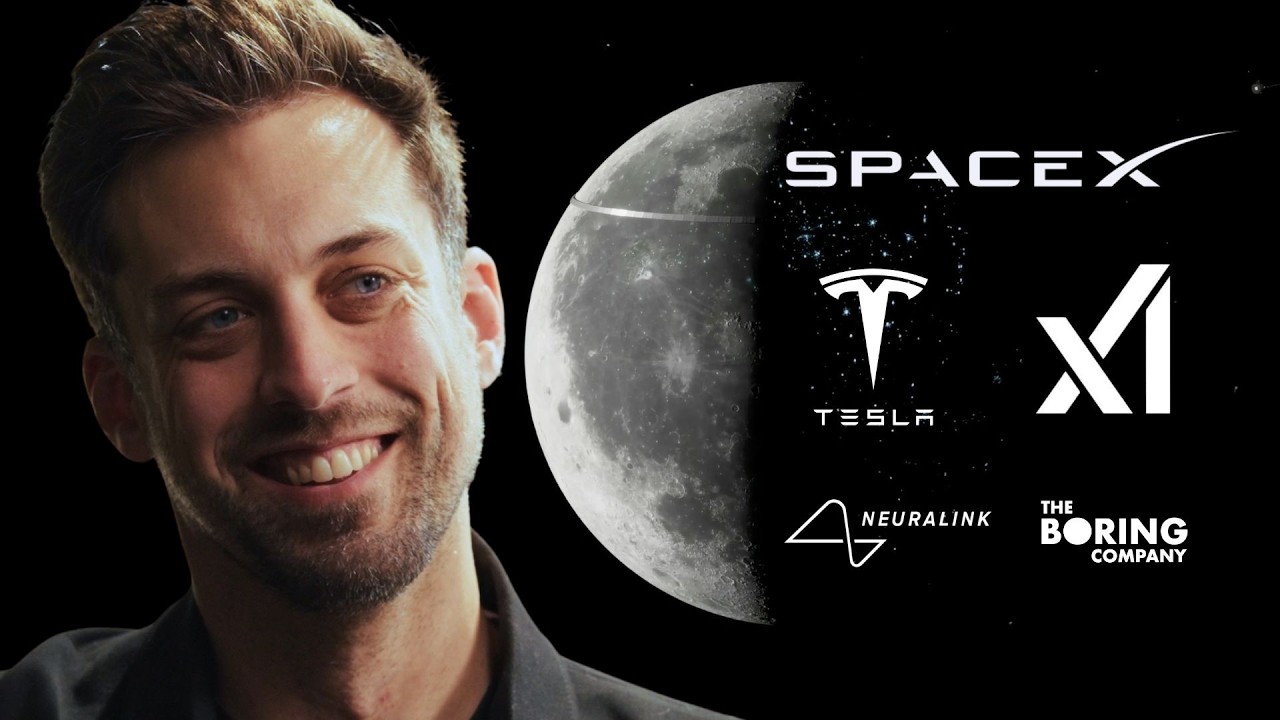
Eric Jorgenson, author of The Book of Elon, breaks down why Elon Musk is an outlier among outliers: he combines a grand, purposeful mission with first principles thinking, maniacal urgency, and step-function improvements that multiply each other’s effectiveness, making him roughly 10,000 times more effective than typical executives—not because he’s 10,000 times smarter, but because each advantage compounds the others.
Why Elon outcompetes everyone
He works on the right thing at the right time with incredible intensity, pursuing not incremental but step-function improvements.
His grand, purposeful missions (multiplanetary life, sustainable energy, AI) unite and inspire people to work harder than they ever have.
First principles thinking, speed of execution, and urgency don’t just add—they multiply each other’s impact.
He sets “purposeful 50% timelines”: aggressive deadlines he believes have only a 50% chance of being met, which forces far more progress than comfortable timelines, even when many are missed.
He encourages small, non-catastrophic failures to maximize learning rate—failure is essentially irrelevant unless it’s catastrophic.
The evolution from reluctant CEO to full control
In the Zip2 and PayPal era (roughly 1996–2001), Elon was primarily a software and sales guy running relatively short-duration companies.
Between roughly 2002 and 2010, he didn’t want to be CEO and tried to control product without running the company—a period he calls a “moral error.”
At Tesla, this played out as a chaotic era where he was chairman and funder but not CEO, sending constant product demands to CEO Martin Eberhard while not having full authority.
The breaking point came around 2008 when Elon discovered Eberhard didn’t know (or wouldn’t acknowledge) the true cost of the Roadster—roughly $150K vs. the $120K Eberhard cited—creating a permanent break in trust.
Elon realized he couldn’t be fully in control of the product without being in control of the company, a lesson shared by Steve Jobs and other visionary founders.
Around 2011–2013, he stopped complaining about being CEO and fully internalized the role across both Tesla and SpaceX simultaneously—Jorgenson describes this as “running a two-minute mile twice at the same time.”
How Tesla and SpaceX survived against tiny odds
Elon estimated each had roughly a 10% chance of success; the probability of both succeeding was asymptotically small.
No successful car startup had been founded in America in 100 years, and space launch was an unprecedented category.
Top VCs like Mike Moritz and Sequoia passed on Tesla despite having made money with Elon at PayPal.
Elon funded both companies personally until they reached inflection points where additional resources would clearly produce breakthroughs.
He is consistently wrong on estimates—overestimating and underestimating success, compressing timelines—but the 50% timeline framework means he achieves more despite frequent misses.
The algorithm: Elon’s five-step method for breaking bottlenecks
Developed around 2019 after painful lessons from the Model 3 production ramp at Fremont, where he had over-automated processes that didn’t need to exist.
He would mark machines with orange spray paint for removal and literally cut holes in the factory wall to haul them out.
The five steps, in order:
Question every requirement—attach individual human names to each requirement, not departments; eliminate as many as possible.
Delete—remove any part, process, or code you can; if you’re not adding back 10% of what you delete, you haven’t deleted enough.
Optimize—make the right trade-offs and improve the simplified system.
Accelerate—go faster.
Automate—only automate what remains after the first four steps.
The key insight: most people (including Elon at Fremont) do these in reverse—automating first, then trying to optimize, when the real gains come from questioning requirements and deleting.
Each epiphany of “addition by subtraction” can be an $8-figure win.
Maniacal urgency and the opportunity cost of time
Elon thinks in terms of future revenue lost per day of delay—he estimated roughly $10 million per day at SpaceX.
He famously flew a part on a private jet for $100K to save days of delay, because the opportunity cost of 10 engineers and $30M in rockets waiting on that part was orders of magnitude higher.
He is frugal on small things but lavishly spends to accelerate timelines, understanding that time is the fundamental currency.
He fires his own scheduling assistant and goes wherever the biggest problem is, using his unique founder authority to parachute into bottlenecks and break through them.
How Elon starts companies
Before founding, he runs informal feasibility studies—for SpaceX, he spent a series of Saturdays at his house with engineers who had worked on major launch vehicles, whiteboarding whether a 10–100x improvement in launch costs was possible.
Only after concluding it was feasible and PayPal sold did he turn it into a company.
He favors small demos over slide decks: Grasshopper at SpaceX, early Roadster demos at Tesla.
Even “shitty demos” work—Larry Page and Sergey Brin invested after a Roadster demo that only reached modest speeds because Elon was showing real progress rather than pitching a vision.
For Tesla’s survival, he retrofitted a Smart car with EV batteries in days (possibly hours) before Daimler executives arrived, let them test-drive it, and secured a $50M investment.
He creates theatrical, tangible demonstrations that catalyze people in ways memos cannot.
Action produces information and action
Elon summons employees to the factory at 2 a.m. not out of cruelty but because action produces both information and further action.
At Starbase, he reportedly blew up when he found only five people working on a rocket with 300 on payroll, demanding the site look like a “time-lapse beehive” 24/7.
Critics call this unreasonable; Jorgenson argues it selects for people who want to operate at maximum effort and creates a culture where surges save companies (Model 3 production, Starship stacking).
He attacks bottlenecks before they become bottlenecks, preventing future delays that would otherwise slow the entire organization.
The “Elon clones”—scaling himself through people
Jorgenson compares Elon’s approach to Mr. Beast’s onboarding: shadow the founder 24/7, absorb their mental models, then execute autonomously.
Elon has roughly 20–25 people across his organizations who think and act in “the Elon way,” allowing him to run six companies.
These clones steep themselves in first principles thinking, maniacal urgency, and the algorithm, then apply them to domains they’ve never worked in.
Starlink example: The existing satellite-expert team had stalled the program. Martin Kopa and a group of SpaceX rocket guys with no satellite experience war-roomed it, applied first principles, and closed a two-orders-of-magnitude gap in roughly 10–12 months.
This demonstrates that Elon’s methods are generalizable mental models, not industry-specific expertise.
Working with Elon is a tour of duty
Everyone who joins an Elon organization is on a clock that could end at any time—some last a month, others like JB Straubel lasted 16–17 years.
The right person has a bias to action, urgency, and willingness to sacrifice; the mission’s grandeur is integral to attracting this level of dedication.
“The reward for work is more work”—high performers are given more responsibility immediately until they break.
Companies turn over roughly 80% of personnel at each order of magnitude of growth; a two-year tenure covering 10x growth is a great tour of duty.
Fresh talent and rapid promotion keep the bar extremely high.
Creating grand missions
Elon’s missions come from sci-fi, long time scales, and statistical thinking about existential risks (asteroids, world wars, extinction events).
He zooms out to the broadest perspective: preserving consciousness, expanding life beyond Earth, understanding the universe.
This sounds “childish” to some, but when laid out it’s hard to argue with—and it answers a deep human need for meaning.
Jorgenson sees a “slow-motion crisis of meaning” (AI job fears, declining institutional trust, declining religiosity) and argues Elon offers a compelling answer: dedicate your life to making the future better.
He recommends getting the book into the hands of 12–18 year olds, whose dominoes (college, career, industry) are still being set.
Empathy for the mission vs. empathy for the individual
Elon’s maxim that “empathy is not an asset” refers to over-indexing on empathy for individuals at the expense of the team and mission.
99.9% of firings err on the side of being too late, not too soon; people always feel they deserve another chance.
In organizations with billions in capital and equipment, empathy for the mission means ensuring every seat has an A or A+ player.
This creates a “shocking zone of competence” (per Marc Andreessen) where A players work with A players and the culture becomes self-reinforcing.
Elon gives hardcore feedback about actions, not people, and actively seeks negative feedback to close the iteration loop.
Fear, ruthlessness, and being willing to be disliked
Fear of being fired for being unprepared is real and functions as a motivator alongside the carrot of a grand mission.
Elon is willing to be disliked when necessary to achieve the mission, but he doesn’t enjoy it—he surrounds himself with people who publicly support him.
He runs a public campaign to avoid unfair characterization (selling his houses, not sitting on cash) because public perception affects capital, talent, and mission success.
He has a deep sense of justice and is enraged by false claims (e.g., his father taking credit for his success, or Bill Gates shorting Tesla while claiming environmentalism).
He expects solidarity from his inner circle when many people are actively trying to undermine him and the missions.
Creating chaos and playing the game in real time
Elon’s speed itself creates chaos—launching new programs (data centers in space, the moon base pivot) changes the board for everyone else.
What looks like chaos to people with a narrow view is navigable to someone who sees the game board from a zoomed out perspective and understands the ultimate goal.
He injects uncertainty and action when things are too stable, because he plays best when the ground is moving and other people’s brains are overloaded.
The data centers in space idea reportedly “went viral on Twitter” and SpaceX’s valuation roughly 4x’d afterward—the first 20 years of SpaceX turn out to be just the foundation for what comes next.
Thinking in limits
Instead of asking “how do we make one robot,” Elon asks “if we were going to make a billion robots, what would the cost curve asymptote to?”—working backward from the theoretical perfect product.
This is linked to first principles thinking and the “idiot index” (the ratio of a component’s cost to its raw material cost).
Once you conceive of the theoretically perfect thing, everything between current reality and that limit becomes an obstacle to tear down.
He asks “what would it take?” rather than “why can’t we?”—e.g., if a material doesn’t have the tensile strength needed, is it physically possible to create a new alloy that does?
This approach drove the Raptor engine’s simplicity and optimization across tens of thousands of decisions.
Expanding vision to expand option value
Elon continuously redefines what his companies are, making them impossible to pin down and value conventionally:
Tesla: car company → full self-driving company → robotaxi fleet → robot manufacturer (a billion a year) → AI company.
SpaceX: launch company → Starlink → data centers in space → multiplanetary civilization.
Each redefinition stacks a new S-curve on top of the previous one, following the pattern Eugene Wei describes about Amazon.
Tesla and SpaceX are unprecedented stacks of S-curves—some plateauing and cash-flowing (Falcon 9), some rising (Starlink, Starship), some still hand-wavy (data centers in space).
People suffer from “dysmorphia of the present”: amazed by past achievements but dismissive of the next S-curve, even after 25 years of the impossible becoming real.
Elon himself says: “I’ve lost many battles, but I’ve lost never lost a war. I’m generally right on the outcome and wrong on the timeline.”
The only two public predictions that clearly didn’t pan out: Hyperloop and battery pack swapping.
Frugality and capital efficiency
Despite the scale of his companies, Elon is remarkably frugal—the common thread is capital efficiency and driving costs down.
Tesla’s north star is maximizing the number of Teslas on the road; SpaceX’s is minimizing cost of mass to orbit.
Like Amazon (low prices) and Costco (max ~15% margin, profit from memberships), these companies pursue a low-cost strategy that maximizes consumer surplus and equity value over time.
SpaceX could cash-flow Falcon 9 for 20 years as one of the best businesses ever, but immediately reinvests in Starship to ride the next S-curve.
Jeff Bezos’s binary: some companies exist to charge more, others to charge less—Elon’s companies are the latter.
Launch capacity as the ultimate moat
Peter Beck (Rocket Lab) argues that in 10 years, the only space companies that will matter are those that control their own launch capability.
SpaceX is building massive Starship volume because volume drives cost down, cost advantage compounds, and the Mars mission requires enormous volume.
There’s an “auction at the toll booth to get off the planet”—whoever can pay the most launches first.
Third-party satellite startups that depend on launch providers are at risk if SpaceX or Rocket Lab prioritize their own use cases.
Internalizing pain and setbacks
After the third Starship blew up, Elon went to the wreckage, figured out what failed, and was laughing about it within a day or two.
He operates in two modes: “come hell or high water, I will not quit, you’ll have to kill me” and a light-hearted “it’s all a sim, let’s play the game as hard as we can” attitude.
He took enormous reputational risk—there were high odds he’d be remembered as a cautionary tale of hubris, burning a fortune on rockets as an internet guy.
Even if he had “multiplied by zero,” his willpower suggests he would have kept trying.
The inflection point and what comes next
The combination of Model 3 success and Falcon 9/NASA contracts made both companies “undeniable” and flipped public perception—this was the Iron Man era.
That credibility unlocked capital and attention for the Twitter/X takeover, DOGE, and his status as a household name.
His ambition follows an S-curve that keeps resetting: starting civilizations on other planets, using the entire moon to launch AI satellites (Terafab).
His imagination has no visible limit, and his track record keeps justifying bigger bets.
Jorgenson’s closing thought: the tools and mindset are available to anyone—it’s not about being a genius, it’s about working on the right thing, at the right time, with maximum effectiveness.