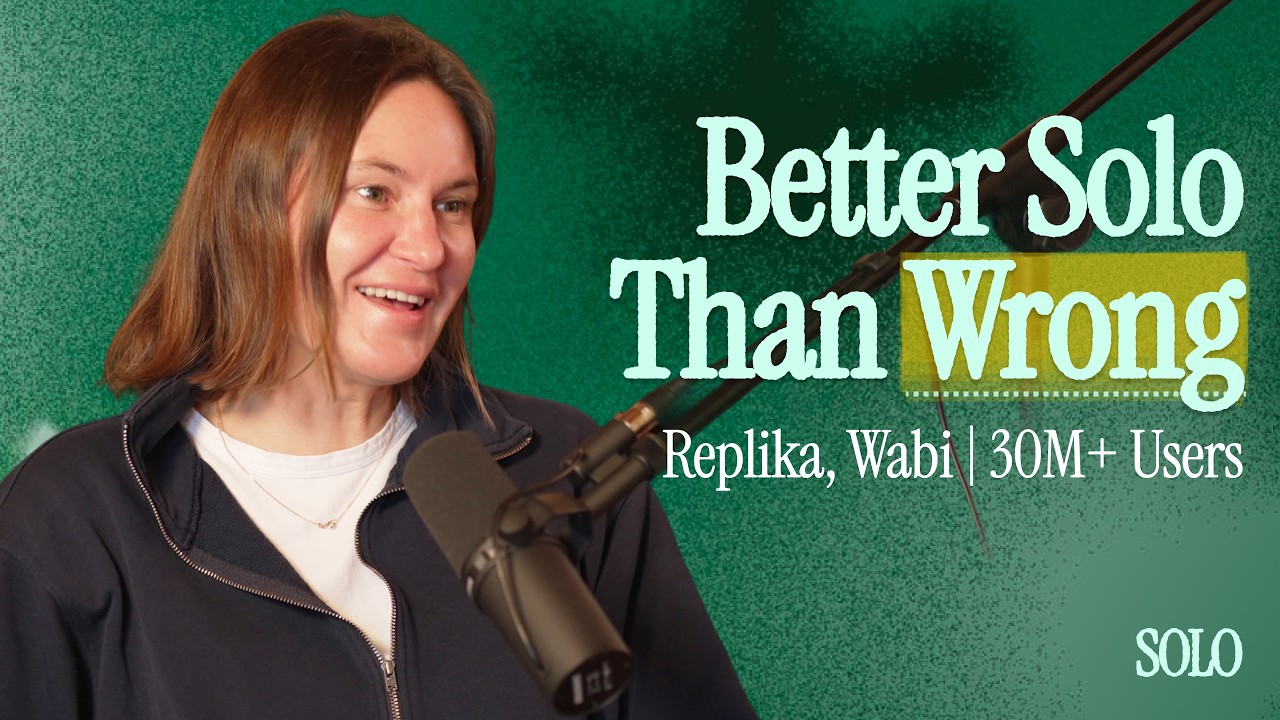
Eugenia Kuyda is a solo founder who built Replika, an AI companion app that reached 30 million users, and is now building Wabi, a platform for creating personalized mini-apps. She argues that solo founding is an underralued path, that most companies are effectively run by one person anyway, and that the pressure to find co-founders often leads to worse outcomes than going alone.
Why solo founding makes more sense than people think
In practice, most companies have one person calling the shots regardless of co-founder structure. Even famous “co-founded” companies like Apple and Facebook are dominated by one visionary.
Co-founders are often just early employees given disproportionate equity because it was hard to hire them otherwise. Calling them co-founders doesn’t change the underlying power dynamic.
Design by committee rarely works. Vision almost always originates from one person; others join because of that person’s conviction and willingness to take extreme risk.
The YC-driven pressure to have co-founders causes people to pick bad ones. Kuyda herself made an employee a co-founder to improve YC odds, which backfired when he developed a misaligned ego and created internal FUD.
Solo founding lets you distribute equity more generously across the actual founding team rather than concentrating it arbitrarily in one or two co-founders.
Origin story: from journalism to Replika
Kuyda was a journalist in Russia working in opposition media. After getting arrested during the 2010 protest wave and seeing independent journalism become impossible, she left for London Business School and then NYU Stern.
Her first tech project was Briber, an app for reporting bribes during Russia’s 2010–2011 anti-corruption protests. It went viral and taught her that a compelling mission attracts people willing to work for free.
In 2012, a friend at Google DeepMind showed her word2vec. She immediately saw that language models would become models of the world and that conversational AI was the future. She started building chatbot tech years before the models were good enough.
While working on a banking chatbot project, she saw users have intense emotional responses to the interface—people cried and said no one had ever talked to them like that. This revealed the deeper potential of conversational AI.
In late 2015, her best friend Roman died. She used her company’s early language models to recreate him as an AI chatbot in three weeks, just to keep talking to him. A journalist friend wrote about it, it went viral, and people were deeply vulnerable with the AI. This became the seed for Replika.
Personal motivation and emotional roots
Kuyda grew up as a lonely only child with young, absent parents. She wrote fiction and bad poetry as a refuge. She didn’t have the vocabulary for anxiety or depression growing up in Russia—those concepts simply weren’t part of the culture.
Her friendships in her 20s were transformative, and losing one of them was devastating. She wanted to recreate that feeling of being truly heard and accepted.
She discovered Carl Rogers’ book on person-centered therapy, which argues that people grow through relationships characterized by unconditional positive regard, belief in their growth, and respect for their separateness. Rogers even speculated robots could eventually provide this.
The key insight for Replika was that even when the models were too weak for meaningful dialogue, they could still listen. Being heard was the core need.
Journalism as founder training
Kuyda credits journalism as her most important founder skill. The art of conversation—asking the right questions, making people feel safe, synthesizing information from many sources—is rarely taught but enormously valuable.
She sees conversation as humanity’s most important craft: people fall in love, start companies, and change the world through dialogue. That no one was working on machine conversation in 2012 struck her as absurd.
Storytelling is the rare skill that matters most. As software development becomes commoditized, the ability to tell a compelling, non-obvious story about the future of the world becomes the key differentiator for founders.
Authorship, team sport, and elevating everyone
Even as a solo founder, Kuyda sees building a company as a team sport. She is extremely generous with equity because not having co-founders lets her split the pot among all founding team members who take the same risk.
She actively pushes team members to post about their own work on social media—not just the corporate account or the CEO. At Wabi, every engineer, designer, and CTO shares what they ship.
This creates a sense of ownership and agency. People become micro-influencers, build their own names, and feel like authors of the company’s story. It also makes the company more attractive to join—people want to see what it’s like to work there.
She draws an analogy to soccer: fans follow the roster, not just the team name. The same should be true for tech companies.
Wabi: personal software as creative expression
Kuyda started Wabi because she believes the chatbot/command-line interface is the “MS-DOS era” of AI. A GUI moment is coming, and the big labs aren’t focused on it.
Wabi lets anyone create mini-apps through prompts—no coding required. The key insight is that software can be a form of creative expression, not just a business.
She builds apps for herself: daily poetry, art movement explorers, Italian learning puzzles with her daughter, weightlifting trackers, a journal that reminds her to capture moments with her kids. Her Wabi home screen feels like a continuation of herself.
The unexpected finding from beta: everyone creates (six apps on average), and they keep tending to them like a garden—constantly adding features, tweaking colors, refining. This is the opposite of passive social media consumption.
Making things for yourself produces better results than making things for an audience. People don’t “upgrade” their friends, pets, or kids—they love what’s theirs. The same applies to self-made software.
Wabi is designed to be social: people can share apps, comment, and discover others with similar niche interests. The vision is that every community (like a subreddit) could have its own software tools.
The return of personal web spaces
The early web (GeoCities, MySpace, LiveJournal, Tumblr) was hyper-personalized and creative. The shift to social media prioritized media primitives (photos, videos) optimized for algorithmic engagement and time-on-platform.
Software remained gatekept by ~20 million professional developers worldwide. Now, with AI, anyone can create software as easily as writing a prompt. This opens the door to a return of personal, creative digital spaces.
Kuyda believes the tools we use shape us. Having apps you built yourself changes your daily routines and habits in ways that downloading someone else’s app never will.
Building elite teams as a solo founder
Hire people with insane ownership and agency—people who think and act like co-founders even if they aren’t called that. Ex-founders are ideal because they just get things done.
Multidisciplinary skills matter more than ever. Engineers need product taste. Designers need to understand prompts. PMs as a separate role are unnecessary if team members naturally take ownership of problems.
Set the bar high and let people go quickly. When there’s doubt about someone’s performance, there is no doubt. Keeping low performers demoralizes the team.
Keep the core team small (10–15 people) and insanely high quality—a “Real Madrid” team. Use contractors for specialized, non-core tasks.
Teams change dramatically at every 3x growth threshold (10→30→100). At 10 people, everyone knows everything and operates as one organism. Beyond that, you need processes and structure.
In-person time is critical. Wabi is mostly in-person in San Francisco. Even if a team is mostly remote, getting everyone together for at least a week at a time is essential.
The bear case for solo founding: loneliness
Being a solo founder is deeply lonely, especially in crises. When things go wrong, you can’t fully share the burden with your team without risking their confidence or making them question whether to stay.
Kuyda went through extremely difficult years at Replika—running out of money, the bank closing their account, no one believing in AI companions—while pregnant with her second child. She describes feeling like crawling into a corner and dying, waking up each morning wondering what horrible thing would happen that day.
Co-founders provide emotional support because they’re “married” to the outcome in a way that employees, however invested, are not. They assume they’ll stick it out.
Her advice: find friends to talk to, but acknowledge that the emotional load is real and significant.
The bull case for solo founding: conviction and speed
Kuyda didn’t have anyone she felt was the right co-founder. She did have people who were right for the founding team, and she could pay them—she didn’t need to ask them to work for free.
She has extremely high pain tolerance and does not give up. She sees quitting as equivalent to losing, and as long as she has conviction, quitting doesn’t exist as an option.
She believes she’ll go further alone than with co-founders who might lose faith. At Replika, there were many moments when co-founders likely would have dropped off—running out of money, no one believing in the space, the technology not being ready.
The case for solo founding is ultimately about knowing yourself: if you won’t give up, if you have the conviction, and if you can build a team of high-agency people around you, going alone lets you move faster, own your vision fully, and reward your team more equitably.