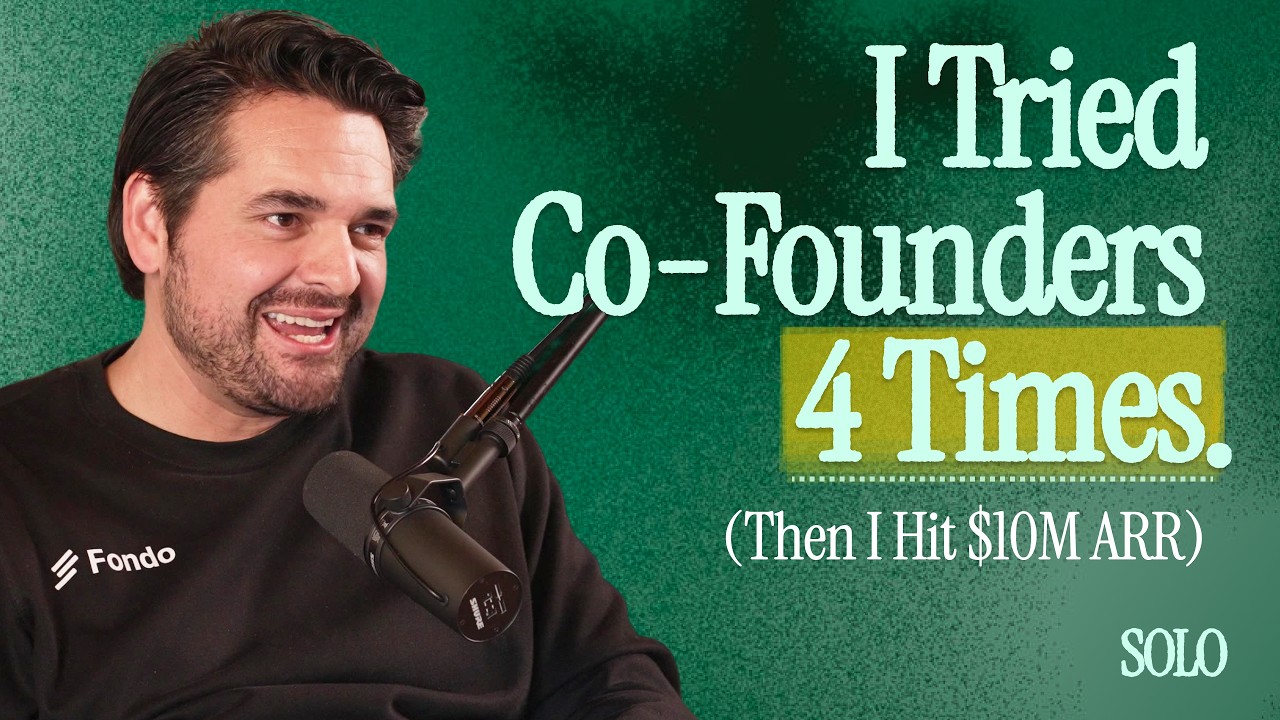
David Phillips built Fondo, a $66M bookkeeping and accounting company for startups, as a solo founder after four previous co-founder breakups across earlier startups. He refounded his previous company (BloomJoy) as Fondo with only $40,000 left in the bank, pivoting from a Facebook page marketing tool to a startup accounting platform. The episode traces his journey through repeated co-founder failures, the emotional and practical challenges of refounding, and why solo founding ultimately worked for him.
Four co-founder breakups before going solo
First startup (college tutoring marketplace): Co-founded in college, learned the basics of building a company, but after graduation the co-founder stayed in Southern California while Phillips moved to San Francisco. They split and built competing versions of the same company.
Second startup (first San Francisco company): Met a co-founder at a hackathon, raised a seed round, and was fired by that co-founder six months later. Phillips had no vesting cliff and only a small equity stake, making the split legally simple but emotionally difficult.
Third startup (coding bootcamp, Hackbright): Phillips learned to code after feeling he hadn’t contributed enough as a non-technical founder in the previous company. He co-founded Hackbright, grew it, and it was eventually acquired, but the co-founder left a couple of years in.
Fourth startup (BloomJoy): Phillips started solo, got into YC, felt pressure to move fast, and brought on two co-founders. The company ran out of money, attempted an acqui-hire sale that fell through, and the co-founders left amicably. Phillips was left with $40,000 and the existing cap table.
Refounding BloomJoy as Fondo
The failed sale: BloomJoy had about 15 employees and was running out of money. Phillips ran a sale process, found a buyer, and the buyer hired the team and absorbed customers during negotiations. The stock purchase agreement never closed because they couldn’t agree on earnout terms. Phillips decided not to sue and instead restart.
Why he didn’t shut down: The company had raised ~$1 million from friends and early investors. Phillips didn’t want to flush those relationships or leave investors with nothing. Because the co-founder split was amicable, the cap table was clean enough to continue.
The investor email: Phillips sent a brief update saying the deal fell through, co-founders were leaving, and he was going to try a new idea called Fondo, promising to update in six months.
Choosing Fondo from a list of ideas: With only $40,000, Phillips filtered his idea list by: (1) could he do it solo, (2) could he launch without raising more money, (3) was he the domain expert, (4) could he empathize with the customer. Fondo, a bookkeeping and accounting solution for startups, rose to the top because Phillips had been an accountant at Deloitte and had managed books at every previous startup.
Why Fondo fit Phillips in ways earlier startups didn’t
Domain expertise: Phillips genuinely enjoys accounting and had done it at Deloitte and at every company he’d started. Earlier ideas (like BloomJoy’s Facebook page marketing tool) were based on shallow, recently acquired knowledge rather than deep expertise.
Enduring need vs. opportunistic insight: BloomJoy was built on a Facebook ecosystem that could be killed by a terms-of-service change. Fondo addressed a permanent need: startups will always need accounting and tax compliance. Phillips references Jeff Bezos’s heuristic of building around what stays the same.
Combining two worlds: Phillips brought together his accounting background with his firsthand experience of what startups actually need, making the product specifically designed for founders rather than generic businesses.
Getting Fondo’s first customers
The false bottom: Phillips’s first customer was The Hustle (Sam Parr), introduced through a mutual investor. He closed them at ~$6,000/month and thought the model was proven. Then nothing: for three months, none of his other startup friends signed up. Many already had bookkeepers or chose competitors because Fondo was too new.
The Delaware franchise tax wedge: A friend complained about how confusing Delaware franchise tax filings were. Phillips posted on “Bookface” (a Facebook group for founders) offering to file them for free. About 100 companies signed up. He learned the domain, built trust, and then pitched those 100 founders on bookkeeping. About 10 converted, giving Fondo its first real customers.
Pattern from earlier: At Hackbright, Phillips had done the same thing: after a Hacker News launch yielded only one applicant, he started teaching code for free at local meetups, built trust, and converted attendees into students. The lesson: the best way to build trust is adding value for free.
Helping the ecosystem as brand strategy
Beyond the product: Fondo runs a blog, a podcast, and a live-stream show featuring founders, not just Fondo customers. The goal is to help early-stage companies get visibility and opportunities.
Why it works: Early-stage founders’ biggest problem is getting customers and awareness. Fondo uses its audience to create opportunities for founders (some have raised funding or been acquired after appearing). This builds trust and brand affinity in ways that are unrelated to bookkeeping but create openings for the product.
Phillips’s view: Helping people with problems unrelated to your product is valuable because it builds trust and creates opportunities you wouldn’t get otherwise.
Working with family
Phillips works with his brother Dylan (who was also his co-founder on the Facebook meme page that preceded BloomJoy) and other family members at Fondo.
Advantages: Trust and loyalty are already baked in. Family members are less likely to have a falling out than co-founders, and they genuinely want the company to succeed.
Caveats: You still need clear expectations, professional boundaries, and open communication about what can go right and wrong.
Practical advice for co-founder breakups
Get experienced startup legal counsel: Phillips’s first co-founder breakup involved a real estate attorney who didn’t understand vesting. He later found a startup lawyer who advised him to move on quickly rather than sue. Good counsel on both sides helps everyone act rationally.
Logic vs. emotion: Co-founder breakups are emotional, but bringing logic to emotional situations doesn’t work. Having an independent third party (a lawyer) advise the departing co-founder helps depersonalize the negotiation.
Cap table matters: If you’re pivoting to a completely new business, you need the cap table in a position for success. This means negotiating with co-founders who may have vested significant equity over years.
Find one investor ally: Phillips credits Chris and Peter at Transmedia Capital, who backed him in a previous company, with giving him the confidence to refound. Having even one supportive investor in your corner makes a difficult transition manageable.
Bear case for solo founding
It’s just really hard, and harder alone: When no one signs up, there’s no one to commiserate with. When you’re stuck, there’s no one to bounce ideas off of. Phillips quotes another founder who described solo founding as “crying in the middle of the day with no one to talk to.”
The lows are lower: Things go badly most of the time in a startup. Having a partner makes it slightly less hard.
Bull case for solo founding
Forced resourcefulness: When you’re solo, the buck stops with you. You have no option but to be relentlessly resourceful. You learn more, build systems earlier, and develop resilience.
Frictionless early days: Without co-founder alignment, decision-making, or process overhead, you can go from idea to market extremely fast. Phillips describes this as “freeing.”
Better team building: Solo founders learn to build teams earlier and can offer more equity to early hires, creating a strong founding team.
Default co-founders are often bad co-founders: Phillips argues that defaulting to a co-founder often means you’re avoiding the hard thing. Great co-founders are valuable, but co-founders of convenience lead to bad outcomes.
Why solo founding is more viable now than ever
AI as co-founder: Phillips argues that tools like Claude Code and Cursor mean anyone can build an MVP without a technical co-founder. “Everyone has a co-founder like in their pocket now.”
No more excuses: In the past, people said “I can’t build this because I don’t have a co-founder” or “I don’t know how to code.” Now, anyone can build and ship quickly. If you can’t figure out how to build something, you’ll struggle to build a company.
The sea change: Phillips believes solo founding should become the default, not the exception. The goal of the Solo Founders program (which he runs) is to normalize solo founding and encourage more people to start companies alone rather than defaulting to co-founders of convenience.