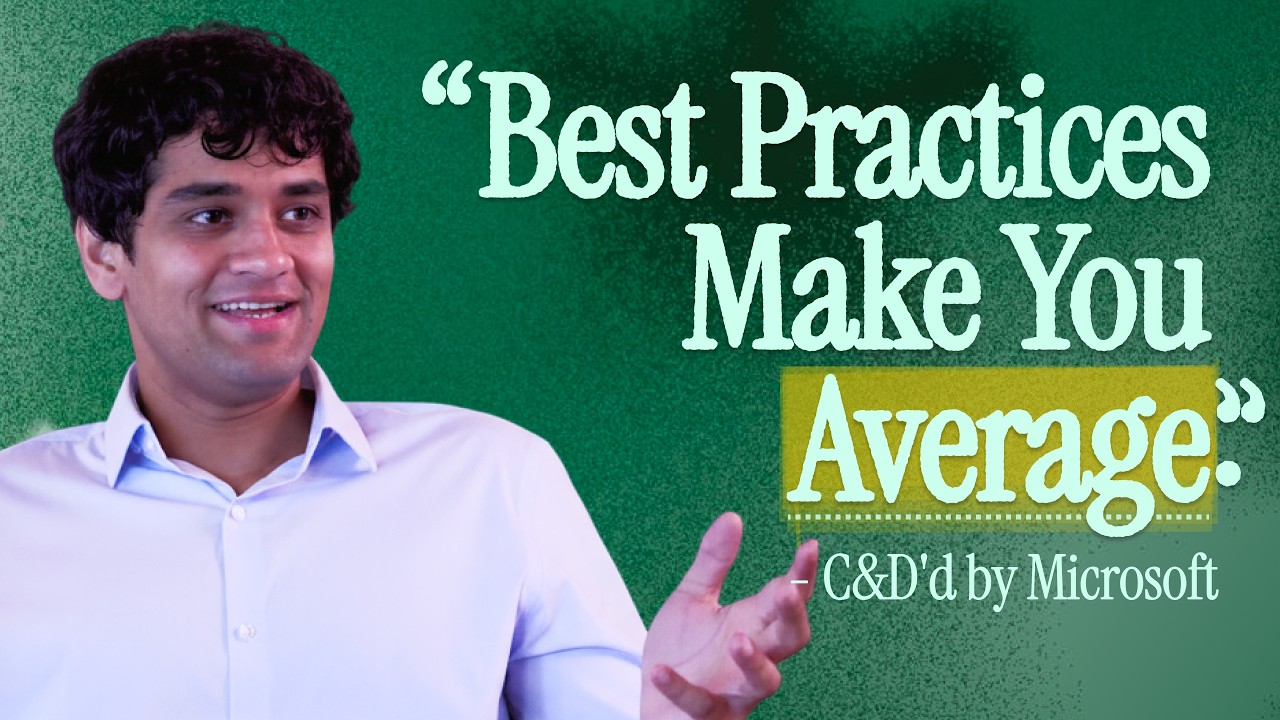
Rahul Sonwalkar is the solo founder of Julius AI, an AI data analyst that Harvard Business School benchmarked head-to-head against ChatGPT and selected for its curriculum. He previously worked as an engineer at Uber and went through six pivots before arriving at Julius. The conversation covers the realities of solo founding: why it’s underrated, how to hire and build culture alone, the importance of equity generosity, and the loneliness and burnout risks that come with it.
Why Rahul ended up solo — and why he stayed solo
Rahul’s first startup attempt in college was unintentionally solo; he just saw a problem and built a solution without thinking about co-founders.
His second startup began with college friends who agreed to co-found, but within a few months they decided startups weren’t for them.
Rather than treating the loss of co-founders as a blocker, Rahul chose to keep building: “I have this idea in my mind and I just kind of want to go build it and I don’t want to let having no co-founder be a blocker for that.”
He advises others in the same situation to start making progress immediately — the easiest way to convince future team members, investors, or co-founders is to show forward momentum.
He compares startups to football: you don’t need a touchdown on every play, you just need to keep getting first downs.
Co-founder trials are a waste of time in the AI era
Rahul sees “looking for a co-founder” as one of the biggest false blockers for new founders, especially because AI tools now allow non-technical people to build prototypes, talk to customers, and validate ideas alone.
Co-founder trials typically fail because people try to align on space, problem, and solution before any real work has been done — and misalignment at any stage blows things up.
His advice: start making progress first, and attract people to you as you build momentum.
Generalized advice pushes you toward average
Rahul believes startups are “a game of liars” — every great company is an outlier that violates at least one or two conventional startup rules.
Examples:
Figma took forever to launch and make revenue, contradicting the “ship fast” rule.
Cursor had insane product-market fit and revenue within weeks.
Rippling launched as a compound product (payroll + insurance + HR + laptop management) instead of starting with a minimal MVP.
Advice is free but often reflects the giver’s specific situation, not yours. Founders need to get good at saying no and pushing back.
Having a perfectly aligned co-founder is a superpower, but Rahul estimates that 8 out of 10 co-founder teams he talks to privately are working through some issue.
Solo founding means hiring sooner and being more generous with equity
Without a co-founder to split functions, a solo founder must hire much earlier.
A major misconception about solo founding is that you can just tell people what to do because you control the company. In reality, smart people won’t do great work just because you ordered it — they need to genuinely believe in what they’re building.
Rahul’s hiring philosophy:
Find people who are multipliers, not task-followers — people who take a direction and run with it without waiting for the next instruction.
Find people who are better than you at their function. Rahul says, “I need to be the worst coder on the team.”
Put enormous faith into early hires because you have to shift focus across the company and trust them to execute.
On equity:
Solo founders should be more generous with equity, not less, because early hires are taking on meaningful risk.
If a candidate is willing to take less cash for more equity, Rahul sees it as a “big green flag” — it signals skin in the game.
He sometimes presents two offer options (higher cash vs. higher equity) and has had candidates ask for even more equity than the high-equity option.
Early hires often end up filling roles beyond what they were hired for (e.g., the first engineer becoming de facto CTO), and they should be rewarded with additional equity over time.
Culture forms with hire #1 — the 50/66 rule
When you’re a solo founder and hire one person, that person is 50% of the company. At three people, they’re 66%. Their influence on culture is enormous.
Rahul references Mark Zuckerberg’s advice from Peter Thiel: make your core team people you genuinely like spending time with, because you’ll be working 14-hour days together.
Julius’s culture reflects Rahul’s personality:
Hacker-oriented: people go from idea to live feature within a day or two, even if it’s not fully tested, then iterate based on usage.
Fluid and tinkering-driven: no rigid central roadmap; people constantly hack on new features and ideas, which suits the fast-evolving AI landscape.
Lighthearted and joke-heavy: memes appear in every Slack channel (not just a designated one), people prank each other, and Rahul is fine being the butt of jokes — he believes this makes the environment feel safe and open.
Six pivots to Julius — chiseling the marble
Before Julius, Rahul spent about a year during COVID building various mobile apps around podcasting, working on them part-time while at Uber. Nothing gained traction, so he decided to quit his job and go all-in anyway.
He started with a loose direction: using AI to help people analyze data in plain English, inspired by tools like GitHub Copilot.
The six pivots:
Started with logistics data (from his Uber experience) — realized logistics companies were too hard to convince to adopt AI.
Built excelcopilot.com — a tool to help people write Excel formulas. Got a cease-and-desist from Microsoft over trademark issues (using both “Excel” and “Copilot”), but the early usage validated that people wanted natural-language data tools.
Built censusgpt.com — let users query US Census data with plain English. Open-sourced the code. Got tons of users on day one, zero on day two — people don’t have recurring questions about census data.
Tried several more public datasets over the next few months.
Realized people care most about their own data, especially work data they use daily or weekly.
Built “bring your own data” functionality — and that became Julius.
Rahul uses the metaphor of chiseling a block of marble: you start with a rough shape and keep revealing the sculpture underneath. He also likes looking at early versions of admired companies (Figma, Zapier, OpenAI) on the Wayback Machine — they all looked like hackathon projects at first.
Convincing is the core job of a solo founder
Convincing is the one thing Rahul has done consistently for three years and expects to keep doing: convincing investors, customers, and employees.
Prerequisites for convincing:
Deep, almost delusional conviction in what you’re building — you need to believe it has a slim chance of working and articulate exactly why you’re the right team, why the timing is right, and what unfair advantages you have.
Reps — the more you practice convincing people, the better you get.
Rahul pushes back on the “sell me this pen” sales analogy from The Wolf of Wall Street. He argues that Sam Altman couldn’t sell you a pen, but he could convince you of AGI because that’s what he deeply believes in. Conviction in the specific thing matters more than generic salesmanship.
As a solo founder, you can’t do every interview or every pitch yourself, so you need to empower your team with a simple, compelling message they can carry forward and make their own.
Authorship and sharing credit
While solo founders are often thought of as having 100% ownership, Rahul sees this as a mirage — you share equity, and more importantly, you should share authorship and credit.
He believes success should have “many fathers.” At Julius:
Engineers do their own product launch videos and post about features on their personal Twitter and LinkedIn.
Infrastructure decisions are fully delegated to the infra team — Rahul acts only as a tiebreaker if needed.
He wants every early team member to feel like a “founding father” of the company.
He references Paul from Browserbase, who puts the company icon next to all teammates’ names on X, and engineers at OpenAI who do live customer support on Twitter — both examples of companies that let employees build their personal brand through the company.
Rahul’s advice: let the company become your team’s identity. When people see the company as part of who they are, they develop incredible skin in the game.
Bear case for solo founding
Loneliness: being a founder is lonely; being a solo founder is “incredibly lonely.” No one can fully empathize with what you’re going through.
Burnout: the company needs your attention across recruiting, marketing, product, and more, but you can only focus on one thing at a time. If you can’t multiply yourself through great hires, you’ll burn out.
The convincing tax: if you don’t like convincing people and just want others to listen to you, solo founding (and founding in general) is a terrible idea.
Bull case for solo founding
Incredibly low friction to start: you can begin tomorrow — build a prototype, talk to users, onboard first investors — without wasting months on co-founder matching and alignment.
Speed of critical decisions: there will be moments (pivots, key hires, strategic direction) where you need to make time-critical decisions. As a solo founder with deep conviction, you can act immediately without spending weeks aligning multiple co-founders who might be blockers.
Rahul has met countless smart, competent people who are blocked from starting companies solely because they don’t have a co-founder. He believes solo founding is stigmatized and hopes conversations like this help destigmatize it.