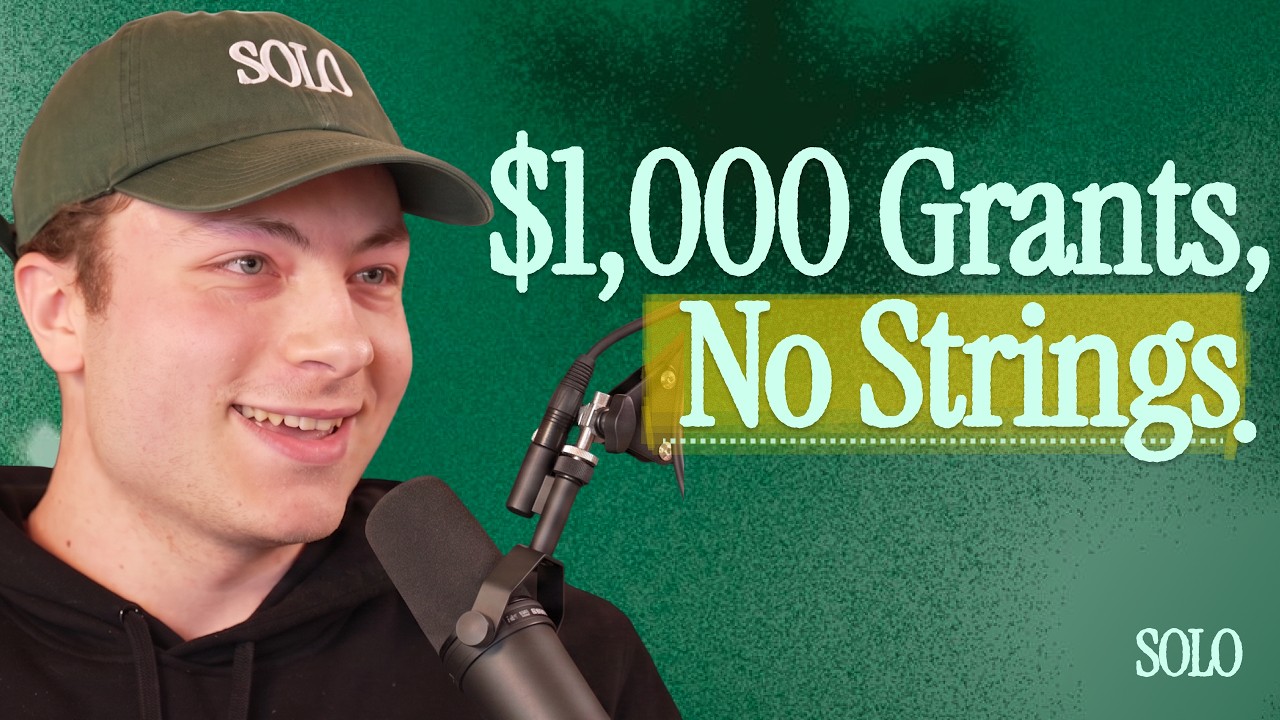
This episode announces the launch of Solo Grants, a microgrant program that gives $100–$1,000 with no strings attached to individuals pursuing technically ambitious passion projects — not necessarily businesses — and also serves as a routing layer connecting builders to the wider ecosystem of microgrant programs like 1517, Emergent Ventures, and the Thiel Fellowship.
The announcement: Solo Grants is live
Solo Grants officially launches as the evolution of “Merge,” a community and grant program the hosts ran for roughly 18 months that funded over 50 people on projects ranging from discovering three new viruses to deploying wildfire prediction systems and raising $10M for ML-driven chip design — all started with $1,000 or less.
The core premise: the world is a collection of passion projects, and a world where more of them are pursued is better; Solo Grants exists to unblock the first step.
Applications are open at solor.com (spelled S-O-L-O-R dot com).
What makes a Solo Grant different (it doesn’t have to be a business)
No requirement to pursue a venture-scale outcome; most projects are not businesses at all.
The frame is exploration, not profit-filtering: builders can follow technical novelty or remix existing technologies without every decision passing through “how does this become profitable?”
Many exceptional businesses (e.g., Ethereum, Figma) began as “quaint” passion projects that looked laughable early on; forcing a business lens too early narrows the search space.
The program is not age-restricted, but the small check size naturally attracts younger or earlier-stage builders for whom a few hundred dollars is decisive.
Check sizes ($100–$1,000) and the routing layer into the wider world of grants
Grants range from hundreds to $1,000; for someone with an established career, that amount is trivial, but for many it is the gap between starting and not starting.
Solo Grants also functions as a discovery mechanism: a directory of microgrant programs (1517, Emergent Ventures, OSS Capital, Thiel Fellowship, etc.) so applicants can find the best-fit funder for their project’s stage and domain.
The goal is to forward promising builders to the people best suited to help them go the distance, not just to deploy Solo’s own capital.
The microgrants space and the origin of Merge
Before Merge, microgrant programs (Emergent Ventures, 1517, etc.) were siloed; grantees working on similar projects in the same region often didn’t know each other existed.
Merge began as a community layer to bring those grantees together for cross-pollination, and as a routing layer for new applicants to discover the right microgrant program.
The insight: the money matters, but the network and visibility matter just as much.
Microgrants 101: the world of no-strings money (1517, Emergent Ventures, Thiel Fellowship)
Microgrants start in the low hundreds and can scale to hundreds of thousands; the defining feature is non-dilutive, no-strings-attached capital — no equity, no right to invest, no requirement to incorporate.
1517 (a venture fund) sets aside a portion of its fund for $1,000 checks to “interesting, wacky ideas” — explicitly not just businesses.
Emergent Ventures (run by Tyler Cowen, operated by Shruti Rajagopalan) typically gives $5,000–$50,000 and often pushes applicants to be more ambitious than they asked for.
OSS Capital / OAY extends into creative domains alongside technology, with checks from $10,000 to $100,000.
The Thiel Fellowship (originally by Danielle Strachman, Michael Gibson, and Peter Thiel) began as a grant + support layer for dropouts to pursue ideas more valuable than school; Vitalik Buterin (Ethereum) and the Figma founders are notable alumni.
Over time, the Thiel Fellowship shifted toward founders who had already dropped out and raised money; 1517 continues the early-stage, pre-business grant model.
Thiel Fellowship origins, Ethereum, and raising ambitions
The original Thiel Fellowship premise: “drop out, you have no money, we’ll give you money to work on something that could be worth more than school.”
Ethereum emerged from that environment as a project, not a company; the exploration path allowed a different trajectory than venture pressure would have permitted.
Emergent Ventures exemplifies ambition-raising: when Ari applied with a biotech project, the program responded not by cutting the budget but by asking “why not go to India? why not give this the attention it deserves?” — increasing the grant above the ask.
The lesson: microgrants shouldn’t just unblock; they should expand the builder’s sense of what’s possible.
The builders who never looked for co-founders
In Merge, the hosts observed a real-time disintegration of the “you need a co-founder” assumption: many grantees were building solo for the first time and it never occurred to them to find a co-founder.
Passion projects are inherently solo at the start — one person at a typewriter, easel, or garage — because they’re driven by personal interest, not market appeal.
The co-founder narrative is startup lore; in the passion-project frame, collaborators may appear later, but the genesis is solitary.
The world is a series of passion projects
When you build for yourself, you’re often building for many (echoing a prior episode with Eugenia).
Exploring personal interests without a business filter leads to unique discoveries: if the only path to an idea is free-range exploration of something that doesn’t look like a business, few others will find it — yielding differentiated outcomes vs. cloned YC ideas.
“How to find a startup idea” is a bad optimization target; the better path is creating personal experiences through passion projects, which then become the substrate for novel businesses.
Why more people don’t build: the few-hundred-dollar gap and role models
Two main barriers: (1) a small capital gap — a few hundred dollars separates many people from starting; (2) lack of visible role models showing that non-monetizable, technically ambitious projects are a valid path with support infrastructure.
Showing that such a path exists, and that there’s a community and funding for it, creates a snowball effect: validation from even one or two believers outsizedly impacts early momentum.
The hosts’ hope: AI and automation free up time for more people to pursue novel passion projects, with AI as a lever to accelerate progress.
The grantee who asked for $100 less
Arian, one of the first grantees (age 19), requested $100 less at the interview than on his application because he’d found a scrappier way to build in the interim.
His project: the world’s largest database of phage viruses; the grant covered Airtable hosting costs (~$100–$150).
Outcome: he discovered and named three new viruses; the tiny check unblocked a trajectory that continues today.
The validation of a stranger believing in the project — not just the money — created a psychological snowball effect.
Ari’s story: a $500 check, 1517, and Emergent Ventures saying “be more ambitious”
Ari’s first grant: $500 from a founder who’d just sold to Dropbox, for a Discord hackathon community (Builder Group) — casual, no incorporation needed.
Next: a 1517 grant for the same project; then a biotech/food-tech project needing transducers, chemicals, proteins — not yet a business, so he applied to Emergent Ventures.
Emergent Ventures (Shruti Rajagopalan) didn’t just fund the ask; they challenged the ambition: “why not fly to India? why not give this the money it deserves?” — granting more than requested.
The cash unblocked; the belief expanded the vision. This dynamic — “do both: start scrappy now, but don’t cap ambition” — is central to the microgrant philosophy.
Building the largest photography Discord and meeting Julian
At 15, during the pandemic, Ari started “Photography Lounge” on Discord to meet photographers while living abroad; it grew organically to 40,000 members and 10,000+ messages/day, now run by a volunteer team.
Later, he built “Builder Book,” a resource hub for young builders (immigration, 83(b) filings, design, etc.), launched with a polished video and site on Twitter.
Julian (the co-host) discovered Ari’s work through Builder Book; they messaged for ~6 months, then serendipitously met in person when Julian was 45 minutes from Ari’s family — a 4–5 hour walk cemented the partnership.
They bonded on microgrants and the idea of an “unblocking mechanism at scale,” leading to Merge and now Solo Grants.
Merge becomes Solo Grants: solo, in community
Solo Founders (the media/community arm) posits that solo founders are underestimated, the future default for starting companies, and that microgrants are the best way to get more great things built — not just businesses, but discoveries.
The model: solo builders working “alone together” in community — finding peers who are also building solo, sharing context, raising each other’s ambitions.
Combining microgrants + community = more accomplished than either alone.
Kai Goodall and the team
Kai Goodall (University of Waterloo, rocketry) joined after meeting Ari at TKS (The Knowledge Society); he’d received a 1517 grant for a rocket-propelled skateboard — a project that epitomizes the “wacky, technically ambitious” archetype.
Kai embodies the hardware-builder, grant-recipient, community-native profile; he runs interviews, selects grantees, and helps grow the program.
Waterloo’s density of hardware talent and visible peer projects (e.g., Waterloo Symposium) illustrates the power of examples: seeing others do it makes it imaginable.
The directory, the grantee showcase, and how to apply
The Solo Grants website hosts a directory of all microgrant programs (with filters for team vs. solo, domain, check size), a showcase of past grantees and their projects, and the application for Solo’s own $100–$1,000 grants.
The team encourages applicants to use the routing layer: if another program is a better fit, Solo will forward them.
Ongoing updates and new grantee announcements will be posted; the hosts invite feedback and applications.